“Most wrong answers in science don’t come from bad data— they come from vague questions.”
You’re staring at wilting plants, a failing product launch, or a stubborn habit. The clues are right there. The twist is this: until you form a sharp hypothesis, your brain can’t actually see them.
Roughly 95% of biomedical papers report a p-value somewhere in the text—yet most never show you the hypothesis that number is supposed to test.
That’s the trap: we’re swimming in “results” without ever clearly stating what would have counted as being wrong.
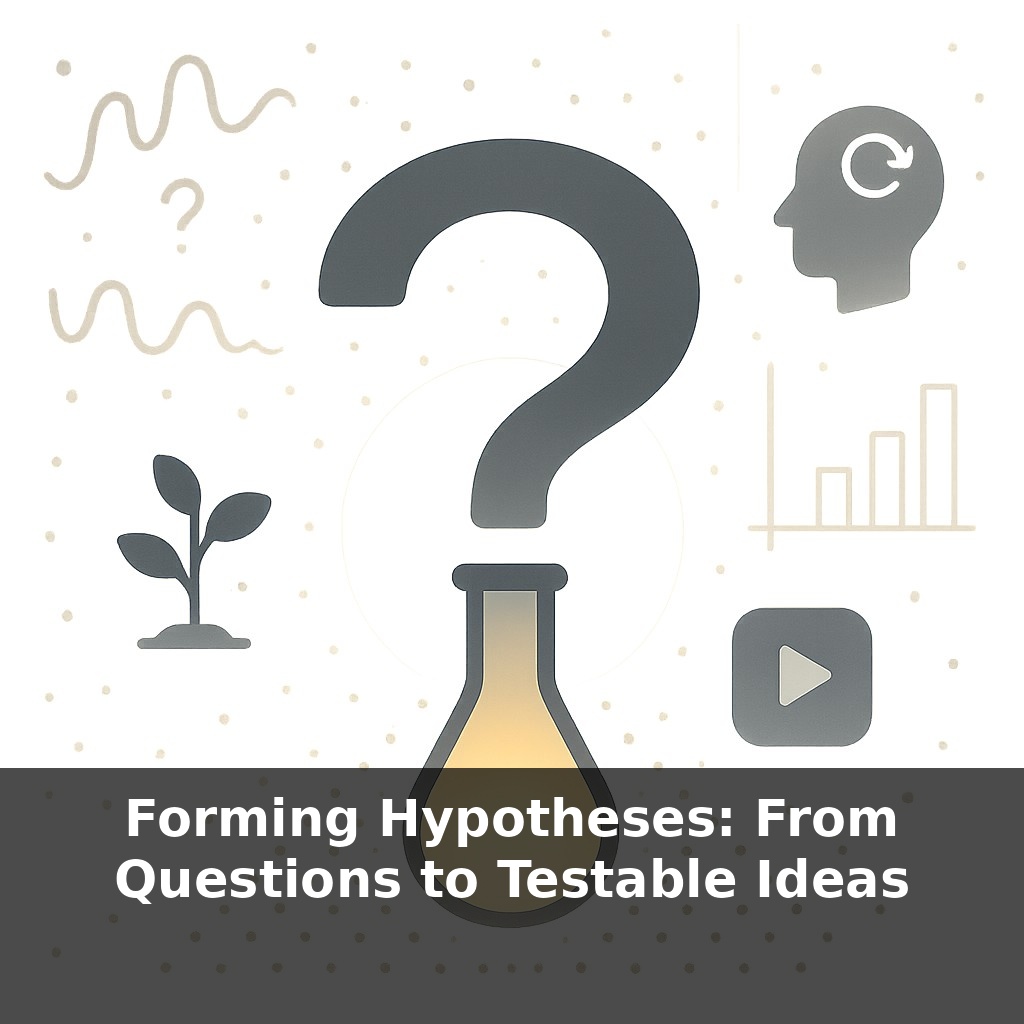
In this episode, you’ll practice something most people skip: turning a fuzzy curiosity into a statement the world can actually argue with. That means forcing yourself to name what could be measured, how it could change, and what outcome would convince you you’re mistaken.
Instead of “Does this app reduce stress?” you’ll learn to say things like: “If users get 10 minutes of guided breathing daily for four weeks, their average morning cortisol level will be at least 20% lower than controls.”
Once you can do that on purpose, every question—from wilted plants to workplace conflicts—becomes an experiment you can actually run, not just think about.
Experts quietly know this: the hardest part of a study is usually the 2–3 sentences that define what’s being tested. Funding, methods, even stats often snap into place only after that.
To get there, scientists lean on two tools you can steal. First, operational definitions: turning ideas into things you can literally count—like converting “better sleep” into “minutes to fall asleep” or “wake-ups per night.” Second, falsification: deciding in advance what pattern of numbers would make you say, “Nope, that story about the world was wrong.”
Soon, we’ll start turning your own hunches into statements that strict.
Here’s the move scientists make next: they stop arguing in words and start arguing in numbers.
Begin with the raw question: “Why are the plants dying?” or “Why are my 2 p.m. meetings always a mess?” That’s not wrong; it’s just too big. The trick is to carve out one narrow, risky claim about how *one* thing affects *one* other thing.
A simple path:
1. **Name the possible causes, not the story.** Instead of “The team doesn’t respect me,” list candidates you could actually poke: meeting length, agenda clarity, number of participants, time of day, prior workload.
2. **Pick one cause-and-effect link.** You’re not trying to explain everything—only to test *a* relationship: “Shorter meetings will reduce interruptions,” or “Moving the meeting earlier will cut late arrivals.”
3. **Force yourself to choose a direction.** Will interruptions go *up* or *down*? Will plant survival *increase* or *decrease*? A directional statement prevents you from later claiming victory no matter what happens.
4. **Decide how bold you’re being.** “A tiny difference” is vague. Saying “at least 30% fewer interruptions over two weeks” or “10% higher survival” makes the claim stick its neck out. Too timid, and any noise in the data looks like support; too bold, and you’ll constantly “disprove” yourself. You’re tuning how risky your bet is.
5. **Write the “could be wrong” line.** Don’t just state what you expect; state the pattern that would hurt: “If moving the meeting earlier leads to equal or *more* late arrivals, this hypothesis is not supported.” That sentence is where intellectual honesty lives.
6. **Pair it with a quiet rival.** Scientists usually test against a “nothing special is happening” story (the null). In everyday life, that might be: “Shifting the time has no meaningful impact on late arrivals.” You’re staging a contest: your directional claim vs. “no real change.”
In medicine, you see this constantly: “If patients take Drug A for 12 weeks, their average blood pressure will be at least 5 mmHg lower than patients on placebo.” Variables, direction, magnitude, and a clear way to be wrong—all in one line.
Your goal is not to be right on the first try. It’s to make your idea precise enough that the world can clearly tell you “no,” so your next idea is sharper than the last.
You don’t need a lab coat to practice this. Start with something stubborn in your own life: a side project that never gets finished, a workout streak that keeps breaking, a friend who replies days late. Instead of asking “Why is this so hard?”, scan for patterns you could count: days of the week, time of day, number of tasks on your plate, how many notifications are on your phone.
Then, zoom in on *one* lever you can move. For a stalled project, it might be “number of uninterrupted blocks per week.” For late replies, “messages longer than three sentences.” You’re looking for knobs, not diagnoses.
Here’s where you shift from noticing to betting. Turn the pattern into a concrete sentence about tomorrow, not a story about yesterday. Name a threshold that would surprise you: “If I cap messages at five lines for two weeks, at least 70% will get answered within 24 hours.” Quietly ask yourself: “What result would actually make me doubt my hunch?” Build your statement around *that* uncomfortable line.
As tools like AI and shared datasets spread, precise hypotheses become more powerful—and more necessary. Soon, software might suggest dozens of plausible claims from the same dataset in seconds. Your edge won’t be generating ideas, but **pruning** them: Which claim is risky enough to be informative, yet grounded enough to matter? Think of weather forecasting: many models run, but forecasters must choose which patterns deserve attention, resources, and real-world decisions.
Treat this like learning a new language: at first you’ll speak in clumsy sentences, then your “if X, then Y” thoughts will become automatic. Your challenge this week: when something puzzles you, write *one* risky, measurable prediction about it—then act on it. Over time, you’re not just solving problems; you’re training a scientist’s reflex.