About two out of three entrepreneurs are sure their start‑up will beat the odds—most are wrong. Now zoom in: you’re choosing a doctor, a job offer, or a headline to trust. In each case, tiny thinking errors quietly tip the scales, long before you feel you’ve “made up your mind.”
A strange thing about these mental misfires: they rarely feel like errors from the inside. Overconfident founders don’t feel reckless; they feel “sure.” Someone deep in a losing project doesn’t feel irrational; they feel “committed.” And when a news story fits our beliefs a little too well, it feels less like bias and more like “finally, something that makes sense.”
What’s going on isn’t random flukes, but patterns—reliable ways our brains lean when evidence is messy or incomplete. In fast, low‑stakes situations, those patterns are often good enough. But as the stakes rise—career moves, medical choices, financial bets—the same shortcuts quietly nudge us away from reality.
This episode is about learning to notice those nudges in real time, and about small, practical habits that can catch you before your judgment drifts off course.
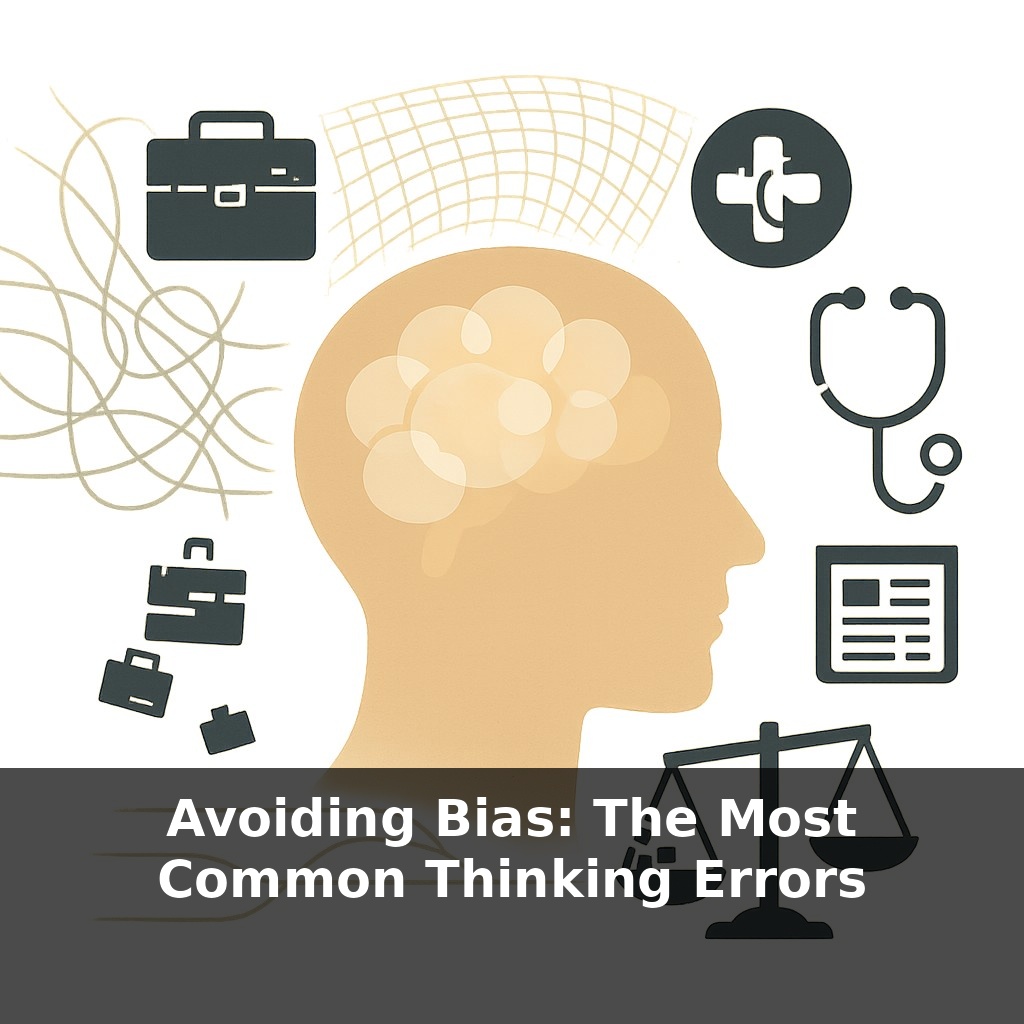
Some of these patterns are so common they’ve been mapped like a weather chart. Psychologists have cataloged more than 180 distinct biases, but a much smaller “storm system” of a dozen or so does most of the damage in daily life. You’ve met them before: favoring evidence that flatters your views, sticking with plans you’ve already paid for, trusting the first number you hear more than you realize. The goal isn’t to scrub your mind clean—that’s impossible—but to learn where the recurring trouble-spots are, and how a few simple tools can keep you from driving straight into them.
A good way to map this “storm system” is to look at three especially common distortions and how they show up in ordinary choices—not as abstract flaws, but as patterns you can catch in the wild.
First, confirmation habits. When you’re deciding whether a supplement works, notice how you search: do you Google “[name] benefits” or “[name] risks and evidence”? Those two tiny word choices send you into different universes. In one, you’ll mostly see success stories and positive summaries; in the other, critical trials and side‑effects. In large studies of online behavior, people consistently feed the first universe and starve the second. In practice, this means you don’t just “have” a view—you’re curating its support team.
Second, availability habits. Suppose a friend mentions a plane crash, then a week later you’re booking tickets. The vivid story is sitting right at the top of memory, so the flight can feel more dangerous than it statistically is. The same thing happens with career news: if your feed is full of tech layoffs, tech suddenly looks uniquely unstable, even if other sectors are shrinking more. What grabs your attention today quietly rewrites your sense of what’s “normal” or “likely” tomorrow.
Third, sunk‑cost habits. You’ve poured 200 hours into learning a coding language or 10 grand into a marketing strategy. Then you learn there’s a better option. At that moment, the earlier investment is gone either way, but it doesn’t feel that way; walking away seems like “wasting” it. Organizations do this at scale: continuing a floundering product line because “we’ve already spent so much tooling up for it,” even when fresh analysis says it’s time to cut losses.
None of this means you’re doomed to keep repeating the same moves. Across hundreds of experiments, certain small interventions reliably bend the curve toward better judgment. Slowing the pace, even by 30 seconds, gives competing possibilities a chance to surface. Writing down your initial estimate before seeing others makes you less vulnerable to the first number on the table. Explicitly asking, “What would I think if this came from the opposite political party—or from a rival team?” helps loosen the grip of your favorite sources.
Think of these simple habits as the mental equivalent of gloves and goggles in a lab: they don’t make you perfect, but they dramatically cut down on avoidable accidents while you’re working with messy, uncertain reality.
A quick way to see this in action is to eavesdrop on three different days of your own life.
Morning: you’re scanning reviews to pick a new dentist. Notice which comments feel “trustworthy.” Harsh one‑star reviews might feel exaggerated; glowing ones from people like you (“also hates needles”) land differently. If you pause and sort reviews by “most recent” instead of “most helpful,” you often get a less flattering, more balanced picture.
Afternoon: at work, your team estimates how long a project will take. The first person says “three weeks,” and suddenly every other guess orbits that number. If, instead, everyone quietly writes a private estimate before sharing, your group’s final timeline tends to be closer to reality.
Evening: you’re halfway through a long TV series that’s getting dull. Asking, “If I hadn’t watched any episodes yet, would I start this today?” often leads to a different choice than “Should I keep going?” Because you’ve reframed, you’re freer to walk away.
Real power comes when you treat bias-spotting as a shared skill, not a private flaw. Teams can rotate a “red team” role in meetings—one person’s job is to poke holes in the prevailing view. Families can do a quick “other side check” before big choices, like moving cities. Schools and workplaces may soon treat this like digital hygiene: routine, teachable, expected. As AI tools start flagging blind spots in real time, the challenge shifts from noticing distortions to having the courage to act on them.
As you practice, notice how some habits spread. A friend who asks, “What are we missing?” can shift a whole group, the way one person opening a window changes the air in a stuffy room. Your mind won’t turn into a perfect instrument—but it can become better tuned, less easily pushed off key by the loudest note in the moment.
Try this experiment: For the next 24 hours, every time you catch yourself saying or thinking “always” or “never” about someone (including yourself), pause and force yourself to list exactly two concrete times when that *wasn’t* true. Then, before you decide what to do next, ask yourself out loud, “What else might be going on here that I’m not seeing?” and generate at least one alternative explanation. At the end of the day, quickly notice which situations felt different or less emotionally charged once you challenged that automatic, all-or-nothing story.