Marco Polo's Odyssey
📝 Transcript
A teenager leaves Venice, expecting a routine trading trip… and doesn’t come home for almost a quarter of a century. Along the way, he crosses deserts, frozen passes, and the richest city he’s ever seen—then returns to a Europe that barely believes a word of it.
When Marco Polo finally returned to Venice after 24 years, he didn’t just bring stories; he brought a completely different mental map of the world. Europe’s best “global intel” still leaned on secondhand rumor and classical texts—like trying to navigate a modern city using an ancient myth instead of a street map. Polo walked into that vacuum with first-person notes on cities that lit streets at night, money made of paper, black stones that burned hotter than wood, and relay stations that moved news faster than any king in Europe could dream of. To many listeners, it sounded less like geography and more like fantasy. Yet merchants, mapmakers, and ambitious princes treated his account the way a startup treats insider market data: imperfect, biased, but too valuable to ignore. His odyssey didn’t just connect Venice to China; it quietly rewired how Europeans thought the world was put together.
Polo’s odyssey stretched across roughly 24,000 km and 24 years, but its real impact lived in ink. His account, dictated in prison and copied into about 150 manuscripts, moved through Europe less like a single book and more like a shifting software release: French here, Italian or Latin there, each “version” patched by scribes, translated, abridged, or expanded. The oldest full copy we have is from around 1410—more than a century after the journey itself—so historians read it a bit like a layered archaeological site, separating Polo’s voice from later edits and the agendas of those who preserved his story.
Marco Polo didn’t set out to write a classic; he set out to do a job. When he reached Khublai Khan’s court, he wasn’t just a tourist with a notebook—he was effectively seconded into imperial service. Sources suggest he was dispatched on missions across the Khan’s vast dominions: inspecting cities, reporting on revenues, and observing local customs. That practical, report-writing mindset helps explain why his descriptions of things like salt taxes, canal systems, and administrative routines feel concrete rather than dreamy. He wasn’t collecting curiosities; he was gathering usable intelligence for a ruler whose empire sprawled over roughly 11 million square kilometres.
That empire mattered. Under the Mongols, regions that had once been fractured by warring states and bandit-haunted frontiers were pulled into a single, if brutal, order. The same power that conquered cities also standardized measurements, secured caravan routes, and enforced merchant protections. Polo moved through a world where an Italian trader could, in theory, cross from the Mediterranean to the China coast under one overarching authority. For European readers used to fractured kingdoms and toll-choked borders, this was disorienting: how could lands so distant operate with such coherence?
His account also broadened what “valuable” meant. Silk caught European imagination, but in Polo’s pages you find long passages on spices that preserved and flavored food, porcelain that signaled status at elite tables, high-quality paper that made record-keeping scalable, and horses that underpinned both war and communication. He was mapping an ecosystem of value, not a single luxury thread.
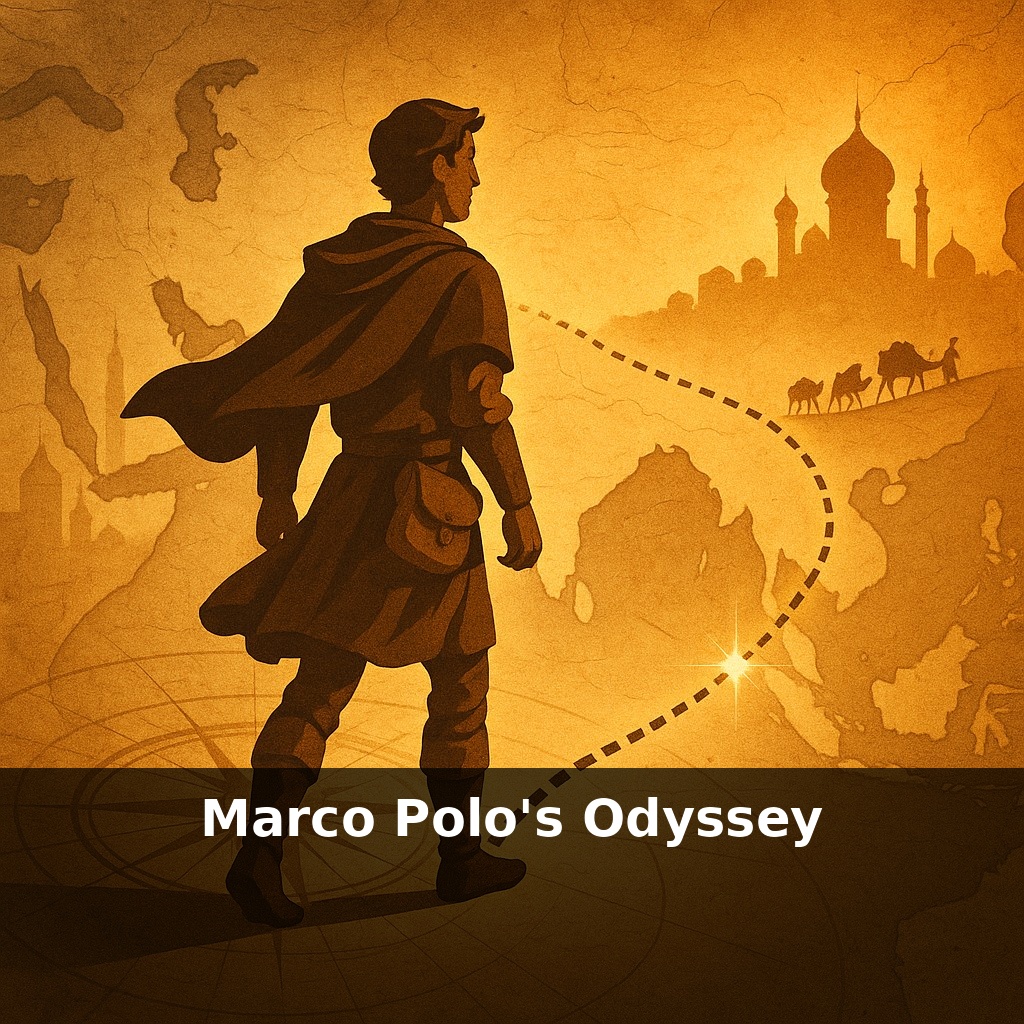
The route itself stitched together deserts, mountain corridors, and booming cities in Central Asia that were, in his day, as crucial as coastal hubs. Rather than a lonely trail through emptiness, he described chains of market towns, caravanserais, and administrative posts—a whole infrastructure for moving risk, capital, and information. The Silk Road functioned like today’s internet backbone: a series of linked nodes that moved valuable “packets” across vast distances under shared rules.
For later generations—Columbus among them—Polo’s odyssey became less a travel tale and more a proof-of-concept that such overland and maritime connections to Asia were not only real, but potentially exploitable, if you were bold—or desperate—enough to follow the clues in his text.
Take one detail Polo adds: the sheer scale of cities like Khanbaliq and Hangzhou, with populations dwarfing any in Europe. He notes merchant quarters, specialized markets, and shipyards turning out oceangoing junks in numbers that would shame a Mediterranean arsenal. To a Venetian trader, this wasn’t color; it was a spreadsheet in narrative form, hinting at volumes of demand and supply that could remake fortunes.
He also dwells on systems that made such density survivable: granaries to buffer famine, regulated markets to stabilize prices, canals that let bulk grain move quietly past tax collectors and petty tolls. In game-theory terms, he is watching how a vast empire tilts the board so cooperation—long-distance trade, honoring contracts—pays better than predation.
Even his side comments on hospitality rules, passport-like tablets, or how foreign merchants are taxed become case studies in “how to plug in” to this machinery. Later readers mined these sections like founders studying an unfamiliar but lucrative platform, looking for the APIs they could call without crashing the system.
His odyssey still nudges policy and imagination today. Modern “Silk Road” projects—rail corridors, fiber cables, port chains—quietly echo his west–east arc, promising smoother flows while reviving old rivalries. Treat his narrative less as a treasure map and more as an early case study in network effects: once routes, trust, and shared rules lock in, whole regions can rise—or freeze out latecomers for generations.
Polo’s odyssey leaves us with a question more than an answer: which distant realities are we still treating as rumor because they don’t fit our habits? His route, traced and retraced, became less a line on a map than a set of experiments in crossing boundaries—political, cultural, and mental—that still quietly shape how we explore the unknown.
Before next week, ask yourself: 1) “If I were embarking on my own ‘Silk Road’ like Marco Polo, what’s one bold, long-term journey (career pivot, creative project, or move abroad) I secretly want to undertake—and what’s the very first scouting step I could take today to explore if it’s truly possible?” 2) “Where in my life am I currently ‘stuck in Venice’—staying in familiar routines—and how could I deliberately seek out a ‘Kublai Khan moment’ by putting myself in a room (event, conversation, class) with people who see the world very differently from me?” 3) “What story about my life am I telling right now that would bore a future listener, and how could I tweak my next week—one decision about travel, risk, or curiosity—so that my ‘travelogue’ becomes more surprising and worth retelling?”
From this course
Threads of the Silk Road
7 episodesUnlock all episodes
Full access to 7 episodes and everything on OwlUp.
Subscribe — $1.99/monthLess than a coffee ☕ · Cancel anytime