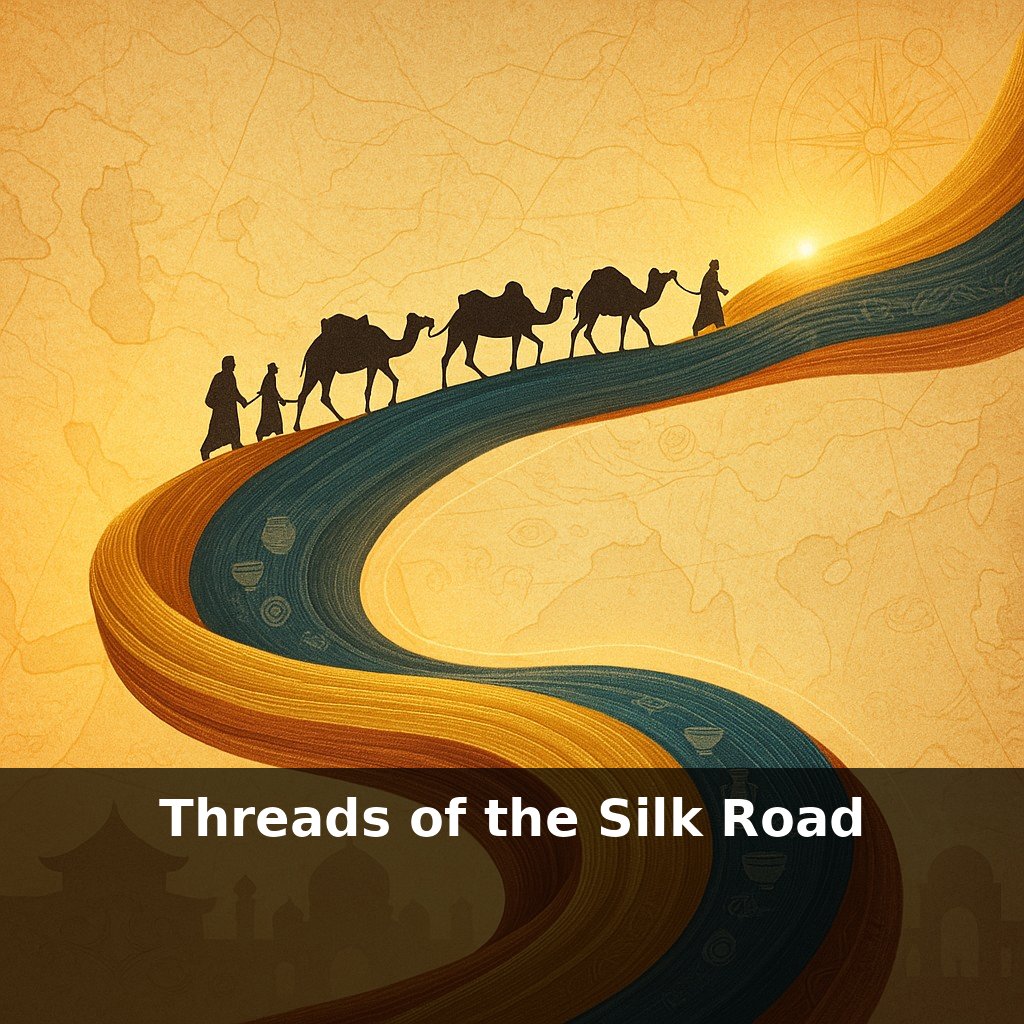
A single shimmering thread of silk once helped decide where cities rose, how gods were pictured, and which stories crossed continents. In this episode, we’ll step into crowded bazaars and royal courts to trace how a fragile fiber quietly rewove the ancient world.
Merchants leaving Xi’an could walk for months and still be inside a world shaped by the same shimmering fiber. Yet what tied their journey together wasn’t just the cloth they carried, but the quiet rules it imposed: which lands could tax it, which courts could wear it, which hands were allowed to touch the worms that spun it. As caravans moved west, they didn’t just pass dunes and mountain passes; they crossed invisible borders of belief, taste, and technology, each region adding its own twist—dyes here, patterns there, weaving tricks somewhere else. Silk receipts scratched onto wooden slips in desert outposts, fragments found in European graves, and imperial edicts arguing over who may wear what—all these traces let us reconstruct the routes like footprints in dust that never quite settled.
Step closer to those fragments and edicts, and the story widens beyond caravans and courts. Along the 6,400 km spine from Xi’an to Antioch, silk became a kind of passport: Buddhist sutras copied on gauzy cloth in Dunhuang, Qur’anic verses woven into Abbasid robes, Christian relics wrapped in brocades that had started life in far-off workshops. Artisans treated patterns like open-source code—Persian weavers refining Chinese clouds, Italian looms translating Iranian geometry into church vestments. What moved was never just fabric, but templates for how beauty, status, and even holiness should look and feel.
Stand in the workshop instead of the marketplace, and the story sharpens around the people who actually touched the thread. In a dim room in Sogdiana or Khotan, a weaver sat before a draw-loom whose logic would feel oddly familiar to a software engineer: a sequence of raised and lowered threads encoding patterns line by line. By the time this technology reached Persia and then Italy, that encoded logic had multiplied into thousands of possible combinations, allowing weavers in Lucca or Venice to “run” designs first imagined centuries earlier in Central Asia.
Follow a single motif—the lotus, for instance—and you can watch it molt as it travels. In Buddhist caves near Dunhuang it unfolds as a throne for bodhisattvas; on Abbasid silks it flattens into a stylized rosette; in Byzantine vestments it morphs again, now read as a symbol of paradise rather than rebirth. Traders didn’t need to agree on theology; they just needed to agree that this particular flower sold well. Over time, buyers in Antioch or Cairo were wearing patterns whose original meanings had been gently overwritten, like palimpsests you can still half-read if you know where to look.
The routes themselves began to crystallize around this steady demand. Oasis towns that could guarantee security, water, and storage turned into dense knots of expertise. In places like Samarkand, silk-finishing workshops sat beside dye yards, paper mills, and manuscript studios. A bolt might arrive as plain weave and leave as something that carried a poem in Kufic script, a caliphal emblem, or a tailor’s chalk-marks mapping out a robe for a distant court.
Silk also forced new kinds of collaboration. Mulberry growers, cocoon steamers, reelers, spinners, dyers, designers, weavers, merchants—each controlled only a slice of the value. In southern India today, you can still see a version of this chain: one village raising worms, another specializing in degumming, a third known for a particular red or gold. Medieval tax ledgers and guild rules hint that similar micro-economies once dotted the arteries between Xi’an and the Mediterranean, each village quietly betting its future on mastering one tiny step in a process that stretched over continents and generations.
Stand in one of those cosmopolitan cities at dusk and follow a single bolt leaving a workshop. It might be cut into armor-linings for Central Asian horsemen, altar frontals for a church in Ravenna, or curtains that darken a scholar’s room in Baghdad so he can read by lamplight in the heat. The same material, three different worlds of use—military, sacred, intellectual—stitched together by the choices of tailors and patrons you’ll never meet.
Because it was so costly, people treated every scrap like prime real estate: worn robes were flipped, patched, then sliced into book covers, reliquary linings, amulet pouches. Textiles became a kind of physical archive, layering lifetimes of reuse. That’s why archaeologists now find Abbasid weaves in Scandinavian graves, or Chinese patterns backing European charters: not as pristine rolls, but as ghosts inside other objects.
Silk’s path also mapped risk. Caravans carrying it drew bandits and tax collectors in equal measure, turning certain passes into tollgates of empire-building. Where protection was reliable, merchants stayed, married locally, and founded diasporic communities that bridged languages and legal systems. Their letters, scratched on paper or parchment rather than cloth, discuss delayed shipments and fluctuating dye prices in a vocabulary that feels startlingly close to modern supply-chain emails.
One analogy: those caravans and cargo holds worked a bit like undersea fiber-optic cables do now—quiet, invisible most of the time, yet constantly recalibrated around storms, pirates, or politics. When a war closed one corridor, routes flexed north or south; when a new harbor offered safer anchorage, traffic flowed like rerouted data, bringing wealth and ideas to fresh shores almost by default.
Over centuries, this constant redirection produced unexpected pairings. A weaver in Anatolia might never travel beyond a three-day radius, yet his patterns echoed distant courts because merchants arrived with sketches, small samples, or just verbal descriptions of what “sold well in Egypt last season.” Fashion forecasting existed, but by camel and dhow: slow, partial, rumor-laced. Still, over time, tastes aligned enough that a color craze in one royal court could ripple hundreds of kilometers away, nudging farmers to plant different dye crops or experiment with new mordants.
Those choices had ecological consequences. Mulberry groves reshaped hillsides; insects, fungi, and diseases hitchhiked on saplings and cloth alike. Outbreaks in silkworm stock could topple local economies, sending desperate makers into other trades. Yet even collapse left traces: abandoned dye vats, repurposed loom-weights, loan contracts where silk is suddenly replaced by wool or grain. Each fragment is a quiet reminder that behind the gleam lay constant improvisation—humans, plants, and animals coevolving around a thread so fine you can barely see it, yet strong enough to pull whole regions into its orbit.
Today’s “silk” experiments look less like caravans and more like labs and logistics dashboards. Designers test biodegradable dyes that behave like seasonal playlists, fading in and out instead of clogging landfills. Bioengineers splice silk proteins into yeast, hoping to “brew” fibers the way cities brew beer. Meanwhile, digital archives turn scattered fragments into shared reference libraries, letting a village weaver in Laos study a Milan museum textile without leaving home. The next thread might be coded before it’s ever spun.
In that light, today’s “silken threads” aren’t only fibers but also climate data, labor rights, and digital replicas of vanished robes. Your challenge this week: trace one item you wear—from field to factory to port. As you follow its path, notice how many cultures, laws, and landscapes now knot together in the space of a single, ordinary seam.