About half of what you say today won’t be a conscious choice—your habits will say it for you. You walk into a tense meeting and, before you “decide” how to respond, your autopilot has already spoken. Here’s the twist: that same autopilot can be rewired on purpose.
Forty‑five percent of what you’ll do today is driven by patterns you barely notice. Not “bad habits” in the dramatic sense—mostly tiny defaults in how you start, steer, and end conversations. Who you interrupt. When you go quiet. How quickly you defend yourself. This week is about catching those micro‑moves in real time and quietly swapping them for new ones, until the swap sticks.
You’re not chasing a personality transplant. You’re upgrading the *defaults* your relationships run on. Research shows that without deliberate practice, almost all new skills erode within months. That’s why one great workshop or book rarely changes how you talk to your partner, your boss, or your friends.
So we’ll turn your real life into a low‑friction practice lab: brief, specific experiments in everyday moments that slowly shift how you communicate—without feeling fake or forced.
Think of this week as upgrading the “settings” on how you show up in real conversations, not just understanding why they go wrong. Neuroscience reminds us that your brain loves efficiency: whatever you repeat—eye contact, interrupting, asking one more question—gets filed as the easiest option next time. That’s good news. It means you don’t have to be perfectly mindful in every moment; you just need enough mindful reps in the moments that matter. We’ll focus on tiny, high‑leverage shifts—like pausing before replying or checking what someone heard—that compound into a different version of you in dialogue.
Nineteen out of twenty people who learn a powerful communication tool this year will barely use it next year. Not because they’re lazy or insincere, but because they never built a bridge from *knowing* to *doing when it counts*.
That bridge is made of three pieces: cues, routines, and rewards. You already run this loop in dozens of ways—checking your phone when a notification pings, grabbing a snack when you walk into the kitchen. This week, you’ll start wiring that same loop around how you listen, question, and respond under pressure.
First, cues. Communication breakthroughs rarely happen in quiet, calm moments; they happen in the messy ones. So you need “tripwires” that tell you, *use the new pattern now*. Common cues: your heart rate jumps, someone raises their voice, you notice yourself rehearsing a comeback, you hear a familiar phrase (“You always…” “You never…”). Instead of treating these as danger signs, we’ll treat them as green lights: *this is your practice rep*.
Next, routines. A routine is just the specific move you’ll run when the cue hits. “Ask one open question before I explain.” “Summarise what I heard before I disagree.” “Name my feeling in one sentence instead of arguing my case for five minutes.” The smaller and clearer the routine, the more likely it is to happen when your old patterns are screaming for control.
Finally, rewards. Your brain doesn’t care that something is “good communication.” It cares whether the behaviour feels worth repeating. That can be external (the other person softens, the meeting stays on track) or internal (a tiny hit of pride, relief, or alignment with the kind of partner/leader/friend you want to be). Catch those wins on purpose. Even a one‑second mental note—*that went better*—is a reward signal.
Over time, this loop starts to reshape your days. A tense email becomes your cue to slow down; your routine is drafting a curious reply instead of a defensive one; your reward is the thread staying productive instead of spiralling. The environment hasn’t changed. You have.
You don’t have to overhaul your whole day to lock in new ways of speaking; you just need a few predictable “practice arenas.” For many people, it’s the weekly team meeting, the school‑run chat, or the debrief with a partner after work. Pick one recurring setting and decide: *this is where I experiment*.
Take a manager who tends to dominate Monday stand‑ups. They set one specific rule for themselves: “In this meeting, I speak last after at least two others.” The cue is the agenda item starting. The routine is asking, “Who wants to kick us off?” and then waiting. The reward shows up when quieter voices surface ideas they’d have otherwise missed.
Or consider replying to messages. You might tag any text or email that frustrates you as a “2‑minute pause” signal. Before answering, you type one clarifying question at the top. Over a month, those tiny pivots can shift entire relationships.
Your one permitted analogy: it’s like setting an automatic transfer from your checking to savings—small, regular moves that quietly change your balance.
As communication habits shift, the ripples extend far beyond single conversations. Teams may start treating meetings less like status updates and more like “live prototypes” for better dialogue—adjusting formats the way product designers iterate on an app. Families could adopt brief end‑of‑day check‑ins, like syncing devices, to keep emotional “software” current. Over time, organisations might map collaboration patterns the way cities study traffic, redesigning workflows to reduce conversational gridlock.
When you treat every tricky chat as a small experiment, your days start to feel less like tests and more like training runs. Some will flop, some will click—but each is another brushstroke on how you relate. Over weeks, your “usual way of talking” quietly updates itself, the way a playlist evolves as you keep skipping old tracks and saving new ones.
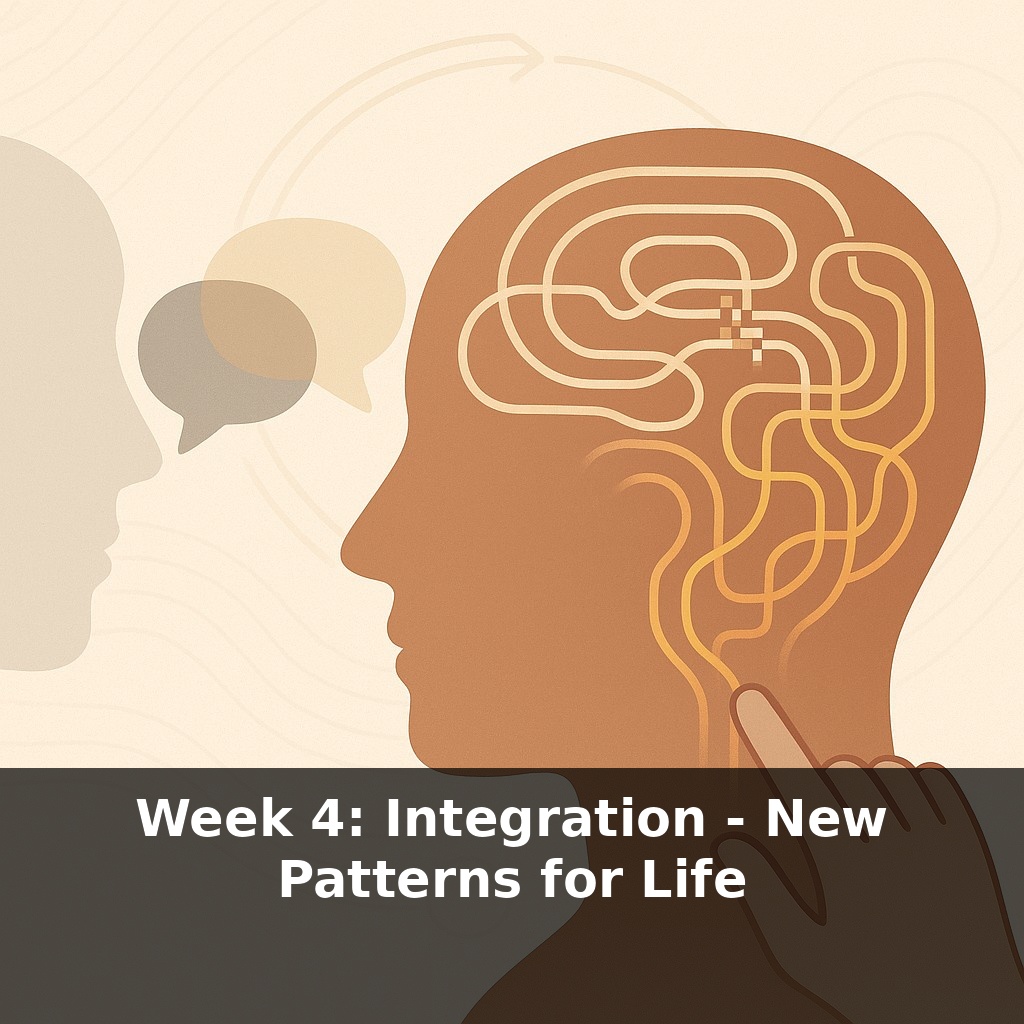
To go deeper, here are 3 next steps: (1) Re-listen to the “Week 4: Integration – New Patterns for Life” episode with a notebook open and map each pattern they mention (morning, work, relationships, evening) into a simple one-page “daily script” using the free template at notion.so or paper-based systems like the Full Focus Planner. (2) Pick one new pattern from the episode—like the grounding morning practice or end-of-day reflection—and set it up in a real tool today (e.g., create a repeating 10-minute “Integration Check-In” event in Google Calendar or Apple Reminders with the exact reflection questions they discussed). (3) Grab a copy of “Atomic Habits” by James Clear or “Tiny Habits” by BJ Fogg and, using just chapter 1 of either book, redesign one of your existing habits mentioned in the episode (like phone use before bed) into an “integration habit” that links directly to your new pattern, then track it this week in a free app like Habitify or Streaks.