Families as Systems: The Interconnected Web
📝 Transcript
Right now, somewhere, a teenager just got into serious trouble—and the most effective “treatment” may not be for them at all, but for their entire family. So why do we keep trying to fix individuals, when the real action is in the invisible web connecting everyone at home?
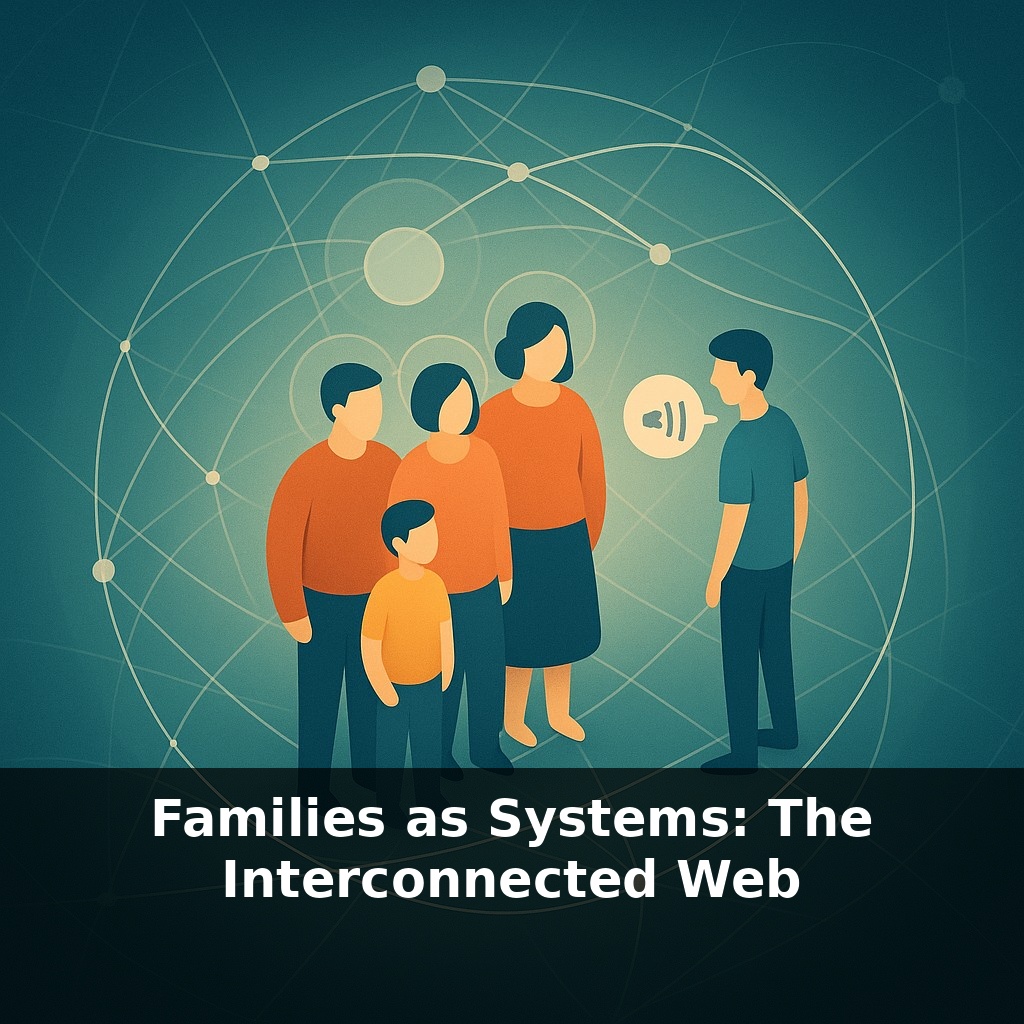
If that “invisible web” is so powerful, here’s the twist: it can quietly work against what you say you want as a family. You might tell a child, “Speak up more,” yet interrupt them whenever conflict rises. You may insist on “less drama,” while everyone tiptoes around one person’s anger like cooks working around a hot pan—never touching the real heat. Family systems theory helps name these hidden patterns: who gets to express big feelings, who smooths things over, who absorbs blame, who disappears when tension grows. Neuroscience and developmental research now back this up: kids’ stress hormones, attention, and emotion regulation all shift depending on how the whole system responds, not just on their own “coping skills.” In other words, the family’s recurring dance steps often matter more than any one dancer’s effort.
Here’s where it gets practical: researchers studying real families don’t just look at who’s “struggling”; they map what happens before, during, and after tense moments. Who speaks first? Who retreats? Who jokes to change the subject? Over thousands of such micro‑moments, families form stable loops—like well-worn shortcuts in a neighborhood—so automatic that no one notices them. That’s why therapies like MST and FFT don’t wait for insight alone; they deliberately disrupt these loops in daily life: who drives to court, who handles school calls, who sets curfew, who backs the rule with action.
If you zoom in on those “micro‑moments,” you’ll notice they’re not random; they tend to follow a few predictable templates. One big idea from systems thinking is feedback: some patterns keep things going in the same direction, others push toward change.
Take a common loop: a child’s grades slip, a parent tightens control, the child resists more, the parent doubles down. Each person is responding logically to the moment, but together they create a cycle that amplifies the very problem everyone hates. That’s a reinforcing loop. By contrast, a balancing loop kicks in when someone does something that steadies the system—like a sibling cracking a joke when voices rise, or a grandparent calling right when a blow‑up seems inevitable.
These loops are shaped by boundaries and roles. Boundaries are the lines—spoken or unspoken—about who is “in” on decisions, emotions, and responsibilities. In some homes, kids are shielded from any adult stress; in others, they’re treated like mini‑therapists or co‑parents. Roles grow around those boundaries: the fixer, the peacemaker, the rebel, the quiet one. Over time, people can get locked into these positions even when they no longer fit.
Hierarchy adds another layer: who actually has power, and who functions like they do. On paper, adults lead. In practice, a child’s anxiety, substance use, or anger might silently set the schedule, the tone at dinner, even where the family lives. That’s a kind of “symptom leadership,” where distress organizes everyone’s behavior.
This is why changing just one person’s skills isn’t always enough. If a teen learns to stay calm but a parent only engages when there’s a crisis, the system quietly tugs the teen back into old reactions so the familiar pattern can continue. Shifts stick better when at least two parts of the loop move together—say, a parent changes how they respond to backtalk at the same time the teen practices new ways to disagree.
Think of a weather system: a single gust matters less than how temperature, pressure, and moisture interact. Likewise, in families, it’s the interaction among boundaries, roles, and hierarchy that predicts whether stress turns into a brief storm—or a season.
Think of a pressure cooker on a stove: you don’t just watch the steam; you watch the flame, the lid, the release valve. In many homes, the “flame” might be school stress, money worries, or a new relationship. The “lid” is how openly people talk, and the “valve” is whatever the family uses to let tension out—arguing, silence, humor, sudden “I’m fine” clean‑up sprees.
Here’s how this can play out. A child starts staying in their room more. One parent knocks often, trying to connect; the other gives more space, hoping it’s just a phase. Siblings complain that “everything is about them now.” No one is doing anything absurd or cruel, but together they slowly build a world where the door stays closed and worry grows on both sides of it.
Or a different scene: a couple argues, and a child consistently rushes in with jokes or distractions. Over time, the child becomes the unofficial “mood manager.” Adults may not notice that their relief is also a training ground: the child learns that their own feelings matter less than keeping the room calm.
A bold shift is coming: instead of asking “Who is the problem?” more services will ask “What pattern are we all stuck in?” Tele-systemic sessions, VR role‑plays, and even wearables could flag rising tension like a smoke alarm, prompting families to try new moves sooner. Policies are slowly catching up—schools, clinics, and workplaces are beginning to see that helping one person means adjusting the whole climate, not just fixing a single “broken” part.
Conclusion: When you start noticing patterns, the goal isn’t to blame the “loudest” or “weakest” link, but to get curious about what each reaction is protecting. Often, the raised voice is guarding a fear, the eye‑roll is shielding shame. Like tuning an instrument with others, small shifts in how you respond can slowly change what the whole group can play together.
To go deeper, here are 3 next steps: (1) Grab a big sheet of paper and map your family as a system using a free online genogram tool like GenoPro or the web-based tool at genopro.com; add patterns you notice (conflict alliances, who goes to whom for support, who withdraws, etc.) as you listen again to the episode. (2) Read Chapter 2 (“Seeing the Family as a System”) from *Family Therapy: Concepts and Methods* by Michael Nichols, and then pick one current family tension and literally trace how it “moves” through three different family members, just like the episode described with feedback loops. (3) Watch Monica McGoldrick’s short genogram lecture on YouTube and, this week, ask one older family member three specific questions about past conflicts, cutoffs, or big transitions so you can update your map and start spotting multigenerational patterns in your own “interconnected web.”
From this course
Understanding Family Dynamics: Systems That Shape Us
7 episodesUnlock all episodes
Full access to 7 episodes and everything on OwlUp.
Subscribe — $1.99/monthLess than a coffee ☕ · Cancel anytime