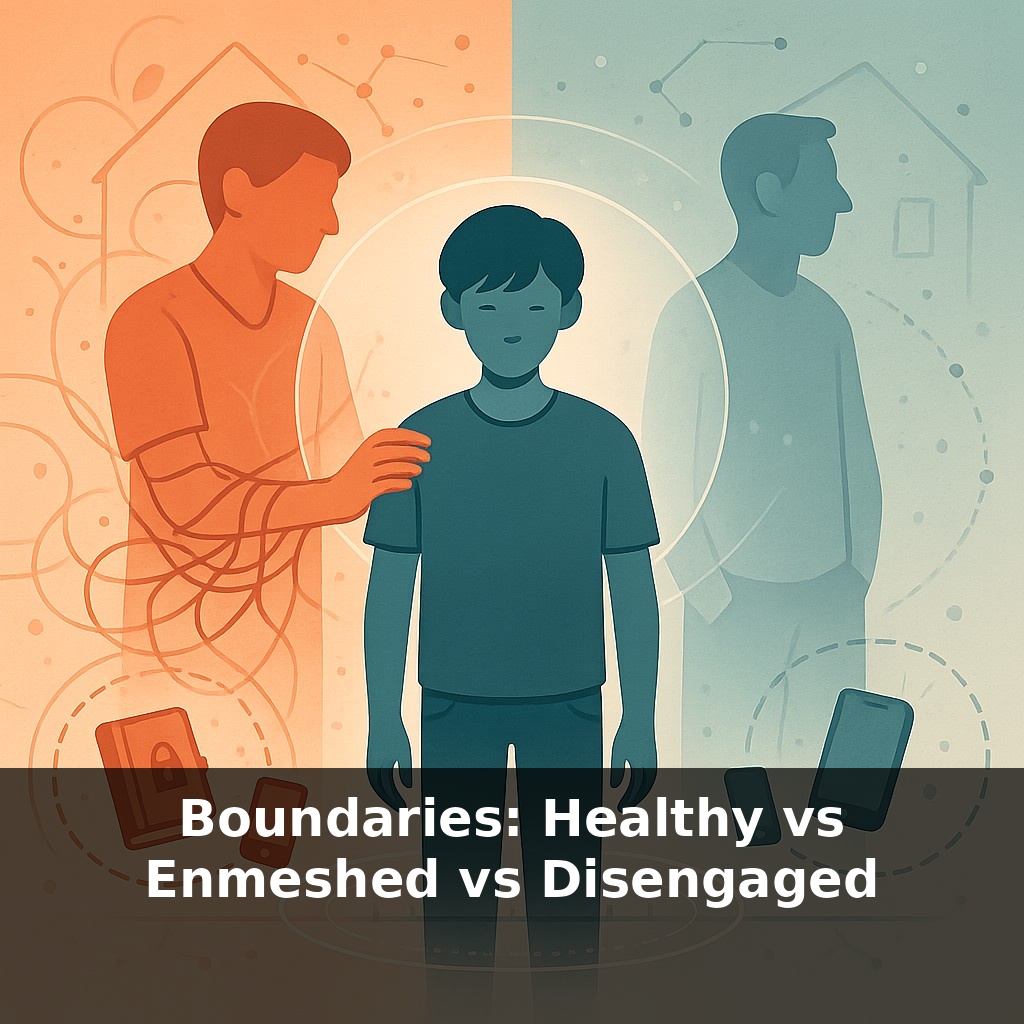
“In many families, the person who looks the closest is actually the most trapped.”
A teen shares every secret with a parent but feels guilty for wanting privacy. Another teen has total freedom but no one really checks in.
Both say, “My family’s normal.” Both are living with broken boundaries.
“Enmeshment” and “disengagement” can sound abstract, but research treats them as measurable patterns, not vague labels.
Minuchin noticed a striking trend: in families of teens with severe eating struggles, parents weren’t just involved—they were woven into nearly every choice, feeling, and crisis. Later studies confirmed this pattern across problems like anxiety, depression, and substance use. On the other end, disengaged families often look calm from the outside, yet kids report feeling like “roommates” more than relatives, and are more likely to act out or shut down.
Most families don’t sit at the extremes. They drift. Stress, illness, divorce, or even a child’s success can quietly pull a family toward over-closeness or emotional withdrawal.
The key question isn’t, “Are our boundaries good or bad?” but, “When and how do they stretch, snap, or disappear—and what does that cost each of us?”
Some clues are obvious: a parent reading every text, or no one noticing when someone disappears for hours. Others are quieter. A sibling who always mediates fights. A child who becomes a parent’s main confidant after a breakup. A partner who cancels plans whenever a family member hints they’re “disappointed.” Research tools like FACES IV can map these patterns, but day-to-day, they show up in small decisions: who’s allowed to say “no,” whose moods set the tone for everyone else, and who gets labeled “selfish” for wanting something different. That’s where healthy, enmeshed, and disengaged start to diverge.
A 2016 study found that when boundaries blurred in parent–child relationships, kids’ externalizing behaviors—things like acting out, aggression, rule-breaking—rose by 17 % the next year. Not after a major trauma, not in “extreme” families. Just when daily lines about “what’s mine, what’s yours, what’s okay” got fuzzy.
So what actually distinguishes balanced boundaries from the two extremes in real life?
One lens is decision-making. In more balanced systems, choices about friends, hobbies, or career paths are joint where they affect the family, and individual where they don’t. Parents might guide, offer opinions, even set limits, but they don’t routinely overrule a teen’s preferences “for their own good,” nor shrug at every risky plan as “their choice.” Enmeshed patterns tilt toward “we” controlling “you”; disengaged ones toward “you” facing life alone.
Another lens is emotion. In some homes, one person’s bad day quietly becomes everyone’s bad day. That’s emotional contagion—strongly tied to over-involvement. In others, distress is handled solo: “Go to your room,” “He just needs to cool off.” Balanced boundaries allow sharing feelings without handing someone else the job of fixing or carrying them.
Power is a third lens. Parental psychological control—guilt-tripping, withdrawing affection, or saying “If you loved me, you’d…”—is a subtle sign that the line between guidance and intrusion has been crossed. Longitudinal work in the Journal of Adolescence suggests this kind of control alone accounts for nearly a quarter of the differences in teens’ depressive symptoms. On the flip side, when adults check out of guiding altogether, kids may seem “independent” but show more behavioral problems and poorer focus at school.
If this sounds stark, the reality is more mosaic than label. Some families are tightly fused around illness yet quite flexible about friendships. Others are distant around feelings but close around shared projects or faith. Stress can push even generally balanced families to temporarily clamp down or drift apart.
The hopeful part: boundary patterns are not destiny. Approaches like Structural Family Therapy and Emotionally Focused Family Therapy literally re-organize who talks to whom, who decides what, and how much influence feelings have in the room. Even small shifts—like a parent moving from “Tell me everything” to “Share what you choose; I’ll handle my own worry”—can start nudging a family back toward that middle space where closeness and autonomy can coexist.
A college student calls home to share a minor setback on an exam. In one household, within an hour three relatives are texting professors’ emails, rewriting study schedules, and staying up late anxiously refreshing the grade portal. The student starts hiding future struggles—not because no one cares, but because they care in a way that crowds out their own problem‑solving. In another home, the same story gets a brief “You’ll figure it out” over speakerphone while everyone keeps scrolling. No follow‑up, no curiosity; the student stops calling not out of rebellion, but because it doesn’t change anything.
Now picture a third version: the parent listens, asks, “What have you already tried?” and offers to brainstorm if wanted. They might set expectations—“We’ll cover tuition, you handle scheduling support”—yet step back enough for the student to own both effort and results. Over months, that pattern quietly teaches, “You’re connected here, and you’re capable out there,” a message strongly linked with better mood, focus, and risk‑taking that stays within the lane of growth rather than crisis.
Courts, schools, and even apps may soon quietly “score” how families handle closeness and space, much like fitness trackers log sleep. Digital tools could flag patterns—late‑night group chats, location‑sharing rules, shared passwords—and suggest tweaks before stress hardens into habit. Cultural research will matter here: norms in a crowded multigenerational flat differ from a quiet suburban home, so any future system that ignores context risks pathologizing what’s simply “how we do things here.”
Your challenge this week: notice one tiny moment when you either over‑step or pull away—a comment on someone’s outfit, a shrug at their bad day, a decision made “for their own good.” Then, as an experiment, rewind in your mind and script a version with 10 % more space or 10 % more care. Like adjusting seasoning in a soup, small shifts can change the whole flavor.