A therapist once said, “In families, tension rarely stays between just two people.” One sibling snaps, and suddenly a third person walks in, cracks a joke, changes the subject, or takes sides. The fight cools off—for now. But why does that relief so often come with a hidden cost?
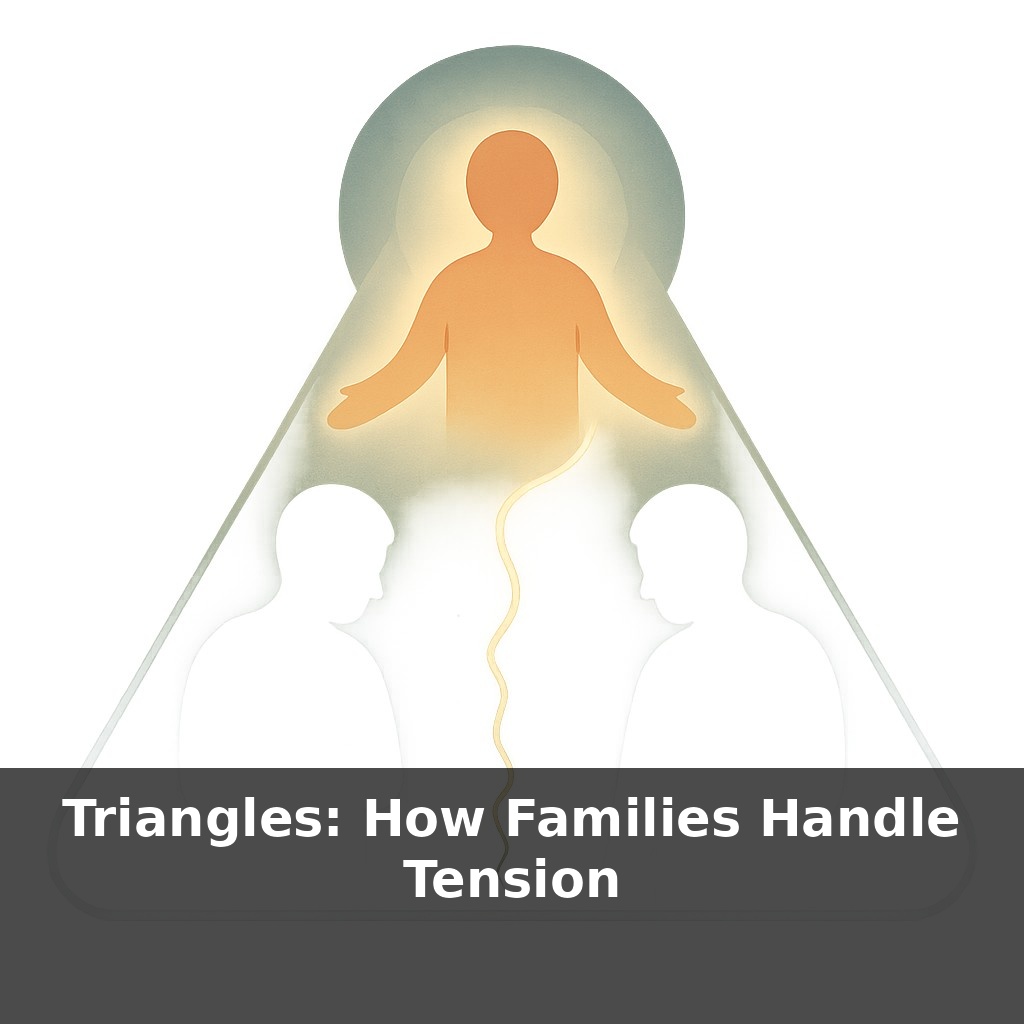
In family systems theory, that “third person” has a name: a triangle. It’s the smallest stable unit in a relationship system—two people plus a third person, activity, or issue that absorbs some of the emotional heat. Under stress, most pairs don’t stay a pair for long; they widen the circle. One complains to a sibling, vents to a friend, throws themselves into work, or suddenly focuses on a child’s grades or behavior. On the surface, things look calmer. Underneath, the original tension is still pulsing, just spread out. Over time, these patterns can become so automatic that each person starts to occupy a familiar role without thinking. In this episode, we’ll look at how those roles form, why some people get pulled in more than others, and what it actually means to step out of a triangle without abandoning anyone.
Some triangles are obvious: two parents arguing, a child crying in the doorway. Others are quiet—like a parent who always “checks in” with one child after fighting with their partner, or a teen who suddenly develops stomach aches whenever adults are at odds. Research finds that when kids are repeatedly placed in the emotional crossfire, their bodies often carry the stress: sleep problems, headaches, anxiety, or shutting down. Over time, nobody has to say, “You’re on my side.” The glances, tone shifts, and who gets texted first after an argument start to map out the real alliances in the room.
“Anxious pairs almost always involve a third person,” noted Bowen, and later clinicians put rough numbers to it: under strain, a two-person relationship reaches for a third element the vast majority of the time. That “third” might be a child, a parent, a sibling, a therapist, work, a hobby, even a health concern. The key is not who or what gets pulled in, but *how* that involvement changes the emotional flow.
Most triangles have a rhythm. One corner grows tense, another absorbs the intensity, the third fades into the background—until the positions quietly rotate. A parent and teen might be close while both complain about the other parent. Months later, the formerly “difficult” parent and teen are aligned, and the more easygoing parent is suddenly “too sensitive” or “the problem.” No one sat down and agreed to this shift; the system simply rearranged itself to keep anxiety moving.
Over time, people’s nervous systems learn these routes. One child’s body might register every marital argument with a headache or sudden rage. Another might turn into the family therapist, checking on everyone, smoothing rough edges, never showing their own upset. A partner who fears conflict may habitually “go through” the kids—sharing worries with them instead of with the other adult in the room. The pattern is circular: the more someone takes on a soothing or distracting role, the more others lean on them that way, and the harder it becomes to show up differently.
The research on children stuck in the middle shows how costly this can be: higher anxiety and depression, but also a quieter loss—less room to develop a solid sense of “Where do *I* end and the family tension begins?” That’s what Bowen called differentiation: the capacity to stay connected while still thinking and choosing for yourself. People with more of it don’t necessarily feel less; they’re just less likely to automatically relieve their own discomfort by recruiting a third person or by becoming that third person on demand.
One way to picture this is like weather in a small valley. When pressure builds in one corner, wind almost always rushes somewhere else. You can’t stop the wind from moving, but you *can* learn to notice its usual paths—and slowly redirect how hard it blows through you.
“Don’t tell your mother I said this, but…” A father vents to his teen after a rough conversation with his spouse. The teen nods, listens, even offers advice. On the surface, it looks like closeness. Underneath, the teen now carries information and emotion meant for the adult partnership. Next week, the teen snaps at the other parent with an intensity that feels “out of nowhere.” It isn’t nowhere; it’s the overflow of that late-night talk.
Or consider a family where every disagreement between adults mysteriously ends with a sudden focus on a child’s grades. Report card time becomes strangely dramatic. The child may start to feel that doing better (or worse) in school is the only reliable way to keep everyone engaged—or to keep two adults from turning on each other.
In another home, one sibling always cracks jokes when voices rise. Over years, that “comedian” might struggle to know what they actually feel, because their body has been trained to pivot instantly from discomfort to performance.
When screens, smart speakers, and group chats sit in the room with us, they quietly volunteer as extra “points” in our relationship geometry. A frustrated parent might unload to a parenting app instead of a partner; a teen may disappear into gaming servers when tension spikes. These new participants don’t just distract—they can solidify quiet alliances: “me and my phone” versus “them.” The experiment ahead is learning when tech cools things just enough, and when it freezes people into distance.
Triangling isn’t “bad behavior” to stamp out; it’s a signal light on the dashboard. When you catch it, you’re already closer to choice than habit. Over time, even small shifts—a slower reply, a curious question, a boundary stated one sentence clearer—reshape the map of who carries what. Families don’t flip like a switch; they evolve like a recipe, one adjustment at a time.
Here’s your challenge this week: Choose one recurring triangle you’re part of (for example, you + your spouse + your teen, or you + your sibling + your parent), and in the very next tense moment, stay in direct contact with the person you usually “go around.” Instead of venting to the third person, have one specific, calm conversation with the person at the center of the tension and share only your own thoughts and feelings (no diagnosing or quoting others). Then, notice and jot down exactly how the intensity of the triangle shifts over the next 48 hours—who calls whom, who vents to whom, and whether you feel more or less pulled into the middle.