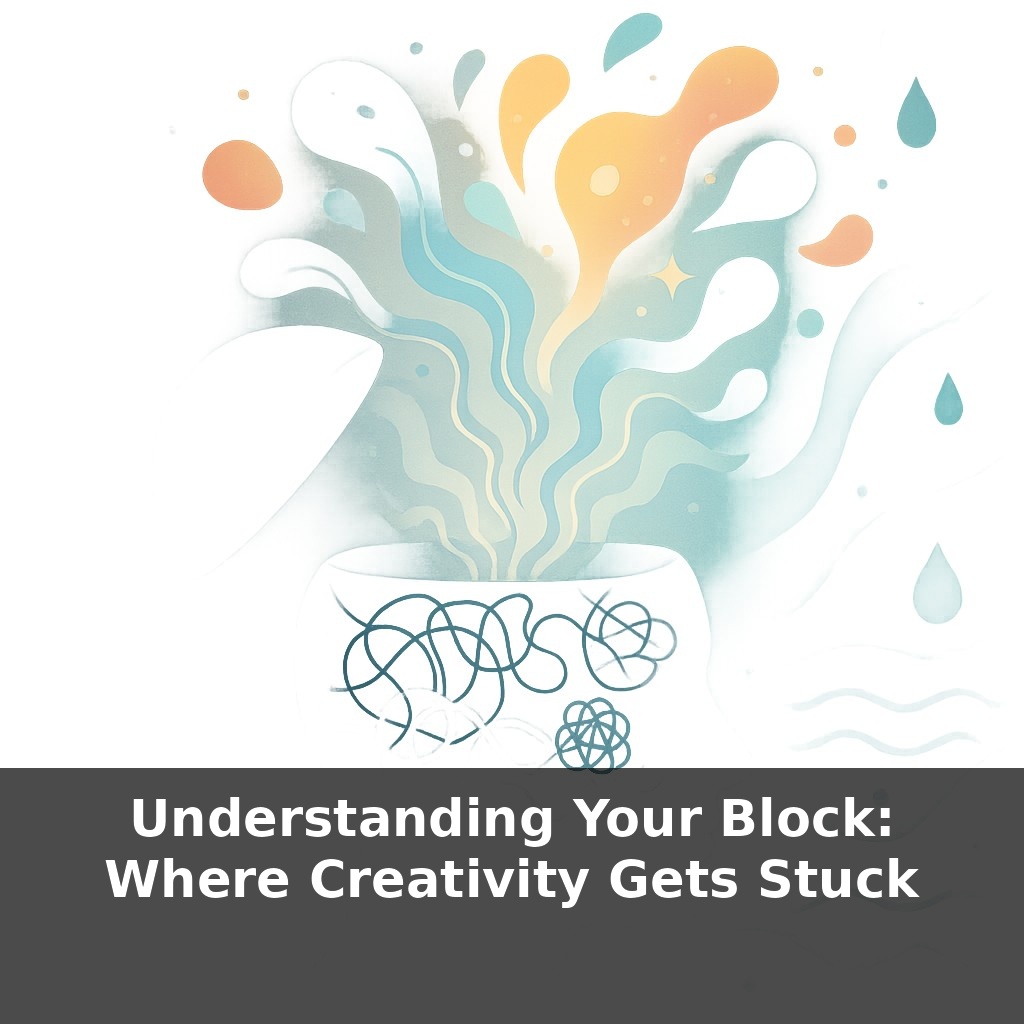
Understanding Your Block: Where Creativity Gets Stuck
📝 Transcript
You’re most creative *right after* you stop trying so hard. A Utah study found focused work can quietly drain idea-generation by almost half. So why do your best ideas show up in the shower, not at your desk? In this episode, we’ll walk straight into that paradox.
If your mind feels “blank,” it’s usually not empty—it’s overloaded. Neuroimaging studies of blocked writers show their brain’s control center (the dorsolateral prefrontal cortex) working overtime, while the networks that usually wander, connect dots, and spark insights stay oddly quiet. Add in low sleep, constant notifications, and the quiet pressure to “make this one brilliant,” and you’ve built the perfect storm for getting stuck.
This isn’t a personality flaw; it’s a system-level mismatch. You’re asking your brain to brainstorm wild options while it’s stuck in spreadsheet mode. It’s like trying to slow-cook a stew on the highest stove setting—things burn instead of blending.
In this episode, we’ll map the early warning signals of that mismatch: the subtle procrastination, the oddly specific anxieties, the way “one more email” suddenly feels urgent whenever you face the blank page.
One hidden twist is that blocks rarely start at the “blank page” moment. They creep in hours earlier, when you override tiny signals: skipping a break, doom‑scrolling between tasks, saying yes to one more meeting. By the time you sit down to create, your attention is already fragmented, like tabs scattered across three browsers. Neurobiology quietly joins in: stress nudges your amygdala, sleep debt dulls insight, and dopamine dips make everything feel flat. The result isn’t just “no ideas,” but ideas that feel oddly unappealing, as if your own work belongs to someone else.
When a block finally shows up, it rarely looks dramatic. It’s more like a quiet slide from “engaged” to “numb.” One of the earliest shifts is in how your brain evaluates risk and reward. Under stress, perfectionism and self‑monitoring crank up the “cost” of every decision: choosing a color palette feels as weighty as choosing a career. That tiny choice suddenly needs more research, more options, more certainty. Decision fatigue isn’t just being tired of choosing; it’s your mind treating every fork in the road as if there’s only one non‑disastrous path.
Cognitively, this shows up as over‑editing the first sentence for 30 minutes, or endlessly rearranging slide titles before adding any content. It feels like “being thorough,” but it’s actually your executive systems trying to protect you from imagined failure by stalling. The irony: the more you push for a flawless outcome, the more your brain withholds the raw, messy material you’d need to get there.
Environmental stressors quietly reinforce this loop. Constant pings and open tabs don’t just interrupt; they reset your internal context. Each switch forces your brain to reload a new “mental file,” draining the very resources divergent thinking depends on. After a morning of rapid‑fire tasks, sitting down to create can feel like trying to stream a movie over a throttled connection: technically possible, painfully slow.
Burnout adds another twist. When your baseline is exhaustion, your brain becomes deeply conservative. It sticks to familiar patterns because novelty is metabolically expensive. You’ll notice yourself reaching for templates, repeating old solutions, or recycling past ideas and hating them, but feeling unable to do anything else.
Even the space around you matters more than most people realize. Too silent, and your own thoughts echo so loudly that self‑critique dominates. Too chaotic, and your attention splinters. That “middle” level of stimulation acts like a gentle background process, occupying just enough control bandwidth that your more associative networks can wander.
Underneath all of this, your block is less about a missing spark and more about a system overloaded with protective routines. Your mind isn’t refusing to work; it’s trying, clumsily, to keep you safe from wasted effort, embarrassment, and further depletion—at the exact cost of the experimentation your best work needs.
You can often spot this “quiet slide” in everyday moments. A designer opens Figma to explore wild layouts, then spends an hour nudging a single button three pixels left and right, hoping the “right” choice will magically feel risk‑free. A songwriter sits down to draft a chorus, but suddenly “remembers” five tiny admin tasks that *must* be done first. A founder blocks two hours for vision work, then burns 90 minutes perfecting the wording of one internal email, telling themselves it’s “still creative.”
Think of it like a budgeting app set to extreme risk‑aversion: every unconventional move gets flagged as “overspending,” while safe, repetitive choices slide through unchallenged. Over time, your internal dashboard stops showing “curiosity balance” and shows only “error alerts.” That’s when scrolling reference work feels safer than making your own.
The clue isn’t just “no ideas,” but where your energy *shrinks*: tiny tasks feel strangely heavy, playful experiments feel unjustifiable, and even good concepts arrive wrapped in doubt.
Soon, spotting your own block may feel less like guesswork and more like reading a weather app. Tools that track keystroke rhythm, cursor drift, and micro‑pauses could flag “creative overcast” before you feel stuck, nudging you toward a reset ritual instead of another forced sprint. Teams might treat blocks like technical debt: routinely scheduled “debugging” sessions for minds, not code. The skill won’t be avoiding stuckness, but shortening the time you stay there and designing workflows that expect it.
So the next time your work feels like typing on a frozen keyboard, treat it as a status update, not a verdict. Curiosity can be your tiny restart button: try one question, one tweak, one odd connection. Blocks often melt when you trade “perform” for “explore,” letting your mind wander off script long enough to stumble into a new doorway.
Here’s your challenge this week: pick ONE project you’ve been circling (the “someday” idea you keep mentally rewriting) and give it a strict 20‑minute “bad first draft” container every day for the next 5 days—no revising, no researching, just forward motion. Each time you notice yourself slipping into one of the blocks from the episode (perfectionism, comparison, procrastination-by-planning, or over-consumption), literally say out loud which one it is and keep going without correcting what you just made. At the end of each session, underline or highlight exactly one messy sentence/section you’re secretly a little excited about, and leave it unfinished on purpose so tomorrow’s session has a clear, imperfect place to start.
From this course
Unlock Your Creativity: From Blocked to Brilliant
8 episodesUnlock all episodes
Full access to 8 episodes and everything on OwlUp.
Subscribe — $1.99/monthLess than a coffee ☕ · Cancel anytime