Kids laugh several hundred times a day; most adults don’t even reach a few dozen. Somewhere along the way, creativity quietly traded giggles for goals. You’re on a deadline, the cursor blinks, and your ideas feel heavy. Yet the science says: play, not pressure, unlocks your best work.
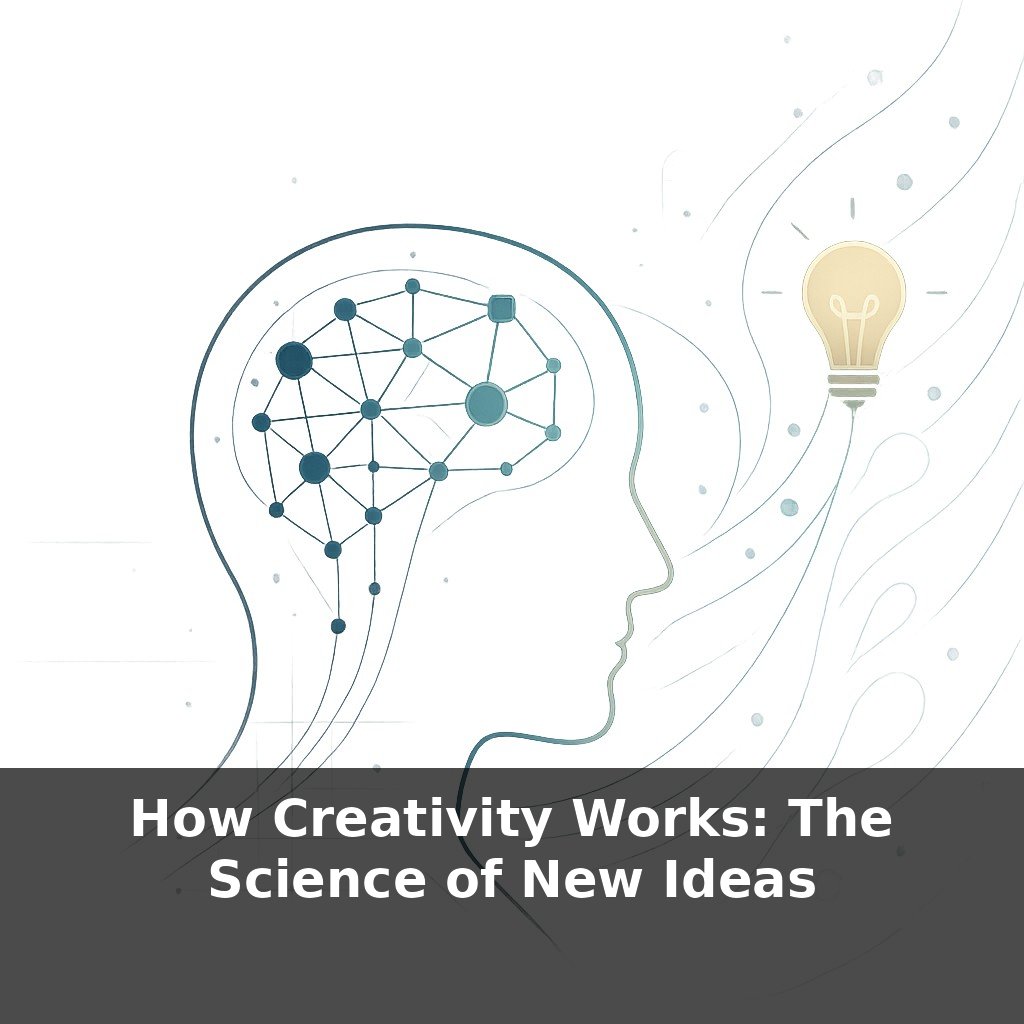
Deadlines, metrics, and inbox pings quietly teach your brain one lesson: only “useful” output counts. Over time, that training shrinks the space where wild, useless-seeming ideas can roam. Yet those are often the sparks that later become the pitch, product, or project everyone calls “brilliant” in hindsight. Neuroscientists see this in the lab: when people enter a playful state, the networks for wandering and the networks for focused control light up together, like two apps finally running in split-screen instead of fighting for the same screen. The result isn’t chaos—it’s flexible seriousness. You can still care deeply about outcomes, but the route there stops feeling like a tightrope and starts feeling more like an open field you’re allowed to explore, trip, and veer off in odd directions without immediately self-censoring. In that space, originality stops being a miracle and becomes…normal.
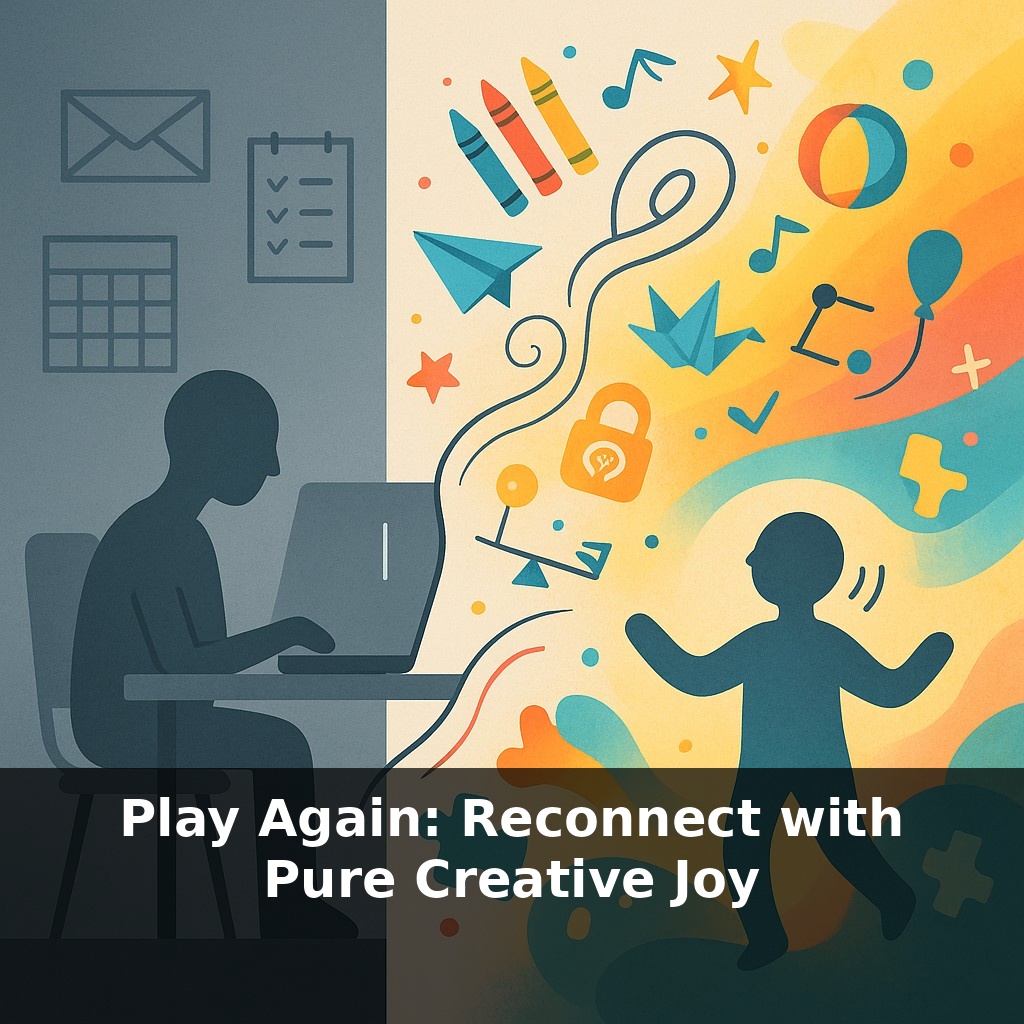
So why did easy, curious making get pushed to the margins of your day? Partly because modern work sneaks in quiet rules: if it can’t be measured, monetized, or posted, it doesn’t “count.” Meetings need agendas, hobbies need side-hustle potential, even rest is optimized with trackers and streaks. That mindset trains you to treat experiments like risks instead of resources. Yet the research on improvisation games, low-stakes prototyping, and “serious play” shows something different: when there’s room to mess around, your options multiply, your stress markers drop, and fresh angles start showing up in places that used to feel stuck.
A strangely consistent pattern shows up across very different places: when people are invited to “mess around” with low stakes, breakthrough ideas quietly spike. Nokia teams with plastic bricks, Pixar directors with silly riffs, improv groups with nonsense prompts—different surfaces, same underlying move: loosen control just enough that your mind can surprise itself.
You can see this even in how kids draw versus how adults brainstorm. A child given crayons doesn’t start by asking, “What’s the objective?” They test colors, stack lines, scribble over what came before. The page is a playground, not a performance review. By the time most people enter professional life, that instinct has been replaced by an internal editor that wants every mark to justify its existence. The result isn’t higher quality; it’s fewer attempts.
Play-based practices work because they temporarily quiet that editor without turning your brain off. Improvisation games force you to respond faster than your doubt can load. LEGO-style prototyping gets your hands moving before your “this is dumb” filter kicks in. Story riffing in a room like Pixar’s Braintrust normalizes half-baked ideas so thoroughly that polishing too early feels out of place.
Notice how concrete and physical many of these methods are. When you’re holding a brick, acting out a scene, or doodling alternative interfaces, abstraction has to pass through your body. That extra step exposes hidden assumptions: a “simple” app flow suddenly looks like a maze when you sketch every tap; a “straightforward” process turns into a comedy routine when colleagues act it out and keep bumping into absurd rules.
There’s also a time component. Burst-play—short, intense, bounded—often beats vague, open-ended “be creative” blocks. A 10‑minute constraint game can surface more unusual angles than an unstructured afternoon, precisely because you’re less invested in being right. When the frame is “let’s see how many wrong answers we can find,” people take bolder swings.
In that sense, playful practices are not the opposite of ambition; they’re a way to protect ambition from becoming so rigid that it strangles the very experiments it needs.
Open a brainstorm like a mischievous cooking show, not a board meeting. Set a 7‑minute timer and challenge yourself (or your team) to “ruin the recipe on purpose”: for whatever you’re working on, list the most delightfully wrong features you can—an app that only works upside down, a report written entirely as stage directions, a meeting you can only attend while walking. You’re not trying to keep any of these; you’re seasoning the session with absurdity so your usual flavors loosen up.
Teams at companies like IDEO run “bad ideas only” rounds for exactly this reason—once the ceiling of seriousness cracks, useful weirdness sneaks in. You can remix this solo: narrate your task out loud in the style of a sports commentator, sketch your next presentation as a comic strip, or redesign your calendar as if it were a video game level with secret shortcuts and power‑ups. Notice which twists make you smirk; those are often the doors to options you hadn’t realized were available.
In the next decade, treating playful effort as “extra” will quietly cap your earning power and impact. As tools like AI handle more routine output, your edge will look more like a lab than a factory: whitespace on your calendar, odd mash‑ups of fields, small experiments no one asked for. Think of your week like a personal R&D budget: which hour can you “spend” on a ridiculous variant of your current project just to see what breaks—and what unexpectedly works?
Treat this like updating firmware, not redecorating the screen: you’re installing a bias toward curiosity. The next time you catch yourself reaching for the “right” answer, pause and ask, “What would be fun to try first?” That tiny redirect turns experiments into a default setting—and over time, your best work starts arriving from the “optional” detours.
Start with this tiny habit: When you close your laptop for the day, whisper to yourself, “Play again,” and spend exactly 60 seconds doing something “pointless” that delights you—like doodling a tiny dragon in the margin of an old envelope, humming a made‑up theme song for your pet, or building a three‑piece Lego sculpture. Don’t aim to finish anything or make it good; the only rule is that it can’t be productive or for anyone else. If 60 seconds feels easy, you can stop anyway and just notice how your body feels when you give yourself permission to play.