About half of what you do today will be automatic—and that includes how you create. One writer stares at a blank screen for hours; another sits down after the same simple coffee-and-notebook ritual and finishes a draft. Same talent, different system. Which one are you training?
So how do you move from “hoping you’re in the mood” to reliably doing the work? You design for it—on purpose, in advance. Look at people who ship consistently: Maya Angelou rented a bare hotel room she went to every morning to write. Toni Morrison wrote before her kids woke up. Haruki Murakami keeps the same wake time, run, and work block day after day. Different lives, same pattern: specific cues, clear start, repeated often.
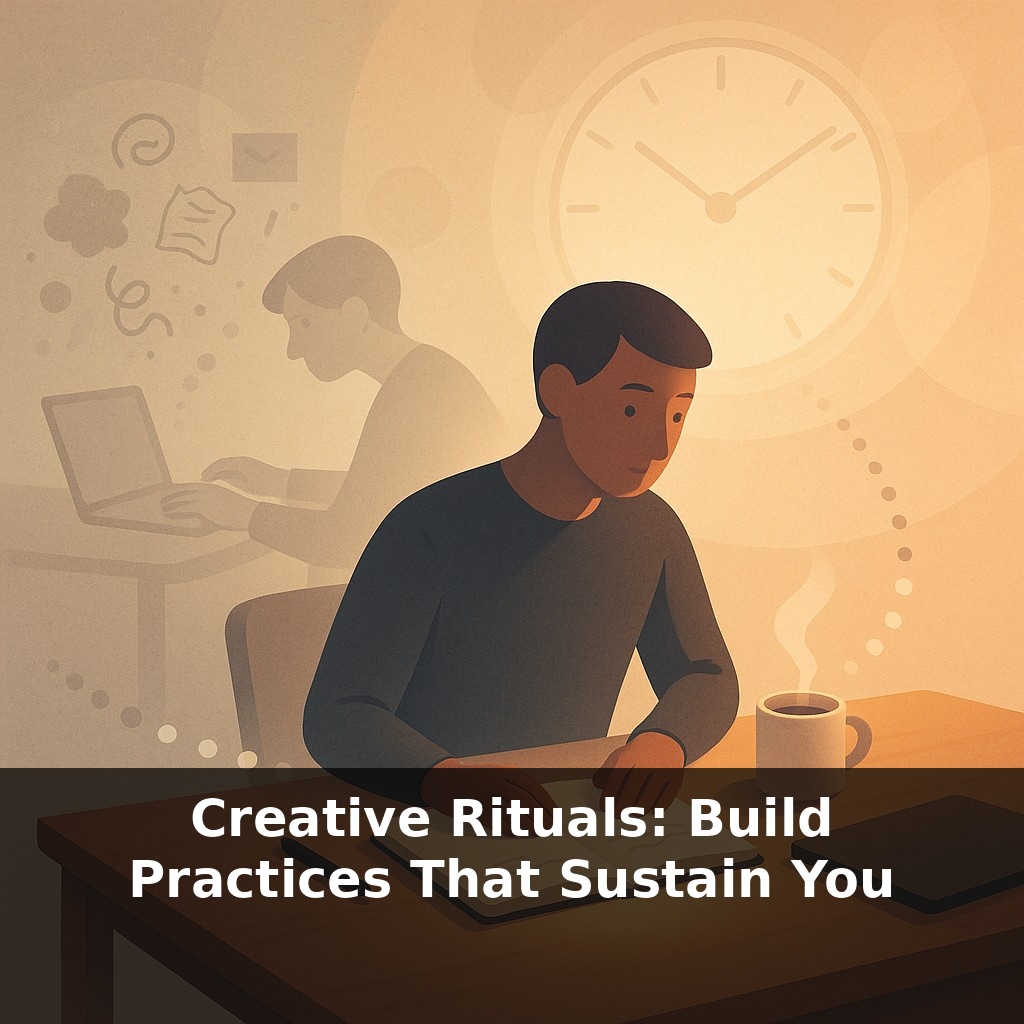
Rituals don’t need to be long or mystical. A 3‑minute sequence done at the same time and place can be enough: close the door, silence your phone, open one project document, set a 25‑minute timer. Done. Over a month, that’s 750 focused minutes—more than 12 hours—created from a tiny, repeatable script. The point isn’t perfection; it’s making starting so easy and so consistent that “whether you feel like it” gradually stops mattering.
Here’s the part most people miss: your brain doesn’t care *what* you create, it cares *when and how often* you start. In that 2006 Duke study, roughly 40% of daily actions ran on autopilot; if even 1 of those is a creative trigger, you’ve suddenly bought yourself hundreds of extra “on‑ramps” a year. The research on habit formation shows a wide range—18 to 254 days—so your job isn’t to be perfect, it’s to be predictable. One small, repeatable setup at the same time each weekday can turn into 250+ creative sessions a year, even if each is only 20–30 focused minutes.
Rituals work because they quietly rewire *where* decisions get made in your brain. Instead of forcing your prefrontal cortex to argue with itself each day—“Should I write now? Scroll? Tidy?”—you outsource the sequence to the basal ganglia. Once a ritual is installed, “start creating” becomes as frictionless as “brush teeth” or “check messages,” but with a far higher return.
Notice how the most prolific creators design not just *a* ritual, but one that matches their constraints. Twyla Tharp doesn’t rely on willpower at 5:30 AM; she relies on a script: call the cab, go to the gym, move. That cab ride is more than transportation—it’s a reliable tunnel between “messy life” and “focused work.” Her result: over 160 choreographed works across decades, not because every day was inspired, but because nearly every day *began the same way*.
Teams do this too. Pixar’s “dailies” aren’t just a meeting; they’re a shared ritual that locks in a rhythm: show unfinished work every morning, give and receive feedback, iterate. For roughly twenty years, that daily loop coincided with a run of 15 consecutive box‑office hits. We can’t say the ritual *caused* the streak, but we can say it supported a culture where consistent feedback, not heroic last‑minute rescue, drove quality.
The useful question isn’t “What’s the perfect ritual?” but “What’s the smallest stable loop that moves me from *not working* to *working*?” You’re looking for three parts:
1. **A fixed cue** you can control: a time (7:10–7:40), a place (the same chair), or a preceding action (after I make tea). 2. **A visible setup** that makes the next step obvious: one open document, one instrument out, one sketchpad on the desk. 3. **A minimum commitment** so small it’s hard to refuse: 10 minutes, 150 words, 1 thumbnail sketch, 8 bars of music.
Treat this like building a tiny piece of software for your day. Once installed and debugged, it runs quietly in the background, but the output—completed drafts, sketches, prototypes—compounds in very loud ways over weeks and months.
Twyla Tharp’s 5:30 AM cab ride works because it’s specific and countable. You can borrow that precision without copying her schedule. For example, a designer might use a 12‑minute “boot sequence”: at 8:18 sharp, put on the same playlist, open yesterday’s file, create *exactly three* rough variations before touching email. Do that 4 weekdays in a row and you’ve generated 12 options; keep it up for a month and you’ve explored around 60—plenty of raw material without needing a “big idea” first.
Here’s another pattern: a developer sets a 9:00–9:25 “bug warm‑up.” First 5 minutes: list issues. Next 10: fix one tiny bug. Final 10: sketch one experiment or feature. In 5 days, that’s 5 fixes and 5 experiments; over 10 weeks, you’re at 50 and 50.
Think like a product manager for your own attention. Define a lightweight, 10–20 minute block with 2–3 clear moves. Track it for 14 days. If you complete the sequence at least 9 times, keep it; if not, shrink one step until it’s almost impossible to skip.
As AI absorbs more routine tasks, the value of repeatable originality rises. Teams that treat rituals as infrastructure, not quirks, can ship more experiments: 1 small daily session = ~250 creative blocks per year. At scale, a 50‑person org gains 12,500 focused blocks—without adding headcount. Expect tools that auto‑detect your highest‑yield 30‑minute window from calendar, biometrics, and output data, then nudge you to defend it like a standing meeting with your future self.
Treat this like a 30‑day build, not a one‑day fix. Pick one 10–20 minute loop, run it 5 days this week, 6 next, 7 after. By day 30, you’ll have logged ~6 hours of focused reps—enough to finish a draft, a small prototype, or 10–15 sketches. Then review: which step felt heavy? Trim it 20% and lock in the version you can keep for the next 90 days.
Before next week, ask yourself: 1) “If I carved out a 20‑minute ‘creative warm‑up’ ritual at the same time every day, what exact sequence would I follow—lighting a candle, putting on a specific playlist, opening the same document or sketchbook—and what needs to change in my morning or evening routine to protect that time?” 2) “When I notice myself reaching for my phone, email, or chores to avoid the discomfort of starting, what tiny sensory cue could I use instead (a certain mug of tea, a particular chair, a five‑breath pause) to gently guide me back into my creative space?” 3) “Looking at my week ahead, which one existing habit (like morning coffee, post‑work walk, or bedtime reading) could I ‘anchor’ my creative ritual to so that creativity isn’t a special event, but something my day naturally leads me into?”