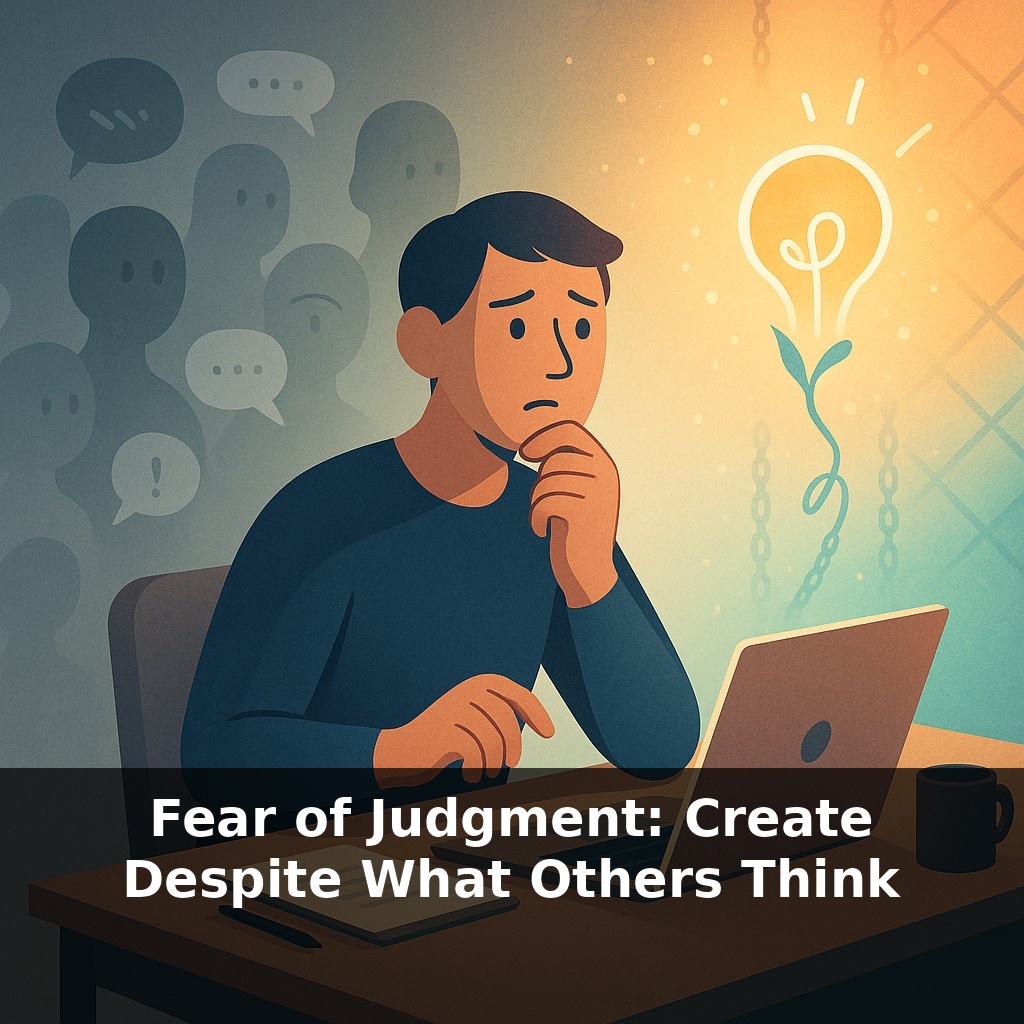
About half of people say they’ve abandoned a creative idea because they worried what others would think. You’re at your desk, that idea tugging at you… and then a single imagined comment from a friend is enough to make you quietly close the tab and move on.
Social disapproval doesn’t just sting your feelings—it measurably shrinks your creativity. In controlled experiments, when people know they’re being evaluated, their creative performance can drop by up to 50%. That’s not about “thin skin”; it’s your nervous system quietly slamming on the brakes.
But there’s a flip side.
In a Stanford study, one simple mental shift—treating criticism as “data” instead of “judgment”—led participants to generate 30% more ideas and stay engaged longer with hard problems. Same brains, same tasks, different relationship to feedback.
History backs this up. Monet was rejected by the official Paris Salon multiple times before Impressionism redefined painting. Early hip‑hop artists were mocked on mainstream radio before it became a multi‑billion‑dollar industry.
The pattern is consistent: those who learn to create *through* judgment, not away from it, change the game.
Here’s the part most people miss: your brain updates based on *exposure*, not intention. If you avoid sharing your work 100 times in a row, you’ve trained a habit loop that says, “Silence is safety.” Break it, and the loop starts to rewire.
We see this in the real world. On Kickstarter, over 70% of successful campaigns included a vulnerable backstory—doubt, mistakes, false starts—yet still raised funds. Not because they were flawless, but because they were specific, human, and out in the open.
Your task now isn’t to feel fearless. It’s to ship small, honest pieces of work often enough that fear stops being the decision‑maker.
Here’s the leverage point most people miss: the bottleneck isn’t your talent, it’s your *tolerance* for being seen while imperfect.
Psychologists call this “evaluation apprehension,” and it shows up in tiny, measurable ways. In lab studies, participants who thought anonymous strangers would rate their ideas used about 40% fewer unusual solutions than those told no one would see their work. Same time, same task—just more self‑censorship.
So how do you stop that internal editor from running the whole show?
You don’t argue with it. You *outnumber* it with new experiences.
Think in terms of reps and intensity, like a training plan:
- **Exposure reps**: How often you let your work be seen - **Exposure load**: How much you feel is at stake each time
Most people do the opposite of what works: they share rarely (low reps) but only when it “really counts” (high load), like a portfolio launch or big presentation. That’s the perfect recipe for paralysis.
Instead, flip it: **high reps, low load**.
Concrete example: - Week 1: Post one rough, 10‑minute sketch or idea to a group of 5–10 trusted people, 3 times. - Week 2: Share 3 more pieces in a slightly larger space—maybe a small online community of ~100 members. - Week 3: Publish 3 small public pieces (a thread, a draft beat, a design mockup) to an audience under 500.
That’s 9 “seen‑while‑imperfect” reps in 21 days. Not hypothetical—creators who run similar sequences often report that by rep 8–10, their physical anxiety (heart rate, sweating) drops by roughly one‑third, even when the stakes inch up.
The key is that each rep has *clear constraints*: a time box (e.g., 20 minutes), a size limit (e.g., 150 words, 8 bars, one screen of UI), and a deadline (today, not “when it’s ready”). Constraints keep your brain from spiraling into “if I’m going to show this, it has to be my best thing ever.”
Layer in **feedback filters** so responses help rather than hurt. Instead of “What do you think?”, ask for one specific type of input: - “Name one part that’s unclear.” - “What’s one thing you’d like to see more of?” - “On a scale from 1–10, how curious does this make you?”
Those prompts turn vague approval or rejection into something you can actually use. Over 5–10 cycles, you’re not aiming to *like* being judged; you’re aiming to stay in motion *while* it happens.
A practical way to see this in action is to look at how different creators structure their “being-seen” reps. A designer I worked with committed to a 30‑day micro‑share streak: every weekday, she posted one unfinished component (a button state, a color test, a layout variant) to a Slack channel of 18 coworkers. Each post took 12–15 minutes. By day 10, she’d logged 10 tiny exposures and collected 47 concrete comments. By day 30, she’d shipped 22 small artifacts, and her manager had 3 clear examples to advocate for her promotion.
Or take a songwriter who started a weekly “30‑second draft” newsletter. He sent 1 short audio clip every Sunday to 37 subscribers, then 68, then 121. After 12 weeks, he had 12 public drafts, 96 minutes of total composing time, and a list of 19 people who replied at least twice—instant candidates for a focused feedback group.
Think of this like versioning in software: v0.1, v0.2, v0.3. No one expects v0.1 to be perfect; its job is simply to exist, so v0.2 has something concrete to improve.
As tools and platforms scale, so does the *speed* at which your work can reshape your trajectory. One scrappy demo in a niche Discord can lead to 3 collaboration offers in a week. A rough newsletter sent to 42 people can surface 5 true fans who share it to 500 more. Over a year, shipping 2 small public artifacts per week gives you 100+ test points—far more useful than 3 “perfect” launches. The creators who win aren’t the most polished; they’re the ones who iterate in public often enough to adjust in real time.
Your next level isn’t braver feelings, it’s braver math. Decide a *shipping quota*: for the next 30 days, release 12 small artifacts—3 posts, 3 drafts to friends, 3 in a community, 3 fully public. Track: pieces shared, responses received, and actions taken from them. In a month, you’ll have evidence, not theories, about what actually resonates.
To go deeper, here are 3 next steps: 1) Watch Brené Brown’s TED Talk “The Power of Vulnerability” and, while you watch, keep your Instagram/TikTok drafts folder open so you can immediately turn one idea into a 30-second “imperfect” post you actually publish today. 2) Grab the book *The Courage to Be Disliked* by Ichiro Kishimi & Fumitake Koga and read just the first chapter, then use the free app “Freedom” or “Forest” to block social apps for 30–60 minutes so you can create without checking who might be judging you. 3) Install the “Day One” or “Notion” app and set up a private “Fear of Judgment Lab” page where, every time you feel scared to post, you paste the exact comment/post you’re afraid people will see and then write one sentence reframing it using ideas from the podcast (e.g., “I’m creating for my future self and my people, not for critics”).