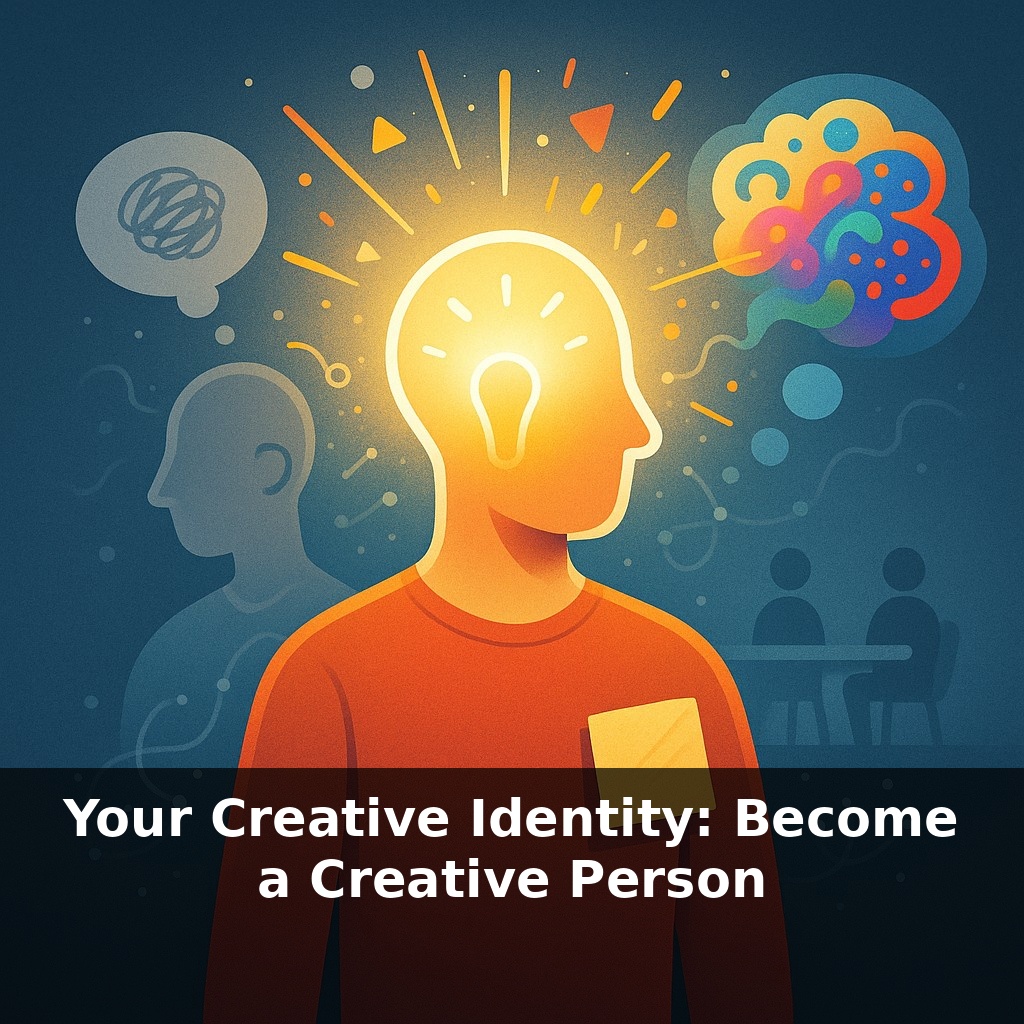
“Creativity isn’t who you are, it’s what you practice,” a neuroscientist told me once. Now jump to a meeting where two people pitch the same idea—one begins, “I’m not really creative, but…” The other starts, “Here’s a wild angle.” Same brainpower. Totally different futures.
A 2012 study found that people scored higher on idea-generation tasks *just* after briefly writing, “I am a creative person.” No training. No extra time. Just a different story about who they were.
That’s the quiet power of identity: it doesn’t shout, it steers.
Identity shows up in tiny phrases: - “I’m the kind of person who notices patterns.” - “I experiment when I’m stuck.” - “I turn problems into projects.”
Those aren’t affirmations for your mirror; they’re mental settings that change what you notice, what you attempt, and what you tolerate feeling awkward about.
In this episode, we’re not chasing inspiration—we’re editing your self-description. You’ll see why “I’m not the creative type” is less a confession and more a habit of speech you inherited, and how small identity tweaks can ripple into daily choices, opportunities you spot, and risks you’re suddenly willing to take.
Social-psychology adds another twist: your self-description doesn’t just follow your behavior—it *predicts* it. When people quietly start seeing themselves as “the kind of person who tries odd approaches,” they don’t just *feel* different; they actually explore more options under pressure and recover faster from failures. Companies know this, which is why internal programs now explicitly invite employees to adopt creative roles, not just creative tasks. The title on the org chart might say “analyst,” but the unofficial role of “in-house experimenter” often belongs to whoever starts acting—and talking—like that’s who they are.
Most people think you earn the right to call yourself creative *after* you’ve produced something impressive. Research suggests it often runs the other way: adopting the label first changes how much raw material you eventually produce.
That’s because calling yourself “creative” quietly rewrites your default responses in ordinary situations. You reach for a second option instead of settling for the first. You stay with a weird idea 30 seconds longer. You’re slightly more willing to look foolish in front of other people. None of these moments feel dramatic, but across a week of decisions they add up to a noticeably different life.
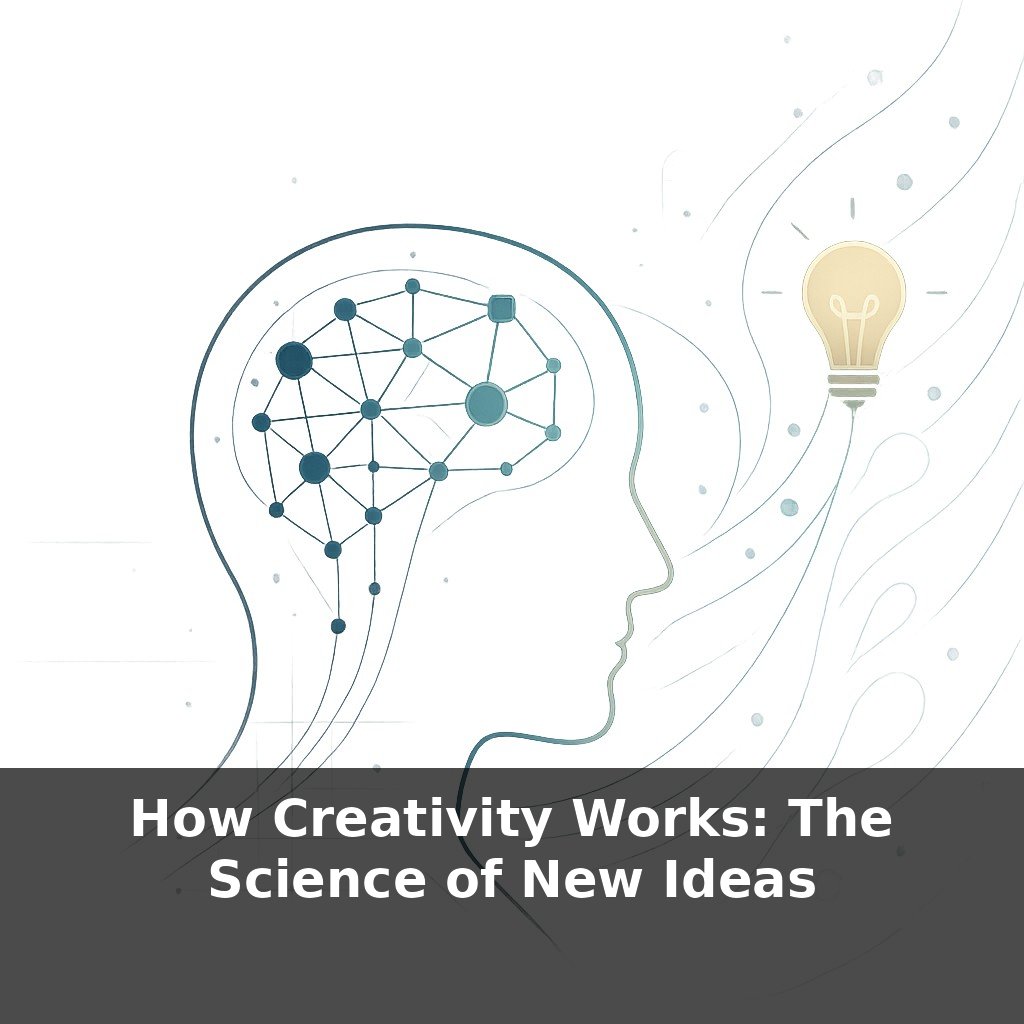
Neuroscience adds a physical layer to this story. When you treat unusual approaches as “something I do,” your brain recruits coordination between regions that don’t normally “talk” as much—those involved in mind-wandering, focused control, and relevance detection. Over time, this repeated co-activation is like building a faster side road between neighborhoods in a city: signals move more easily, and switching between modes (serious vs. playful, critical vs. generative) becomes less clunky. You’re not growing a “creativity center”; you’re improving traffic flow.
The sneaky obstacle is the quiet, inherited script: “I’m just practical,” “I execute other people’s visions,” “I need instructions.” Those phrases are not neutral. Under time pressure, they nudge you to choose safety over exploration, to defer instead of propose, to wait for assignments instead of reframing problems.
People who break this pattern rarely start with grand declarations. They start by upgrading their job in their own mind. A software tester decides, “I’m a pattern hunter,” and begins logging odd user behaviors, which later become product ideas. A nurse starts thinking of herself as a “micro-innovator” and experiments with tiny changes to handoff routines, cutting errors on her ward. Their official titles don’t change, but their daily questions do: from “What should I do?” to “What could I try?”
One helpful lens: treat every recurring frustration as a design brief addressed specifically to you. The commute that wastes your energy, the report everyone avoids reading, the family chore that always causes friction—each is an opportunity to act in line with a creative self-story, without waiting for anyone’s permission.
A practical way to see this in action is to zoom all the way down to tiny, ordinary moves. Think of a project manager who quietly starts adding one “wild card” option to every plan she writes: a version that bends a rule, borrows from another industry, or uses a tool the team has never tried. No one gave her that assignment; she just began behaving like someone who’s allowed to propose odd angles. Six months later, that “extra” column becomes the one executives scan first when they’re stuck.
Or take a junior accountant who treats monthly reports like prototypes. Each cycle, he experiments with a different visual: a timeline, a traffic-light summary, a one-page “story” of the numbers. Co‑workers start forwarding his version around, and eventually he’s asked to redesign the entire reporting format.
Adopting this stance is like switching your phone into developer mode: the hardware doesn’t change, but new menus appear, and you start poking into settings you used to ignore. Everyday tasks turn into low‑risk test beds rather than fixed routines.
As more people claim a creative identity, whole systems start to bend. Teams stop waiting for “the ideas person” and treat meetings more like potlucks than lectures—everyone brings a small, experimental dish. Schools might assess students on how many thoughtful variations they try, not just final answers. Workplaces could reward “most improved experimenter,” not only star performers. The risk: without boundaries, constant originality-chasing can feel like permanent improvisation with no sheet music.
The real shift happens when you let small choices snowball: you take the scenic route in a conversation, ask the odd question in a meeting, season a routine task with one unexpected ingredient. Over time, those “why not?” moments stack up like compound interest, quietly reshaping what feels normal until exploring options is your default move.
To go deeper, here are 3 next steps:
1. Block 25 minutes today to do a “creative sprint” using the free web app [Focusmate] or a Pomodoro timer, and dedicate it specifically to one tiny creative move (e.g., drafting 3 logo concepts, outlining a short story, or recording a 2-minute voice note for a song idea) that aligns with the creative identity you want to grow into. 2. Pick up **“The War of Art” by Steven Pressfield** and read just Book One (about Resistance) tonight, then use a highlighter to mark every line that sounds like it’s describing the exact excuses you use to avoid your creative work. 3. Join one online community that treats creativity as an identity, not a hobby—such as **r/creativity**, **r/makingmusic**, or a Discord for your specific craft—and post a short “I’m claiming my identity as a ___” intro plus one concrete creative goal you’ll tackle this week.