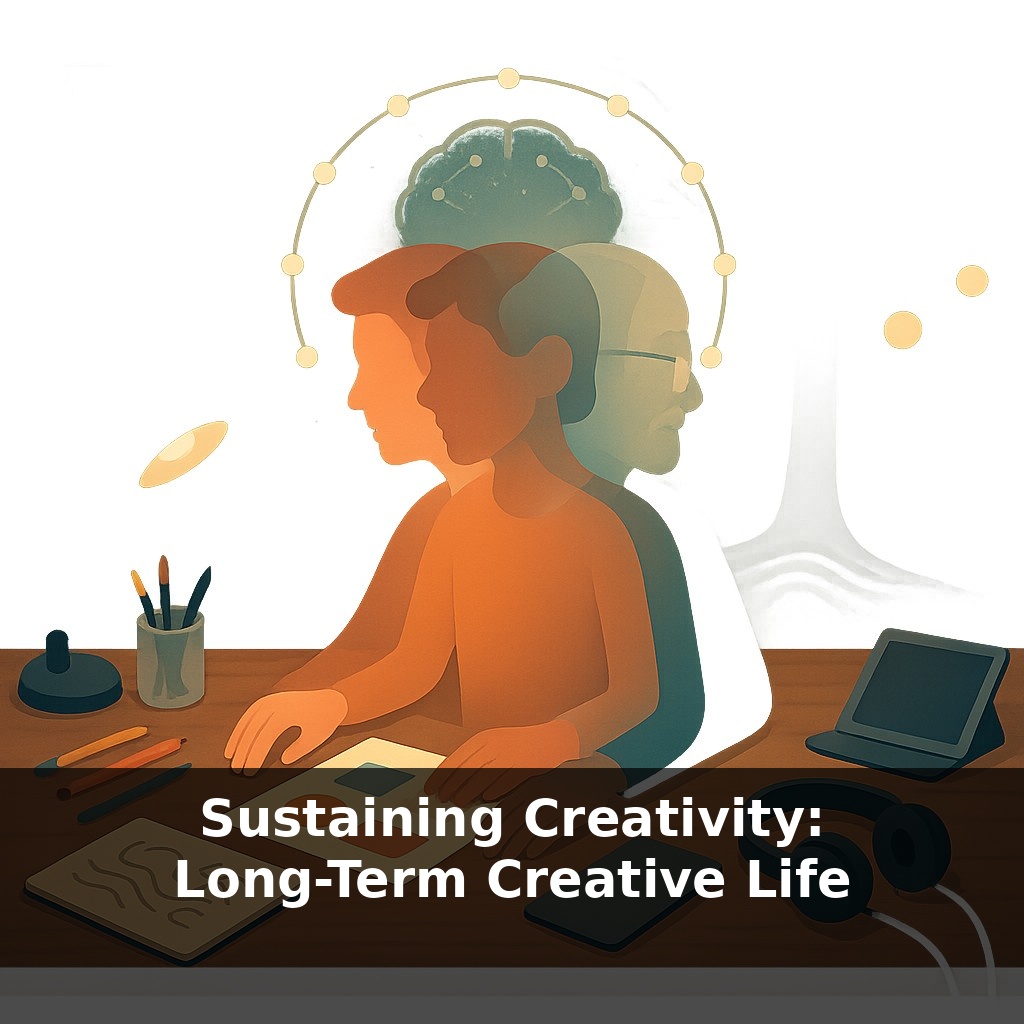
A national arts study found older adults who did one creative activity a week saw their thinking decline dramatically more slowly. So here’s the twist: your creative peak might not be in your twenties at all. It might be decades from now—if you learn how to protect it today.
Here’s the plot twist most people miss: sustaining creativity isn’t about “staying inspired”—it’s about designing a life that quietly keeps refueling you in the background. Think less lightning bolt, more smart lighting system that turns on when and where you need it.
Across long creative careers, you see the same patterns repeat: people who alternate intense sprints with deliberate recovery; who rotate projects like crop fields so the soil never gets stripped; who treat their bodies less like delivery trucks and more like the whole studio infrastructure.
Neuroscience backs this up: the networks that generate ideas are also the ones that reorganize with sleep, movement, and novelty. Organizational research says something similar at the team level: cultures that last don’t squeeze harder—they build trust, slack, and room for experiments that can fail without wrecking anyone’s future.
Here’s the catch: long-term creative lives rarely collapse from “no ideas left”—they erode from tiny, unexamined tradeoffs. You stay up a bit later, skip exercise “just this week,” say yes to one more project, and slowly build a life where your best thinking has nowhere to land. The research on healthy aging and high-performing teams points to the same quiet lever: how you manage constraints over time. Not just deadlines, but energy, attention, and emotional bandwidth. The goal isn’t to avoid limits, but to shape them so they protect your curiosity instead of grinding it down.
Long-term creative lives tend to rest on three quiet pillars: how you manage your body, your attention, and your relationships. Not glamorous, but they’re the levers that keep your ideas from drying up or burning out.
First, body. The data on movement and brain health is blunt: regular aerobic exercise doesn’t just help you live longer; it keeps the parts of your brain that juggle options and make remote connections structurally healthier. Over years, that compounds into a very real gap between “still sharp and experimenting” and “coasting on old tricks.” Sleep works the same way: chronic short nights slowly tax the systems that help you notice patterns and detach from stale solutions. You may still “function,” but your ceiling for originality sinks.
Second, attention. Creative people often hoard projects and say yes too quickly, then wonder why everything feels flat. What actually scales is rhythm, not volume. Alternating between divergent and convergent days, deep work and admin days, even “input” and “output” weeks gives your mind time to reconfigure. Neuroscientists sometimes talk about brain networks as if they were dynamic teams; if you never stop assigning them tasks, they never get to reorganize the roster.
Third, relationships and context. The most enduringly creative organizations—Pixar, 3M, research labs—design structures that keep ideas bumping into each other without constant ego defense. Psychological safety isn’t “be nice”; it’s the norm that you can expose half-formed thoughts, question assumptions, and change your mind without it counting as a personal failure. People stay more playful, and play is where unexpected combinations arise.
On a personal level, that means regularly upgrading your “creative environment contract”: what time and space you protect, what kinds of people you invite into your orbit, which feedback you treat as signal versus noise. It also means deliberately layering in experiences outside your default domain—different disciplines, generations, and cultures—so your mind has more raw material to remix, especially later in life when pattern recognition becomes a superpower.
Sustaining creativity, in other words, is less about chasing inspiration than curating conditions: a body that can show up, attention that can focus and roam, and relationships that make it safe to keep taking intellectual risks for decades.
A useful way to test these ideas is to zoom in on how different people structure an ordinary week. A novelist in her sixties might set a rule: three mornings for drafting, two for “cross-training” her mind—one spent in a life-drawing class, another volunteering at a science museum. None of those sessions are about the book, yet details sneak back into it: the way a teenager explains black holes becomes a line of dialogue; the posture of a model suggests a scene’s mood.
Or take a small design studio that sets aside one afternoon a month as a “cross-pollination lab.” An accountant can pitch an app idea; an intern can critique the website; the lead designer has to prototype something outside their specialty, like packaging or sound. No one is graded, but they capture the most intriguing oddities and pin them to a shared digital board. Over years, that messy archive turns into a quiet engine for fresh directions when client work feels stale.
Governments and companies are quietly redesigning for lifelong originality. Expect mid-career “creative pit stops” to become as normal as parental leave, with employers rotating people through labs, arts residencies, or cross-country teams. AI tools will behave less like vending machines and more like sharp collaborators, poking holes in your defaults. Think calendars that flag when your weeks all look the same—and nudge you to add “weirdness deposits” to your routine.
Long-term creativity isn’t a single masterpiece; it’s more like compounding interest in a savings account, built from tiny, steady deposits of attention, health, and honest collaboration. Your future self is an unknown collaborator watching what you do with today. Leave them a rich archive of experiments, friendships, and half-finished ideas they’ll be excited to inherit.
Start with this tiny habit: When you close your laptop or put your phone down at the end of the day, say out loud one tiny creative thing you did (or wanted to do) and add, “and I’ll show up again tomorrow.” Then, before you walk away, set a 2-minute timer and do the smallest version of your practice: doodle one box in your sketchbook, play two chords on your guitar, or rewrite a single sentence in your draft. When the timer goes off, you’re allowed to stop—even if you feel like you could do more.