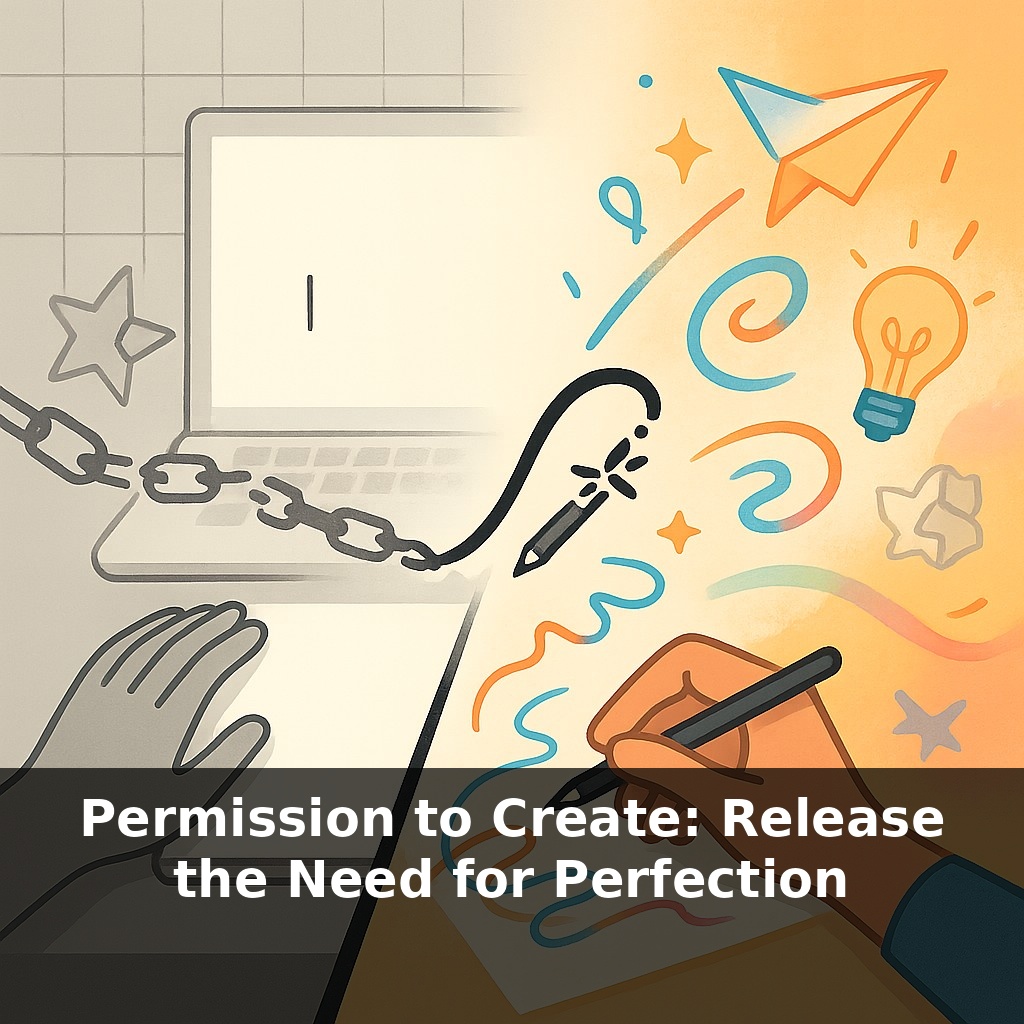
About a third of people walk around with perfectionism turned up so high it quietly kills their best ideas. You’re at your desk, cursor blinking, heart racing. The idea is there—but your brain whispers, “Not good enough.” In this episode, we’re going to dismantle that voice.
That inner pressure doesn’t just slow you down—it quietly rewires how you create. Studies show that when you treat every idea like a test you have to ace, your brain shifts into threat mode: you generate fewer ideas, take fewer risks, and abandon projects earlier. In one meta-analysis, researchers found a strong link between rigid standards and higher anxiety, which directly narrows creative thinking. On the flip side, teams that normalize “messy first drafts” ship more and learn faster. Pixar, for instance, expects to rewrite storyboards 10–12 times. They don’t see that as failure; it’s the process. In software, Agile teams embrace short cycles and imperfect releases—and still get products out about 28% faster. You don’t need to work at Pixar or in tech to borrow this. You only need one shift: trade the goal of “getting it right” for “getting it moving.”
So what does “getting it moving” look like in real life? In one study of over 2,000 adults, people who set “good-enough” goals finished about 40% more personal projects in a year than those chasing flawless outcomes. Another experiment found that participants asked to produce 20 bad logo ideas in 10 minutes ended up with 3× more usable concepts than those told to design one perfect logo. Across domains, output climbs when you lower the bar for version one. This isn’t about laziness; it’s about switching your metric from “Is this impressive?” to “Did I advance it by one visible step today?”
Here’s the paradox: the more you try to protect your work from criticism, the less work you actually produce—yet your fear of criticism gets stronger. To break that loop, you need three practical shifts: how you define success, how you relate to mistakes, and how you structure your creative time.
First, redefine “success” at the level of a single session. Instead of “write something impressive,” try “produce 300 words, even if 250 are trash.” In one small study of student writers, those given output targets (e.g., word counts) generated about 45% more usable material than peers told simply to “do your best.” The quality didn’t come from trying harder; it came from having more raw material to refine.
Second, treat mistakes as data you are obligated to collect. A design team I worked with ran 5 micro-tests per week on rough concepts. About 60–70% of those tests “failed”—but within two months they had 4 strong directions validated by real users. Contrast that with the single “perfect” concept that had previously taken them 6 weeks and then flopped in one big launch. Many creative professionals quietly follow a 10:1 ratio: for every polished piece you see, there are 10 drafts, variations, or abandoned attempts behind it.
Third, structure your time so perfectionism physically can’t get a grip. Use short, timed sprints—say, 15–25 minutes—where the only rule is visible output: 5 thumbnail sketches, 3 melody ideas, 1 prototype screen. When researchers asked participants to generate ideas under tight time boxes, they produced up to 2.5× more options without a drop in average quality. The constraint forces your brain to prioritize finishing over fixing.
Here’s the key: you’re not lowering your standards, you’re relocating them. Hold high standards for the *final* version, not for version one. You separate two phases: a production phase where the bar is “done exists,” and an editing phase where the bar can be as high as you like. When you mix those phases, you stall. When you separate them, momentum does the heavy lifting.
Think of a single project you’ve been delaying because it’s “not ready.” Now put numbers on it. If you’re drafting a song, set a target of 5 rough chorus ideas in 25 minutes. If you’re designing, commit to 12 thumbnail sketches in one sitting. Most professionals quietly work at these volumes: a novelist might generate 80,000–100,000 words to end up with a 60,000-word book; photographers can shoot 300–500 frames to select 10 final images.
A concrete example: one YouTuber I coached went from publishing 1 video every 6 weeks to recording 3 quick, low-stakes drafts for each idea. Within 3 months, her upload rate doubled and her average views per video rose by about 40%, not because each draft was brilliant, but because every draft taught her something specific to fix next time.
Here’s your challenge this week: pick one stuck idea and give it a “quantity quota”—a specific count of versions, sketches, or takes. Don’t stop when one attempt feels bad; stop when you’ve hit your number. Only then are you allowed to judge.
As tools accelerate, your value shifts from flawless output to how quickly you can test and refine ideas. Teams that ship small experiments weekly can outlearn slower rivals by 50–100 tests per year. Schools piloting “failure credits” (e.g., 3 low-stakes do-overs per project) report ~20% higher project completion. Your edge: track your “iteration velocity”—how many distinct versions you create per month—and aim to increase it by 25% over the next quarter.
Track output, not worth. Over the next 30 days, log how many *things* you ship: 10 sketches, 4 audio drafts, 3 slide decks, even if only 2 feel solid. Then review: which “bad” version taught you the most? Keep a visible counter near your desk. When the urge to polish shows up, ask, “Will this get me closer to 50 completed attempts this month?”
Start with this tiny habit: When you open your notebook, sketchbook, or notes app, add **one deliberately “bad” line** on the page (a wobbly circle, a messy sentence, a clashing color—anything obviously imperfect) before you do anything else. This is your permission slip: you’ve already “ruined” the page, so the pressure’s off. Then, if you feel like it, add just **one** more mark—another line, a word, or a color—nothing more required. Over time, this trains your brain to associate creating with play and release, not perfection.