The Origins of Viking Myths
📝 Transcript
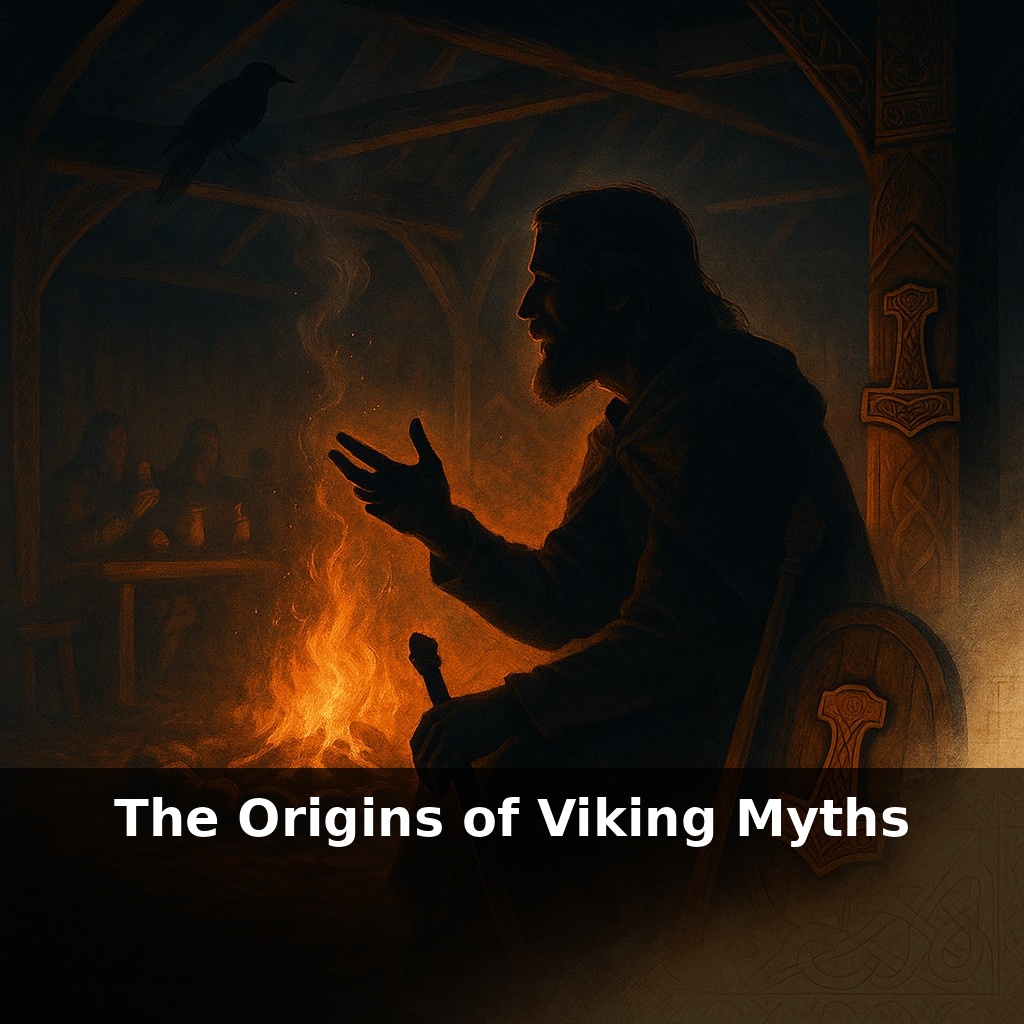
Viking myths were first written down in a country that didn’t even exist during the Viking Age. Now, step into a smoky hall: a storyteller’s voice rises over clinking cups, weaving tales of Odin and Thor—stories no one thinks to write, because the gods are still listening.
Most of what we “know” about Viking beliefs comes from sources that feel more like glitchy backups than pristine originals. The parchment that holds the Poetic Edda is one manuscript, copied by a single hand, centuries after the beliefs it describes had already started to fade. Our picture depends on what that scribe chose to include, skip, or simply mishear from his own teachers. Around those pages, archaeologists read clues from objects that were never meant as textbooks: a hammer pendant tucked into a grave, a ship buried as carefully as a king, a picture stone that looks, at first glance, like abstract art. Each artifact is less like a chapter and more like a blurry screenshot—partial, cropped, and out of context—yet together they let us reconstruct a living world of ritual, fear, humor, and hope that once felt too obvious to anyone there to bother writing down.
Those beliefs didn’t float in a vacuum. They were tied to real landscapes and shifting power. When a farmer in Denmark carved a runestone, or a chieftain in Norway ordered a ship burial, they were making choices about which stories and symbols mattered enough to freeze in wood or stone. Place-names quietly locked in loyalties too: a valley or hill dedicated to a god could outlast any local temple. Later, when Christianity spread, new churches often rose right beside older sacred spots, like software installed over an old operating system—traces of the previous version still running underneath daily life.
When we talk about “Viking myths,” we’re really talking about several different signal sources that don’t quite line up.
One signal comes from language itself. Skaldic poets in the Viking Age hid mythic references inside praise poems for kings. They used dense kennings—compressed metaphors like calling gold the “fire of the sea”—that only made sense if the audience already knew the backstory. Those poems were memorized for generations because they were politically useful, not religious manuals, yet they smuggled deities, monsters, and cosmic events into court life. When later Icelandic scribes explained these kennings so students could keep composing, they accidentally wrote some of our best myth glossaries.
Another signal is law and ritual practice. Early Scandinavian law codes, written down under Christian rule, quietly preserve older boundaries: bans on certain foods at certain times, rules about oaths at sacred sites, penalties for “waking up” old cults. They don’t lay out a creation story, but they show which behaviors smelled too much like the old gods for comfort. A king didn’t need to outlaw a myth; he just needed to outlaw the feast that kept that myth socially alive.
A third signal comes from comparison. Medieval writers in England and the Frankish world describe encounters with Scandinavians who swore by “a tree,” “a stone,” or “the war-god.” They weren’t interested in preserving Norse tradition—they mostly wanted to condemn it—yet their insults and fears highlight practices so normal to the practitioners that they rarely explained them themselves. Historians cross-check these hostile reports with Scandinavian evidence to reconstruct lost festivals and cult roles.
Then there’s the editorial layer. Figures like Snorri Sturluson didn’t simply copy older tales; they organized them into neat sequences with beginnings and ends, aligning them with classical models. It’s a bit like a later software engineer refactoring an old, messy codebase: spaghetti functions become clean modules, odd edge-cases get trimmed, and what started as a tangle of local versions turns into a single, elegant system. Useful—but also potentially misleading, because the elegance is new.
Modern scholars stress-test every strand of this web. Philologists track how key religious words shift across centuries. Archaeologists experiment with reconstructed halls to see how sound, smoke, and sight-lines shape a story performance. Religious historians map which gods cluster with which social roles—farmers, warriors, seafarers—and when those clusters start to fray.
The result isn’t a single master text, but a layered, probabilistic picture: we can be fairly sure of some core story arcs, tentatively confident about regional variants, and honest about places where we’re filling in gaps with educated guesswork rather than inherited memory.
Think of how we reconstruct a lost recipe from scraps: a handwritten note with half the steps, a photo on someone’s old phone, the taste-memory of a grandparent. That’s how scholars work with Viking-age material, but the “ingredients” are weirder. A 10th‑century pendant shaped like a tiny hammer might turn up in a woman’s grave in England; a carved image from Gotland shows a serpent coiled beneath a figure with a raised weapon; a later saga offhandedly mentions men “wearing their hammers” at a wedding. None of these is a full myth, but together they suggest how a god’s favor was woven into travel, gender, and family contracts.
Or take Codex Regius. Its compiler quietly chose which poems sat next to which. Modern readers see a narrative arc there, but that may be editorial architecture rather than ancient structure. By comparing its sequence with stray mythic hints in skaldic verses and foreign chronicles, researchers can sometimes glimpse an earlier, messier ecosystem of stories that refused to line up tidily.
Only now are we starting to see how much is still missing. As climate data, DNA studies, and text databases are layered together, patterns flicker into view: a cold decade here, a migration wave there, suddenly lining up with a particular doom‑laden verse. It’s like turning up the brightness on a dim photo—details we thought were lost begin to sharpen. Future tools may not just tell us what Vikings believed, but when and why certain stories became necessary.
We’re left with something closer to a beta version than a finished myth “app”: patch notes lost, early features missing, bugs introduced by later editors. That uncertainty is a strength. It lets new questions in—about women’s voices in lost tales, about children hearing these stories first, about everyday fears that never made it into law codes or carved stone.
Start with this tiny habit: When you unlock your phone for the first time each day, whisper one Viking name from the myths—like Odin, Freyja, or Loki—and picture what real-life custom or event might have inspired their story. Then, type that name into your browser and read just the first paragraph of a reputable article about how that myth may have started (for example, Odin and ancient chieftain cults, or sea serpents and terrifying longship voyages). Stop after that first paragraph—your only job is to plant one small, curious question in your mind each day about where these legends truly came from.
From this course
Vikings: Beyond the Myth
8 episodesUnlock all episodes
Full access to 8 episodes and everything on OwlUp.
Subscribe — $1.99/monthLess than a coffee ☕ · Cancel anytime