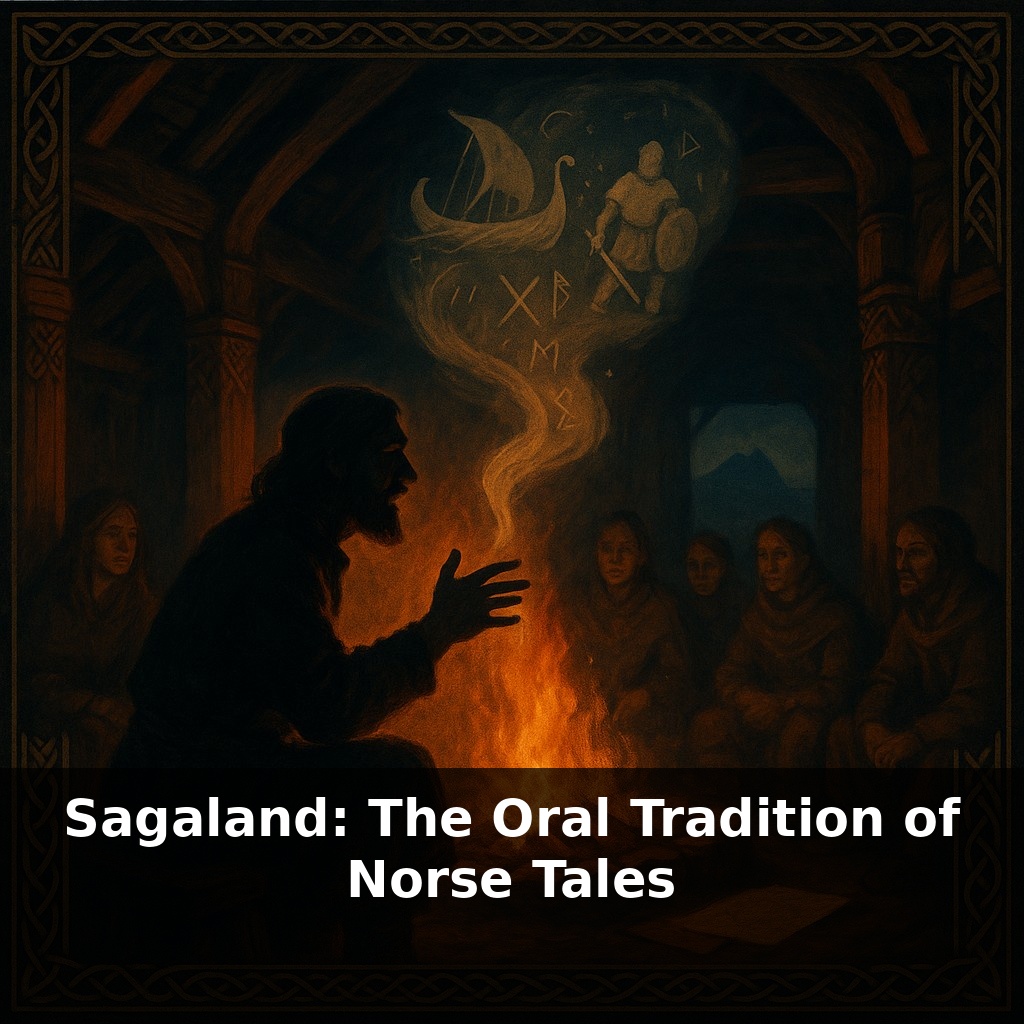
About half of medieval Icelanders could read—yet their most powerful stories lived off the page. A crowded hall, firelight flickering, one voice holding an entire community’s memory. How do tales survive for centuries before ink ever touches parchment?
By the time a saga reached parchment, it had already lived many lives. Each performance in a smoky hall was less like pressing “replay” and more like cooking from a shared recipe: the core ingredients stayed, but seasoning, order, even whole courses could shift with the audience, the occasion, or the skald’s nerve. This constant reworking didn’t weaken the stories—it stress-tested them. Only the most compelling scenes, sharpest insults, and most useful legal or moral knots survived countless retellings. That’s why modern scholars treat sagas as both art and archive: they carry traces of real feuds, travel routes, and alliances, even when wrapped in drama. In this episode, we’ll follow how skalds balanced loyalty to tradition with personal flair, and how that tension between “keep” and “change” shaped what we now call Viking history.
Audiences weren’t passive in this process; they were more like a live review committee. A detail that clashed with local knowledge, a law misquoted, a lineage skipped—someone in the hall would speak up, and the version would be corrected, sharpened, or quietly dropped next time. Over years, these micro-edits turned certain narratives into a kind of community “master branch.” That’s partly why genetic studies and place‑names now line up with some saga migrations and marriages: what sounded like drama also had to pass as plausible minutes of who owned what land, owed which debts, and descended from whom.
main_explanation: Kennings were one of the skald’s sharpest tools. Calling the sea “whale-road” or blood “sword-rain” wasn’t just poetic flair; it acted like a compact code. Once an audience knew the system, a single phrase could summon a whole scene, saving breath and making long narratives easier to carry in the mind. Over 5,500 distinct kennings survive in skaldic verse, a hint of how densely layered a master performer’s language could be. They also signalled status: if you could follow the verbal twists, you belonged in the inner circle of those “in the know.”
Alliteration and rhythm did similar work. Lines locked together by repeating sounds created an almost physical groove for memory to sit in. This mattered in noisy halls, where people shifted, coughed, or refilled cups. A strong metrical pattern let a skald recover quickly if interrupted, much as a musician can drop back into a familiar riff after a broken string. It also forced discipline: to hit the required beats and sounds, you had to choose words that fit both form and meaning, which kept key names, laws, and insults crystal clear.
The stakes were high. These narratives doubled as public records of who owned which valley, which marriage bound which families, which killing still demanded compensation. So when a performer recited a genealogy, they weren’t indulging in dry recaps; they were articulating a social map everyone relied on. Disputes could hinge on whether a single relationship line was remembered—and accepted—the same way by all present.
Written manuscripts didn’t end this process; they added another layer. When Icelanders began copying sagas into codices in the 13th century, they weren’t freezing a pristine “original.” They were snapshotting one moment in a long, messy evolution, often adding marginal notes, alternate versions, or local details. Codex Regius, with its 31 Eddaic poems, is a striking example: a single book that gathers many prior voices, then itself becomes an anchor for later retellings—on parchment, in print, and, eventually, in living rooms and podcasts far beyond the North Atlantic.
Some of the most revealing moments come where things *don’t* line up neatly. A saga might claim a chieftain’s descendants still farm a certain valley, while archaeology shows the site was abandoned for a generation after an eruption. Rather than treating that as “error,” historians ask: whose interests were served by quietly smoothing over a break in continuity? In law‑minded Iceland, being able to narrate an unbroken line of occupancy could strengthen later land claims.
You can see another kind of editing when Christian scribes copy older poems but slip in hints of doctrine—a sudden reference to a single high god, or a moralizing aside after a bloody revenge. Those touches don’t erase the older worldview; they sit alongside it, letting us see a society negotiating two value systems at once.
Your challenge this week: pick one modern “Viking” image—a horned helmet, a berserker, a TV hero—and trace it back. Where does *that* version come from: a saga passage, a 19th‑century painting, a game, a tourism ad? Treat it like a mini‑saga, and see how many hands have shaped it.
If AI can help restore faded vellum, the next step is linking those revived lines to landscapes, DNA data, even weather records—like layering transparent maps until patterns pop. We might spot when a boast hides a bad harvest, or when a “heroic voyage” masks forced migration. The Norse case becomes a testing ground: if we can braid code, soil, and song there, we can use the same toolkit to protect fragile oral knowledge wherever it’s still being spoken.
So when we read a saga now, we’re not just peeking into Viking halls; we’re joining an ongoing experiment in how communities remember. Each translation, film, game, or classroom retelling is another layer of code added to the project. The real mystery isn’t only what “really happened,” but why each age chooses to keep, rewrite, or quietly delete particular lines.
Before next week, ask yourself: - When I think about one Norse story from the episode (like the tale of Gisli or the family feuds in the sagas), what parts feel closest to my own family history or conflicts, and why do those particular scenes stick with me? - If I had to retell one of these sagas out loud to a friend tonight—without notes—what details, moods, and values would I choose to keep, and what would I consciously change to fit my own voice? - Looking at the landscape around me today (a street, a hill, a tree I pass often), how might I describe it the way the sagas tie stories to Icelandic places—what memory or turning point in my life could I “attach” to that spot so it becomes part of my own living saga?