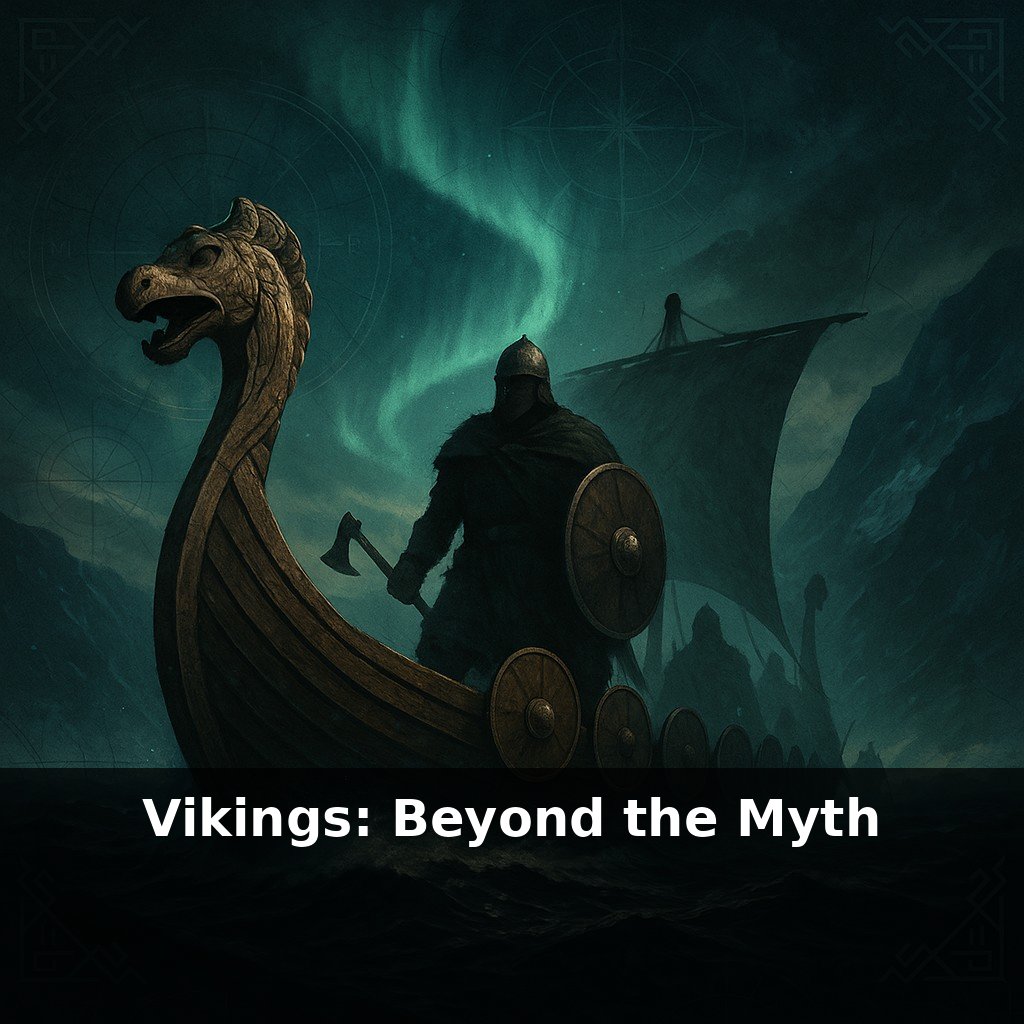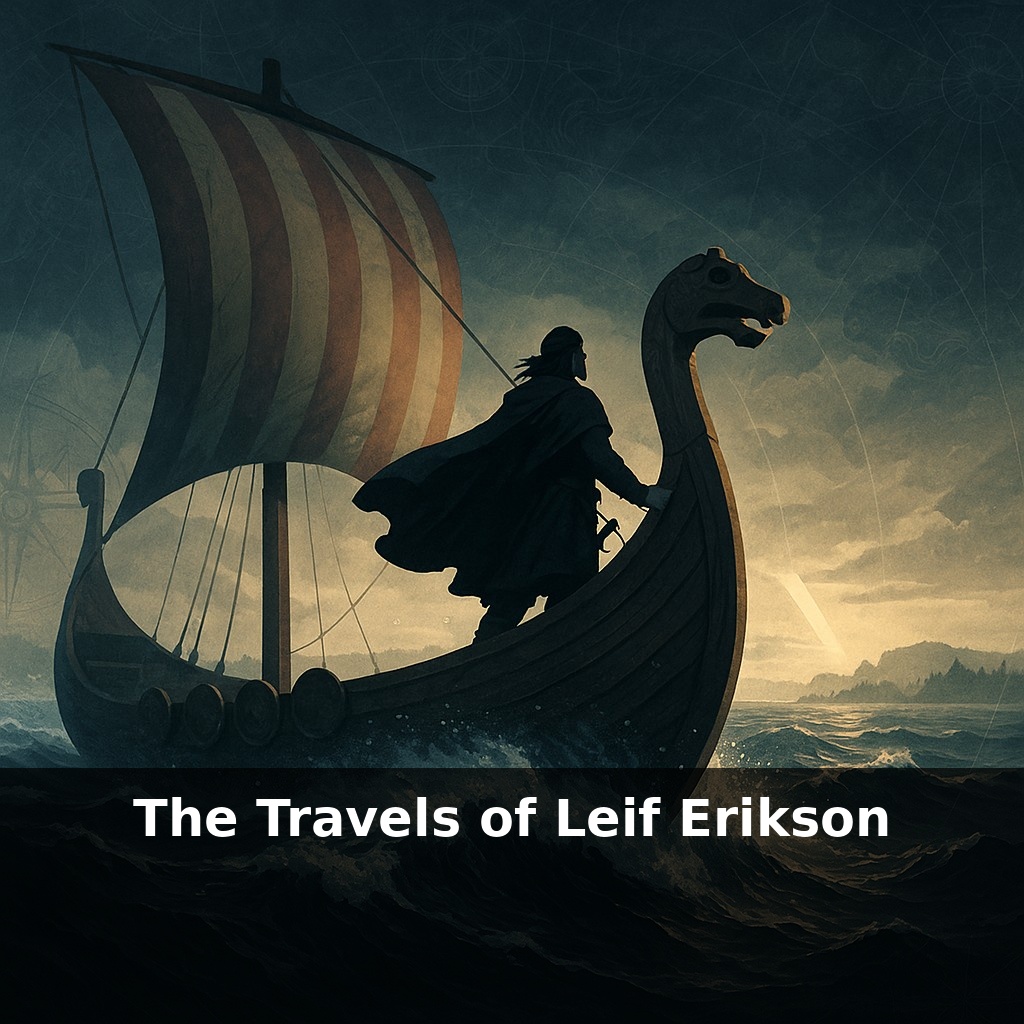
Ocean spray lashes your face. The coastline ahead is unknown, uncharted—and you’re following a man who believes there’s land beyond the edge of every map. Around the year 1000, Leif Erikson did exactly that, steering a Viking ship straight into history.
Leif wasn’t chasing glory; he was following rumors. Sailors’ gossip about land glimpsed to the west, stories half believed over smoky hearths in Greenland. His decision to sail was less a sudden leap and more like a careful gambler pushing a few extra chips forward—risking enough to matter, not enough to lose everything. Behind him lay a fragile colony clinging to icy shores; ahead, the possibility of timber, iron, and new fields. Think of his voyage like a cook testing a risky new ingredient in a small batch first: if it worked, it could change the whole menu of Norse survival. His crew carried not just weapons, but tools, livestock, and seeds—quiet evidence that they weren’t only exploring; they were running a real-world experiment in living on another continent.
They weren’t guessing at random. Leif had clues: drifting timber unlike any found in Greenland, tales of a trader blown off course who’d seen rich forests to the west, and migratory birds flying purposefully out over open water as if commuting to a second homeland. He was also sailing from a world already wired for long-distance risk. Norse routes stitched together Norway, Iceland, Greenland, and beyond, like a network of sparsely connected outposts where news traveled in fragments. Each rumor of western land was a data point; Leif’s voyage turned scattered hints into a testable route.
The sagas split Leif’s westward journey into stages, like chapters in a logbook. First came a barren, stony shore he called Helluland—“Flat-Stone Land,” probably Baffin Island. Little to graze, little to harvest; they moved on. Next: Markland, “Forest Land,” likely Labrador, thick with trees that Greenland sorely lacked. This was valuable intel. Even if no one stayed, they’d found a renewable source of timber within sailing range.
Only after that did they reach the place that mattered most: Vinland. The texts describe milder weather, self-sown wheat, salmon so large they were “in the rivers as well as in the lakes,” and berries that could be turned into wine. Instead of clinging to the ship, Leif’s crew built houses, wintered there, and tested how far they could stretch this new environment—cutting wood, herding animals, mapping resources in the landscape as if it were an unfamiliar but promising tool.
Centuries later, L’Anse aux Meadows gave this story a physical address. Turf-walled halls, iron-working slag, and Norse-style artifacts on Newfoundland’s tip match the saga pattern: a base camp close to rich forests further south. Tree-ring analysis of locally cut wood—traced to the year 1021—pins at least one expedition with calendar precision. This isn’t a legend floating in time; it’s a dateable moment when people from opposite sides of the Atlantic occupied the same region.
Yet Vinland was never a second Iceland. No churches, no graveyards, no long-lasting farmsteads appear in the ground. What we see instead are signs of intermittent use: a smithy for repairing nails and rivets, spaces for butchering and boat work, temporary structures that speak of crews cycling in and out rather than families putting down roots. Like a tech team running a limited beta in a foreign market, they proved the route was possible, the resources real—but the maintenance cost, distance, and thin numbers back home kept any permanent transplant from taking hold.
Meanwhile, Indigenous communities had long mastered these environments, moving through seasonal rounds of fishing, hunting, and gathering. To them, Norse visitors were a brief, puzzling episode in a much longer local story.
The odd thing is how small Vinland looks beside its outsized impact. Archaeologists point out that the built space at L’Anse aux Meadows could fit inside a modern parking lot, yet it forces us to redraw world timelines: transatlantic contact isn’t a 1492 story anymore. Helge and Anne Stine Ingstad’s work there is a case study in slow, stubborn verification—matching saga place-names to wind patterns, sailing distances, and coastal shapes until the turf walls finally surfaced from the bog. Their excavation also hints the camp was more than a one-off: repairs to nails, evidence of boat work, and butchering sites suggest repeated use, like a seasonal workshop supporting deeper forays to the south. Indigenous oral histories from the region, while not a simple one-to-one match with Norse texts, preserve memories of encounters with pale, metal-bearing strangers who came and went. For historians, that overlap is a rare, fragile junction where European parchment and Native memory briefly talk to each other.
Future implications from Leif’s brief North American foothold reach far beyond saga pages. As LiDAR, seabed mapping, and AI sift coasts and archives, more seasonal camps may surface like hidden files on an old hard drive. Partnering this data with Indigenous oral histories could refine where and how early contact unfolded. Meanwhile, a warming North Atlantic is reviving high-latitude routes, forcing modern states to revisit the political puzzles first posed by those experimental crossings.
Leif’s landfall becomes less an endpoint than a loose thread in a bigger fabric of movement, curiosity, and chance crossings. Today, satellite scans and seabed surveys act like metal detectors on history’s beach, pinging for subtle traces of camps, encounters, and failed starts—reminding us that even short-lived experiments can quietly rewrite the map of the past.
Before next week, ask yourself: Where in my life am I more like the cautious crew wanting to turn back from Vinland than like Leif, willing to sail past the known Greenland coast—and what “unknown shoreline” (a project, place, or person) am I actually curious enough to explore next? If I treated my own curiosity the way Leif treated the tales he heard from Bjarni Herjólfsson, what story or hint I’ve already heard (a friend’s experience abroad, a book, a local site with Norse history) would I finally decide to follow up on this week? When I picture Leif carefully choosing his landing spots and building those temporary shelters, what is one concrete “base camp” I could set up today—a reservation, a museum visit, a research session, or a short trip—to start my own small voyage of exploration rather than just daydreaming about it?