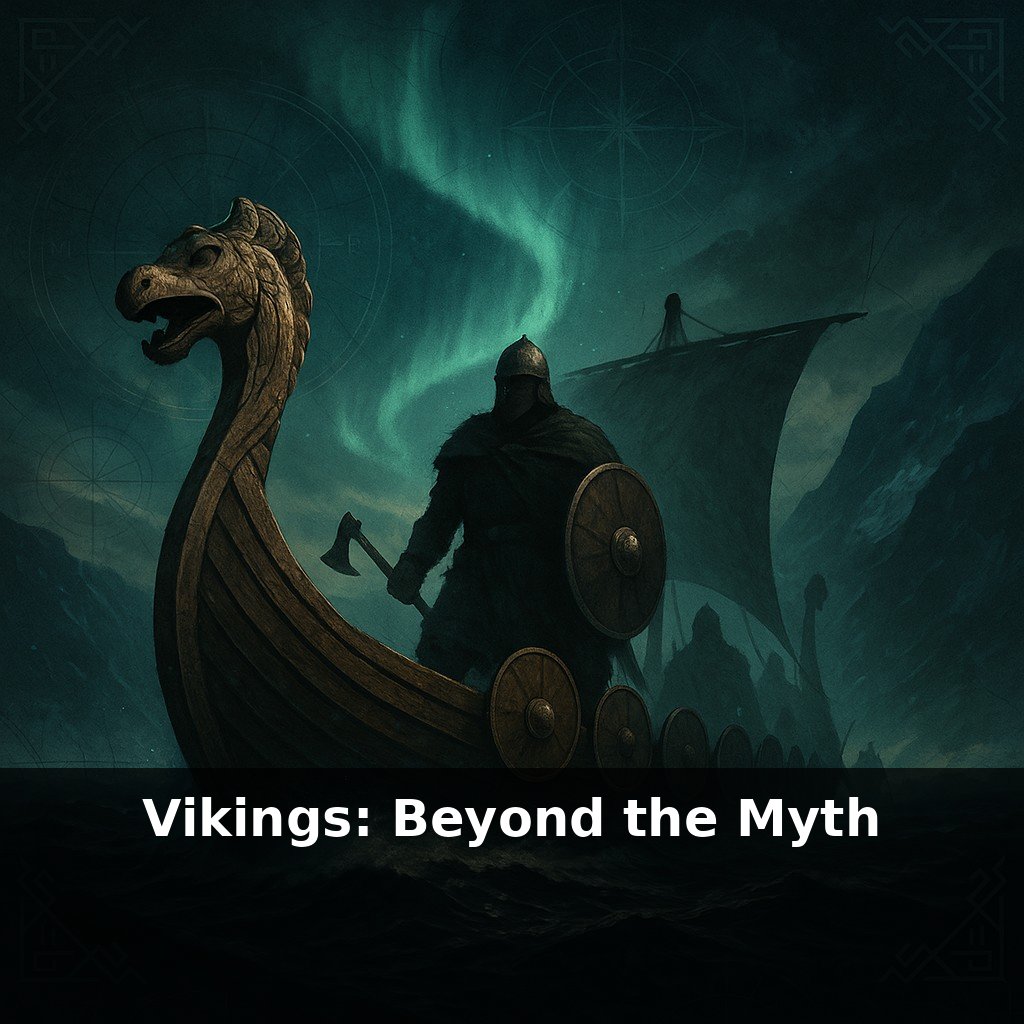
Only a tiny fraction of Viking dead were buried in ships—yet our mental image is nothing but flaming longboats and warriors bound for Valhalla. So where did everyone else go? In this episode, we step into the quieter afterlives most Vikings actually expected.
Most Vikings never expected a front-row seat at Ragnarök—but they did expect to keep participating in the social fabric that defined their lives. Honor, obligation, and kinship didn’t end at the grave; they simply changed address. The dead could guard a farm, blight a field, or stand as witnesses to promises once sworn. Ancestors weren’t abstract memories; they were powerful neighbors with long-term interests in the family’s success.
This is where Viking religion stops looking like a simple “myth system” and starts looking like social technology. Oaths invoked gods as guarantors, gifts to the spirits “balanced the books” after a risky voyage, and an insult might have consequences in this world and the next. Even the landscape—mountains, waterfalls, stray boulders—could be read as a network of resident powers, each demanding a certain kind of etiquette from those who passed.
Viking religion also flexed to fit different moments in a person’s life. A birth, a lawsuit, a sea voyage, a failed harvest—each called up a different mix of gods, land-spirits, and ancestors, more like choosing tools from a well-used workshop than following a fixed checklist. Local chieftains might host seasonal feasts and sacrifices, but a farmer could still whisper a quick bargain to a roadside spirit on a lonely trip. Crucially, none of this was written down at the time; it spread through habit, story, and imitation, evolving as new trade routes, rulers, and even Christian neighbors reshaped the stakes.
For archaeologists, the puzzle starts in the soil. Open a Viking grave, and you’re not just finding “stuff”—you’re reading a conversation between the living and the dead. A blacksmith goes into the ground with hammers and tongs carefully snapped in two. A woman’s oval brooches are laid near her chest, but her keys—symbols of household authority—rest at her waist. Children might have miniature tools or gaming pieces. None of this is random. It hints at what people thought the dead might still be doing, and what roles mattered enough to carry beyond the last breath.
Textual sources, written centuries later, echo this focus on ongoing roles rather than static reward or punishment. Skaldic poems don’t linger on moral judgment; they dwell on *how* someone died, *who* they joined, and which relationships were reaffirmed in the process. A chieftain might be remembered as feasting with a god, while a farmer could be praised for “sitting happily with his kin.” The point isn’t cosmic scorekeeping—it’s whether your story still circulates, your reputation still has weight.
That’s one reason why dying “well” mattered so much. Not just bravely, but appropriately: on campaign, on a voyage, at home handing over responsibility to the next generation. A messy death—alone, unburied, or without proper rites—risked leaving a restless presence, the kind found in sagas as draugar: animated corpses who cling to property, harbor grudges, and sometimes must be physically wrestled back into the grave. These tales may exaggerate, but they underline a fear of social ties snapping the wrong way.
Conversion to Christianity didn’t erase these patterns overnight; it redirected them. Early Christian laws in Iceland, for example, ban open pagan sacrifice yet still allow quiet, private observance for a time. Churchyards begin to replace family mounds, but people keep telling stories of dead relatives protecting farms or appearing in dreams to warn of storms. Even as priests preach heaven and hell, local communities continue to act as if the departed remain nearby, interested, and occasionally negotiable.
In that sense, the Viking “other side” isn’t far away. It’s more like another room in the same longhouse, separated by a threshold you cross only once—but still within shouting distance of the living.
Think of the Viking spiritual “ecosystem” a bit like a decentralized tech network: no single server, lots of local nodes, and constant updates. A fisherman in northern Norway might prioritize sea-spirits and weather charms, while a trader in Hedeby leans on rituals for safe markets and fair weights. Same broad system, different plug‑ins.
Saga episodes often show this modular approach in action. A family facing a feud might quietly move a boundary stone and leave offerings there, turning a legal problem into a spiritual negotiation. A traveler snowed in at a mountain farm might listen for uncanny noises in the loft and decide whether to treat them as rats, land-spirits, or an offended ancestor—and act accordingly.
Even time itself could feel “stacked” with presence. Certain nights—like winter’s first evening or the start of Yule—were treated as high‑traffic windows when more beings were thought to be moving around. People adjusted behavior: extra food on tables, doors unlatched, sharp tools covered, not just for hospitality but to avoid accidental offense in a crowded, invisible neighborhood.
Only in the last decade have we begun to “overhear” Viking-era voices in new ways. Isotope analysis can trace whether a buried woman grew up by fjords or on Baltic plains; aDNA links graves into family trees that sagas never mention. Layer that with VR models of burial grounds and you get something closer to a time-lapse than a snapshot—beliefs shifting like a longhouse roof repeatedly repaired. Your challenge this week: seek out one recent study, not a TV show, and notice how it changes your picture of Viking religion.
So the next step isn’t memorizing more names or maps of the unseen; it’s treating beliefs as moving parts in a living system. Follow how ideas travel—through law codes, trade routes, marriages—like recipes tweaked in each kitchen. When we do that, the Norse dead stop being distant curiosities and start looking like partners in a long, unfinished conversation.
Before next week, ask yourself: How would my daily choices change if I believed, like many Vikings did, that dying bravely (not just in battle, but in facing fears and hard truths) shaped my “afterlife” or legacy—what’s one situation in my life right now where I’m tempted to avoid courage? If I imagined an afterlife hall like Valhalla or Hel’s realm specifically for people who live the way I’m living today, what would it look, feel, and sound like—and would I actually want to end up there? Thinking about how Vikings honored ancestors and the dead, who in my own life (or history) would I choose as my “ancestor council,” and what might they tell me to change or protect in my life this week?