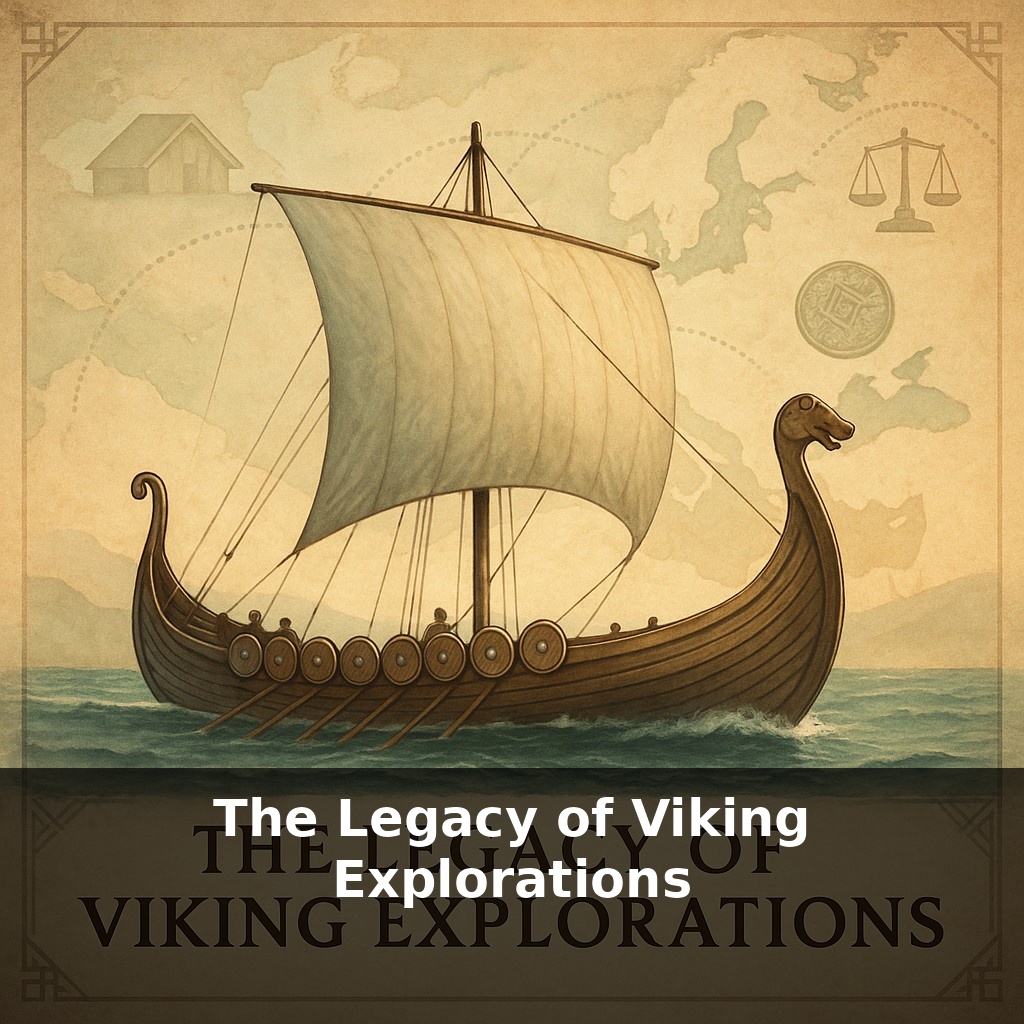
Viking ships reached from Canada to Baghdad, yet most of their passengers weren’t raiders at all. A trader in silver dirhams, a farmer naming a new English village, a lawmaker shaping Iceland’s courts—each thought they were building a life, not a legend.
By 1021 CE, Norse timber was already weathering on North American soil—but the real Viking legacy isn’t just in where they went, it’s in what quietly survived after they left. Their routes stitched together worlds that rarely met: Arabic-speaking merchants in Baghdad, Slavic traders on the Dnieper, Gaelic communities in Dublin, farmers on the windswept edges of Greenland. Along these routes moved not only silver and furs, but habits: how to share land, settle disputes, measure weight, even how to name a hillside or a stream. Like a software update that installs in the background, Viking-era exchanges rewrote parts of everyday life across regions without most people noticing the source. Today, linguists, geneticists and archaeologists can still trace those hidden “patch notes” in place-names, DNA patterns, and legal customs scattered from Yorkshire to the Volga.
Walk through parts of northern England or coastal Ireland and you’re still walking through a Norse archive—only the ink is baked into place-names, family lines and legal quirks. A “-by” on the signpost, a local custom about shared pasture, even how a town council is organized can be quiet fossils of Scandinavian influence. Genetic studies now pick up the same trails: Y‑chromosome clusters in Iceland, patches of Scandinavian ancestry in Orkney or the Wirral. And in courtrooms, every time an English speaker says “law” instead of a Latin term, they echo a choice made on some long-vanished Thing-field over a thousand years ago.
A timber offcut at L’Anse aux Meadows, felled in 1021, is a time-stamped receipt for just how far this maritime web reached. Yet that North American outpost was less a bold new colony than a seasonal experiment on the edge of possibility. The real, long-term transformations unfolded in places the ships visited again and again.
Take England. After a century of Scandinavian settlement, you could stand in a northern courtroom and hear something curious: legal terms that sounded closer to words from Trondheim than from Rome. English already had native ways to talk about rules, but speakers quietly promoted Norse-derived ones like “law” to centre stage. It’s a bit like updating the operating system on a phone: most apps still look familiar, but core functions now run on different code.
Across the Irish Sea, the trading town of Dublin became a laboratory for hybrid identities. Norse families married into Gaelic ones; grave goods blend Scandinavian and Irish styles. A person buried with a sword made in Norway and a brooch in Irish fashion didn’t think of themselves as a cultural thesis topic; they were simply using whatever best signalled status in a mixed community. Identity here worked more like a layered account: multiple “currencies” of language, style and kinship coexisted in a single life.
Further east, river ports along routes to the Black and Caspian Seas show a similar mosaic. Arabic coins stamped with Quranic verses turn up in pagan burials. Some warriors hired themselves out as elite guards in Constantinople, then carried back Byzantine tastes in jewellery or military organisation. Others settled for good in towns that would later become Russian or Ukrainian hubs, leaving traces in both genes and governance.
Even Iceland, often imagined as a pure Norse offshoot, took shape through selective borrowing. Early settlers adapted Scandinavian assemblies to a land with no king, amplifying the power of local law gatherings. Over time, tight-knit communities, relative isolation and a strong literary habit “froze” much of their speech and social structure in ways that let modern scholars read Viking-Age patterns almost in real time.
In all these places, what lasted wasn’t the momentary drama of a raid, but the slower work of thousands of quiet decisions: which spouse to choose, which word felt natural, which custom solved a quarrel fastest.
Stroll through modern York or Dublin with a map of street names and you can almost “see” past coastlines. In some neighbourhoods, clusters of Norse-derived names sit beside older Celtic or Anglo-Saxon ones like layers in a digital photo editor—evidence of populations overlaying rather than replacing each other. Archaeologists do something similar with soil: in places like the Dnieper river ports, they peel back strata where Scandinavian-style brooches lie above Slavic ceramics and beneath Byzantine glass, a vertical record of people plugging into wider networks. Geneticists, in turn, treat DNA like a long-running ledger. Those Norse Y‑chromosome signatures in Iceland or the North Atlantic don’t just say “Vikings were here”; they hint at whose descendants stayed local, whose lines dwindled, and where women from surrounding communities married into incoming groups. Even legal historians read medieval town charters the way coders read commit histories, watching specific procedural tweaks ripple from one city to the next.
Future tools will likely treat Viking mobility less as a mystery and more as a dataset. As cheap sequencing spreads, regional DNA projects may expose tiny Norse “signatures” the way a careful taster spots a spice in a stew. Micro-excavations in Arctic Canada or Siberian river ports could add single posts or beads that force maps to be redrawn, like late edits on a blueprint. Your challenge this week: notice where your own city’s names, customs or faces quietly reveal older, layered journeys.
Viking traces can also surface in places we don’t expect: a ship burial uncovered during roadworks, a loanword hiding in a sport’s rulebook, a genetic hint in a medical study. Like finding an older recipe behind a favourite dish, we keep discovering prior layers in cultures we thought we knew, suggesting the “Viking Age” never fully ended—it just blended in.
To go deeper, here are 3 next steps: 1) Pull up the free *Icelandic Sagas* collection on SagaDatabase.org and read at least one voyage-focused saga (like *The Saga of Erik the Red*), jotting notes on how its account of Vinland compares to what the episode said about archaeological evidence at L’Anse aux Meadows. 2) Open Google Earth and search for “L’Anse aux Meadows, Newfoundland” and “Hedeby, Denmark,” then use Street View / 3D mode to virtually “retrace” a Viking trade-and-exploration route, pausing to screenshot places that match themes from the episode (like resource scouting, ship ports, or seasonal camps). 3) Watch at least one lecture from the free “Vikings” course on Wondrium/The Great Courses (or Yale’s open course material on medieval Norse history if you prefer text) and compare the scholar’s view of Viking exploration motives—trade, prestige, survival—to the podcast’s framing, noting one way it changes how you see their legacy.