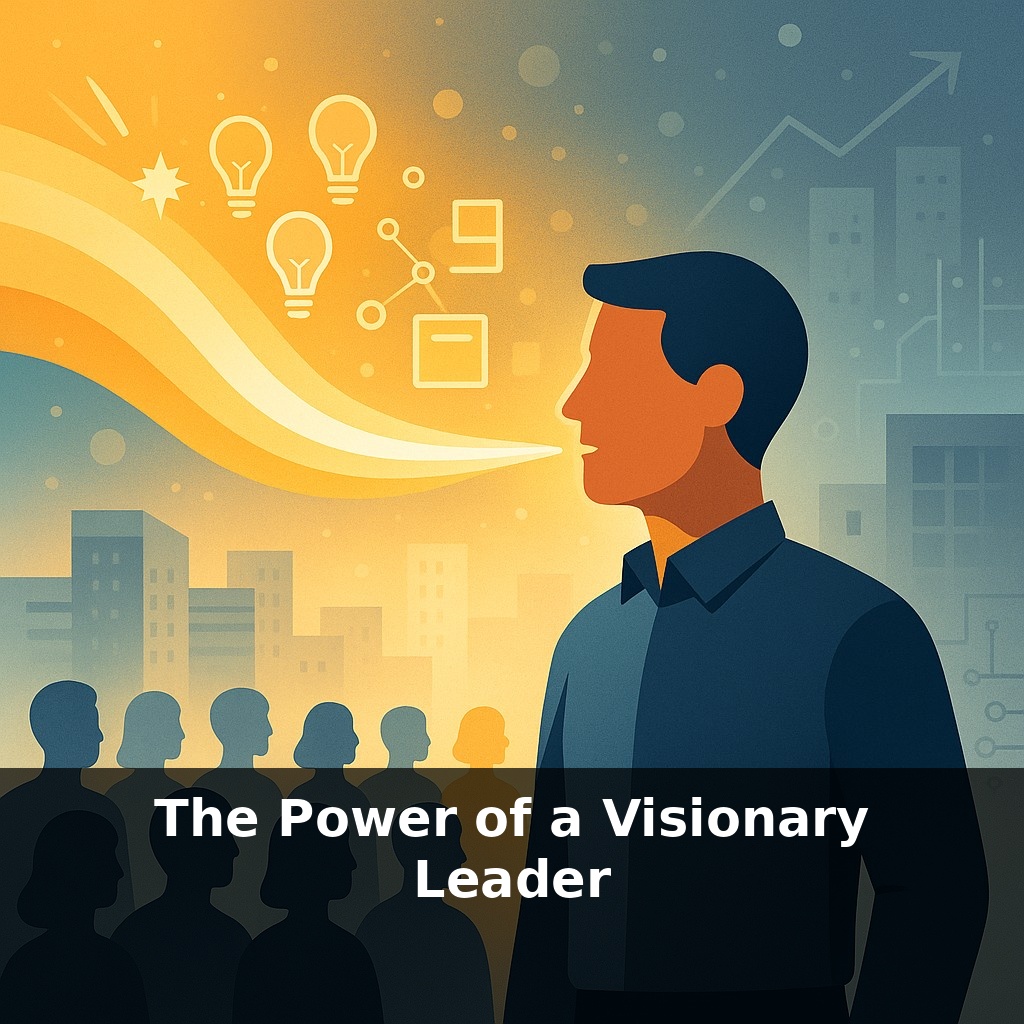
The Power of a Visionary Leader
📝 Transcript
A single sentence from a leader can be worth more than a multi‑year strategy deck. In one tech giant, the business barely changed, but a new, simple vision turned a tired workforce into believers—and the company’s value multiplied. The products followed the story, not the other way around.
Most leaders underestimate how much their words shape reality. Not in a mystical way, but in a deeply practical one: what you choose to describe in detail, people start to notice; what you repeat, people start to prioritize. A vision isn’t just a slogan on a slide—it’s the filter through which your team interprets every meeting, metric, and milestone. When that filter is fuzzy, smart people pull in different directions and call it “misalignment.” When it’s sharp, even small, unglamorous tasks feel connected to something that matters. The surprising part? You don’t need a global brand or a breakthrough product to do this. You need the courage to say, out loud, “This is where we’re going, and this is what we refuse to be.” The clarity of that stance quietly rewires how your team chooses, argues, and ultimately performs.
Visionary leaders don’t just point to a destination; they change how time feels for their teams. A strong vision compresses the distance between today’s grind and tomorrow’s payoff—people feel like they’re working “in” the future, not waiting for it. That’s why research links visionary leadership to faster pivots and higher resilience under pressure: when reality shifts, the story doesn’t collapse, it updates. Think of how a great coach reframes a losing season as the foundation for a title run—suddenly setbacks are data, not doom. The same role is available to you, even if your “team” is three people and a shared spreadsheet.
A useful way to approach this is to stop thinking of “having a vision” as a single lightning-bolt moment and start treating it as a design problem: what future are you trying to make feel inevitable to your team?
Research on transformational leadership gives three practical ingredients you can work with: *direction*, *meaning*, and *evidence*. Direction is the bold, forward-looking “where.” Meaning is the “why this matters, especially to us.” Evidence is the “here’s how you’ll know we’re actually moving.” Weak visions skip at least one of these, which is why they sound impressive and change nothing.
Look at Nadella’s move at Microsoft. “Empower every person and every organization on the planet to achieve more” wasn’t just poetic. It quietly rewired choices: suddenly, products were judged by how well they empowered others, not just how dominant they were. That gave engineers and managers a simple test they could apply without waiting for orders. Your team needs something similar: a phrase, or short paragraph, that lets them quickly sort ideas into “on the path” or “off the path.”
The mistake many leaders make is trying to cram everything into the sentence itself. The words are only the visible tip. Underneath, visionary leaders build a small, consistent *story system*: the examples they spotlight in all-hands, the behaviors they promote, the tradeoffs they explain out loud. Over time, people infer, “Oh, that’s what we’re serious about.” The vision becomes less of a poster and more of a pattern.
Here’s where evidence comes in. A vision with no early proof points feels like wishful thinking. Jobs didn’t unveil the entire Apple future in one go; he lined up a sequence of moves that each made the next step more believable. In your context, that might mean choosing one or two near-term initiatives that make your long-term direction concrete: a prototype, a pilot customer, a new capability hire.
Think of your vision like designing an operating system for decisions: it should be light enough that everyone can run it in their head, and opinionated enough that it gives clear guidance when things get messy.
A simple way to test your own vision is to watch what it *changes* in the small, boring moments. A founder I worked with ran a 20‑person product team. Her vision wasn’t about being “number one” in the market; it was a clear promise: “We will be the product our customers trust with their riskiest decisions.” Within a quarter, you could see the shift. Roadmap debates stopped centering on “shiny” features and focused on reliability and transparency. Engineers began pushing for better failure messaging instead of only performance gains. Support reps started logging not just bugs, but *moments of doubt* customers expressed on calls.
Notice what’s happening there: the vision quietly re-weights tradeoffs. In meetings, someone would say, “Does this make us more trustworthy with high‑stakes use cases?” and half the options would fall away. Decisions sped up, not because there were fewer opinions, but because everyone knew which questions mattered most.
Boards are quietly shifting from asking “Can they run this?” to “Can they reimagine this?” As AI, climate risk, and demographic shifts collide, the leaders who thrive will prototype futures, not just defend forecasts. Expect selection panels to probe how you connect seemingly unrelated trends and test your ability to narrate *consequences*, not just goals. Careers will tilt toward those who treat vision like a living product: iterated, user-tested, and regularly re‑launched.
Treat your vision less like a tagline and more like a prototype you’re constantly user‑testing with your team. Notice where it bends, where it breaks, and where people light up. Over time, the rough sketch turns into a shared blueprint, with everyone holding a piece. That’s when your leadership stops directing traffic and starts shaping the terrain.
To go deeper, here are 3 next steps: 1) Block 90 minutes this week to read the “Vision” chapters from *Vivid Vision* by Cameron Herold and rewrite your company’s 3-year future story in a shared Google Doc you’ll review with your leadership team. 2) Grab the free “Painted Picture / Vision Script” templates from Michael Hyatt’s site (or use Notion’s “Company Vision” template) and turn your high-level vision into 3 concrete bets for the next 12 months—then post them in your team’s Slack #strategy channel for feedback. 3) Watch Satya Nadella’s “Empathy and Innovation” interview on YouTube and, using Loom, record a 5-minute “Vision Clip” for your own team that clearly explains where you’re going, why it matters, and what will be different for your customers in 3 years.
From this course
Visionary Leadership: Crafting and Sharing Your Vision
5 episodesUnlock all episodes
Full access to 5 episodes and everything on OwlUp.
Subscribe — $1.99/monthLess than a coffee ☕ · Cancel anytime