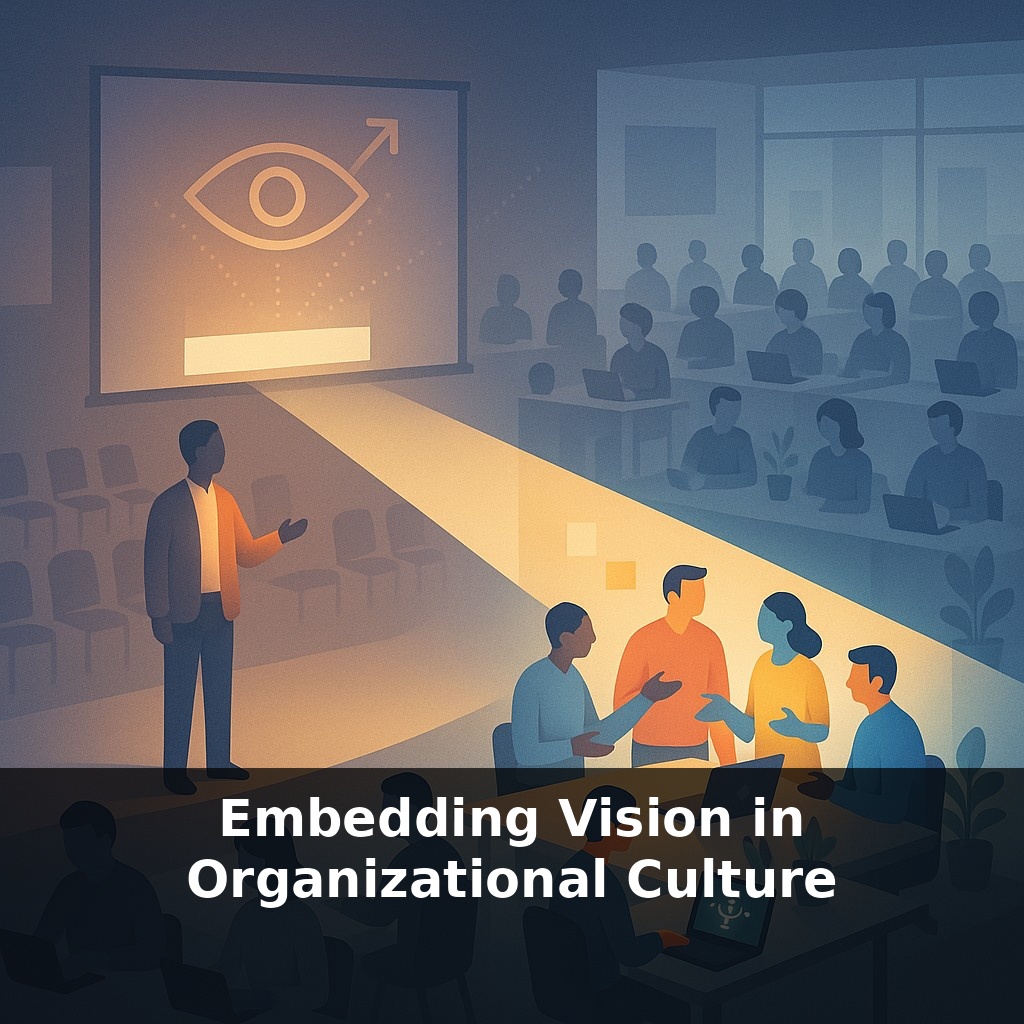
Gallup reports only about a quarter of employees feel truly engaged at work—yet nearly every company has a “vision” slide. A leader announces a bold new future, the room applauds…and six weeks later, nothing has changed. So where does that energy actually go?
Only about 23% of people say they feel engaged at work, yet most of them can probably recite a slogan from their company’s last town hall. The real test isn’t whether people can repeat the words—it’s whether those words quietly steer decisions in meeting rooms, 1:1s, and budget reviews when no senior leader is watching. That’s where vision either becomes culture or becomes wallpaper.
In organizations where it *does* become culture, you see subtle but consistent shifts: who gets promoted, which projects survive tough trade-offs, what people casually praise or criticize in corridor conversations. It shows up in how new hires are chosen, how mistakes are handled, and which metrics leaders actually obsess over. In this episode, we’ll look at how to embed vision into those invisible routines—so it stops being a campaign, and starts becoming “just how we do things here.”
In most organizations, the gap isn’t *intent*—it’s translation. Leaders describe a compelling future, but people still wake up on Monday facing the same inbox, the same priorities, the same trade‑offs. The question becomes: how does that future vision actually change what gets said “yes” or “no” to this week? Research points to a few levers that matter most: the stories leaders repeat, the specific behaviours that are rewarded, and the systems that decide who gets hired, promoted, or funded. When those elements shift together, a vision stops feeling like a campaign and starts acting like an operating system.
Research on organizations that actually *live* their vision points to five reinforcing moves.
First, leaders make the vision emotionally real. Not by repeating slogans, but by telling specific, vulnerable stories: a customer who was failed and how that will change; a moment in their own career when they chose the safer path and regretted it. People remember the turning points, not the bullet points.
Second, they translate broad aspirations into visible behaviours and hard numbers. “Customer-obsessed” becomes: reply to client escalations within 24 hours; run monthly listening sessions; prioritize NPS alongside revenue in reviews. At Microsoft, Nadella’s “growth mindset” wasn’t just a phrase—it reshaped how performance conversations were run and how experimentation was judged.
Third, they re‑wire systems so the vision isn’t optional. Hiring rubrics include evidence of the desired mindset. Onboarding assigns new hires to projects that embody the direction, not just to where there’s capacity. Promotion criteria and bonus formulas are inspected for contradictions: are you paying for short‑term output while preaching long‑term impact?
Fourth, they use symbols, rituals, and peer learning as constant, low‑friction reminders. A weekly “decision of the week” email that unpacks a tough call and why it matched the aspiration. A short story at the start of team meetings about someone who acted in line with the promised future. Leaders publicly narrate trade‑offs: “We walked away from this deal because it clashed with who we say we are.”
Fifth, they keep the vision permeable. Feedback loops—AMA sessions, internal forums, pulse surveys—aren’t just for sentiment; they’re used to adjust language, priorities, and examples. When people see their input shape how the vision is described or measured, it stops feeling like a script from head office and starts to feel like shared authorship.
Think less about a one‑time launch and more like releasing a new version of your organization’s “operating system,” with regular patches, user feedback, and visible feature updates.
Consider how differently two teams might interpret the same headline vision. One sales team hears “trusted partner” and quietly doubles down on long-term relationships, even if it means walking away from deals. Another hears the same words and continues pushing end‑of‑quarter discounts because that’s what still gets them applause. The divergence isn’t in the slogan; it’s in the cues people read from everyday decisions.
Think of a football club that changes its style of play. The shift only sticks when recruitment, training drills, match analysis, and even youth academies all favour the new approach. A single inspirational speech in the locker room won’t turn a defensive squad into a high‑pressing side; changing who gets picked, what’s reviewed on Monday, and which risks are forgiven will.
That’s why small, local choices—who gets staffed on the flagship project, whose story opens the town hall—quietly teach people what the “real” vision is.
In the next decade, “living the vision” will be audited almost like financials. Real‑time tools will surface where behaviour drifts, a bit like a spell‑checker underlining off‑brand decisions as they happen. Leaders who treat this as surveillance will see people game the system; those who open the data up will invite teams to debug their own habits. Expect board agendas to shift from “Do we have a vision?” to “Can we prove it shows up in thousands of small, daily choices?”
Treat each meeting, hiring choice, or budget cut as a tiny “pull request” to your culture, signalling the direction you’re really coding into the organization. Over time, those small commits either converge toward the stated direction—or quietly fork into a different path. The leaders who notice that drift early will shape cultures others spend years trying to imitate.
Try this experiment: For the next two weeks, start every recurring team meeting by asking one person to share a concrete example of how they saw your organizational vision in action since the last meeting (e.g., a customer interaction, a decision, or a process they changed). Capture each story on a shared “Vision in Action” board (digital or physical) with three columns: Situation, Action Taken, and Impact. At the end of the two weeks, review the board with your team and ask: “Which of these stories feels most like the culture we want to be known for, and what’s one practice we should keep or stop based on this?”