About one in five people at work can actually state their company’s vision. Now, here’s the twist: many of those same people are working hard every day. So why doesn’t effort turn into momentum? Stay with me as we step into that gap between busy and truly directed.
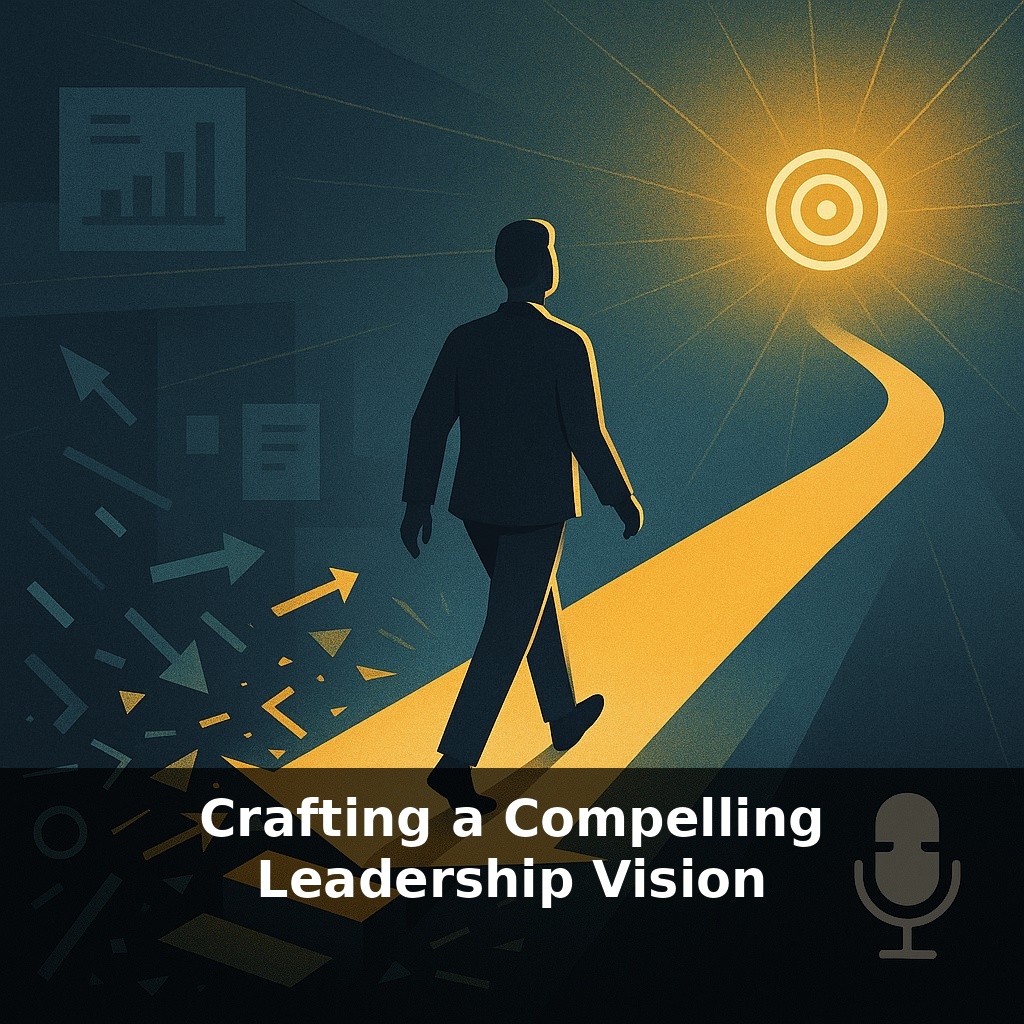
Here’s the uncomfortable part: most leaders *think* they’ve already nailed their vision. There’s a slide in the deck, a paragraph on the website, maybe a poster in the hallway. But if you listen closely to how people actually talk about the future in meetings, one-on-ones, or standups, you’ll often hear a different story: projects, priorities, and personal goals that don’t quite line up. It’s like everyone is following their own GPS route, all technically heading “north,” but taking side streets that never converge. In this episode, we’ll explore how to craft a leadership vision that people don’t just memorize, but internalize—one that quietly shapes decisions, trade-offs, and daily conversations, even when you’re not in the room.
Think about the last time your team kicked off a big initiative: slides were polished, timelines clear, energy high. Fast forward three months—updates sound more like a list of disconnected errands than a shared journey. That drift rarely comes from laziness; it comes from a vision that feels distant from real work. Research shows the turning point isn’t having *a* vision, but having one that’s purpose-driven, emotionally sticky, and specific enough that people can “see” themselves in it. In other words, the vision must live not just in documents, but in the daily language and choices of the team.
Think of this next step as zooming in from the “big future” to the texture of how that future actually feels and works.
Start with *why it matters to people in the room right now*. Not to “the organization” in abstract terms, but to the staff engineer stuck in legacy code, the nurse juggling three patients, the sales lead staring at a brutal quarterly target. When researchers talk about emotionally resonant, they’re usually describing visions that make these people say, “If that existed, my day would be meaningfully different.”
One practical way to get there is to anchor your future state in a specific, vivid moment. Example: instead of “We’ll be the market leader in customer experience,” try something like, “A new customer gets from problem to solution in under 5 minutes, without needing to call us—because our product simply ‘gets’ them.” Notice how that zooms straight into an actual scene someone can mentally walk through.
Clarity is the next fault line. A lot of leaders mistake sophistication for sharpness. Long, nuanced statements may feel safer, but they’re harder to recall and nearly impossible to repeat consistently. That’s one reason those 14–20 word visions perform so well—they force trade-offs. If you only had one sentence on the whiteboard, what *has* to be there? What can you safely leave out without losing the essence?
Now layer in values. Instead of sprinkling value words around the vision, test the vision against your real, observed behavior. If you say you value transparency, does your described future include people having more information, more context, more voice? If you claim experimentation matters, does the future you’re painting make intelligent risk *normal*, or does everything still sound tightly controlled and approval-heavy?
Finally, don’t confuse clarity with rigidity. The most resilient visions don’t lock in *how* you’ll get there—they lock in *what must be true when you arrive*. A product team’s path might shift from on-prem to cloud; a hospital might adopt new tech or workflows. The route flexes, but the destination—say, “zero preventable harm for patients”—stays non-negotiable, like a well-designed API that lets the system evolve without breaking core contracts.
Notice how the strongest visions feel almost “interactive” — people can test decisions against them in real time. To make this concrete, look at how one mid-size tech company rewrote its fuzzy statement about “innovation and excellence” into: “We remove two hours of wasted work from every customer’s week.” Suddenly, product, support, and marketing had a shared lens. A designer deciding between two features could ask, “Which one actually kills more friction?” A support lead could rework their scripts to cut back-and-forth messages instead of just chasing satisfaction scores.
You can also prototype a draft vision the way you might prototype a new feature. Share it with a cross-section of your team and ask just three questions:
1) “What decisions would this make easier?” 2) “Where does this conflict with how we actually operate?” 3) “If this were real, what would you brag about to a friend?”
Collect the answers, then tighten the wording until it feels like a filter, not a slogan.
Most teams don’t fail from lack of effort; they stall because no one’s sure which version of the future they’re working toward. As tech, climate, and politics keep rewriting the rules, the real differentiator won’t be a single “perfect” statement—it’ll be your capacity to refresh direction without whiplash. Think of revisiting your vision like updating software: regular, light-touch releases beat rare, disruptive overhauls. Leaders who treat vision as a living artifact can attract talent that wants both meaning and movement.
Your challenge this week: Run a “future friction audit” with 5–7 people from different levels. Ask them to list three moments in their week where they feel most misaligned, confused, or stuck choosing between priorities. Map those moments on a whiteboard, then draft one sentence about the future that would make each friction point disappear. Don’t polish the wording yet—just notice which patterns keep reappearing.
Treat this as ongoing design work, not a one-time offsite output. As your context shifts—new markets, tools, constraints—treat your statement like a jazz standard: the core melody stays, but you keep improvising around it with your team. Over time, the real test is simple: does this still pull us slightly forward every day, or are we just humming on autopilot?
Start with this tiny habit: When you open your calendar each morning, whisper one sentence of your leadership vision out loud, starting with “I lead so that…” and keep it under ten words. Then, glance at your day’s meetings and circle just one person’s name (on paper or screen) that you want to impact through that vision today. Before your first meeting, add a three-word intention next to their name (for example: “listen for fears” or “spot their strength”).