About half of major change efforts quietly fail. Not because the strategy is wrong, but because the vision slowly fades from people’s daily work. A reorg hits, a new tool rolls out—and suddenly, no one’s sure what “winning” even means anymore. That’s where this episode begins.
Seventy percent of large-scale change initiatives underperform. Not because people are lazy or leaders don’t care, but because, in the chaos of shifting priorities, the original “why” gets crowded out by the urgent “what now?”. In this episode, we’re stepping into that messy middle—where reorganizations, new technologies and evolving customer demands collide with the need to stay true to something that actually matters.
You’ll see why some companies move through disruption with surprising calm, while others burn people out chasing the latest trend. We’ll explore how leaders keep direction steady without becoming rigid, and stay flexible without looking unreliable. Think of it as learning to run effective “software updates” on your strategy—without corrupting the core operating system your people rely on every day.
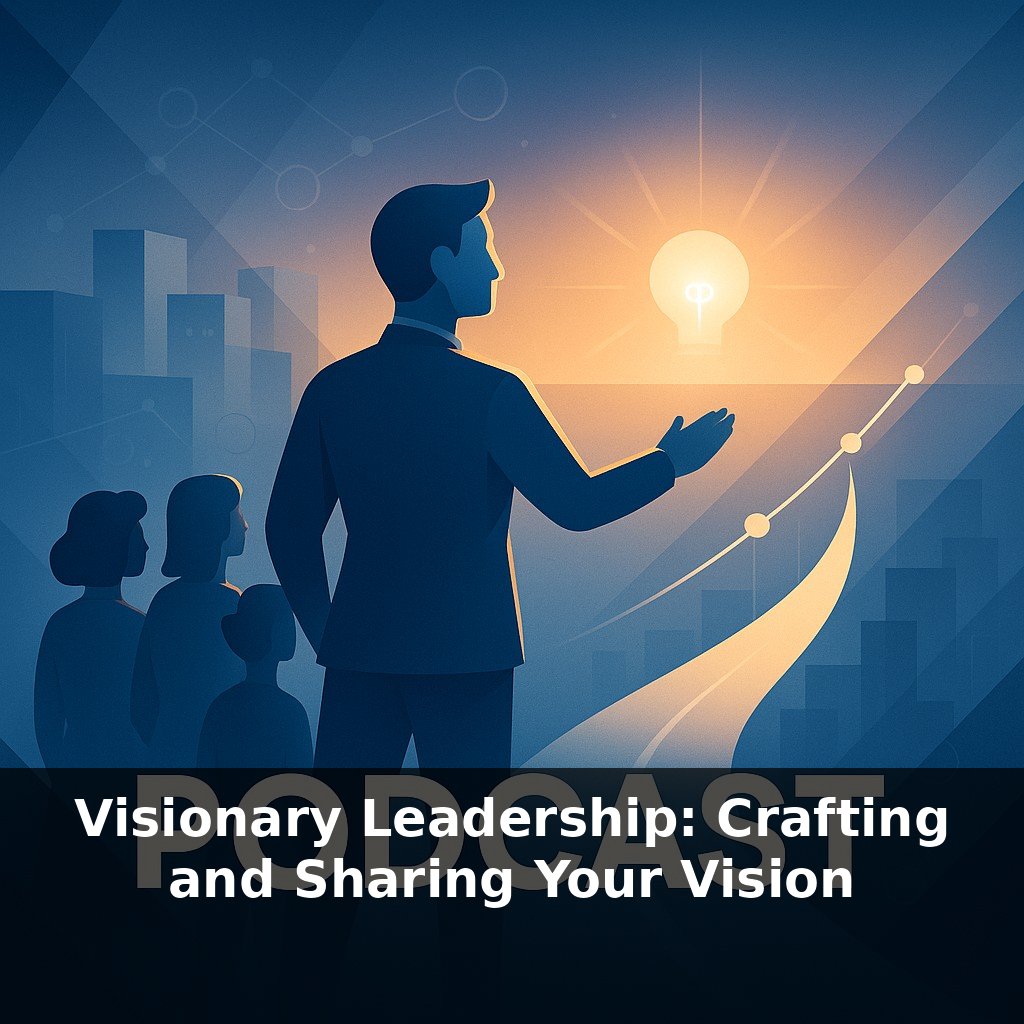
Here’s the twist: in most organizations, the problem isn’t that there *isn’t* a vision—it’s that people only hear about it in town halls and slide decks, not in the moments when work actually changes. During disruption, your team is quietly asking three questions: “Are we still the same company?”, “Does my work still matter?”, and “Can I trust what’s being said today to still be true next quarter?”. How you answer—through decisions, trade-offs and daily communication—determines whether your vision feels like a living guide or a museum piece bolted to the wall.
Here’s where the research gets very practical. When everything around you is moving, people stop listening to *what* you’re saying and start watching *how* you behave and *where* decisions land.
First, clarity: a vision that only exists in a strategy document is useless in turbulence. Leaders who navigate disruption well translate lofty statements into concrete direction in three places: priorities, trade‑offs, and language. Priorities: what gets funded, staffed, and protected when cuts happen. Trade‑offs: what you’re willing to *not* do, even if it looks attractive. Language: the way you explain decisions so people can connect them to a shared future, not just this quarter’s metrics.
Second, adaptation: keeping the essence while updating the expression. That’s where feedback loops matter. Instead of waiting for the annual engagement survey, effective leaders create “micro‑listening posts”: five‑minute debriefs after big meetings, quick pulse polls after a rollout, or regular skip‑level conversations that ask, “What feels misaligned between what we say we’re about and what we’re doing?” The point isn’t to collect commentary—it’s to spot where the current plan is drifting away from the intended future.
Scenario planning and experiments turn that insight into motion. Scenario planning is less about predicting the future and more about stress‑testing your path: “If X happens in our market, how would we respond *without* betraying who we are?” Small experiments then let you try those responses on a limited scale and learn quickly, instead of gambling the whole organization on a single bet.
Finally, resilience: people don’t just need a north star; they need to see that you can stand in the storm without pretending there’s no wind. Leaders who do this well name the uncertainty, share what they *don’t* know yet, and keep returning to what *won’t* change. Their behavior—showing up consistently, staying curious instead of defensive, admitting course‑corrections—becomes living proof that the vision is sturdy enough to handle reality, not a fragile slogan that only works on a calm day.
In practice, this often looks less dramatic than the slide decks suggest. A consumer‑goods company, for example, realized during a supply crunch that teams were quietly making conflicting promises to customers. Rather than issue another all‑hands memo, the COO set up a weekly “decision log” broadcast: five minutes where she walked through three real decisions, explained why each aligned with their long‑term intent, and named one tension that still felt unresolved. Within a quarter, managers were copying the format in their own teams.
Or take a product leader in a fast‑growing SaaS firm. Every time the roadmap shifted, her engineers heard only “more work.” She started opening sprint planning with a single question: “What are we *not* doing this cycle, and how does that protect the future we say we want?” The conversation slowed them down by ten minutes and sped them up over months—because people stopped resisting changes they finally understood.
Boards will soon ask leaders to prove their story still fits reality, not just recite it. Think less “annual vision speech,” more “always‑on alignment check.” AI can surface where teams’ choices drift from stated aims, like highlighters over a dense document. Gen Z will notice when leaders invite them into these recalibrations, not just the rollout. The edge will belong to organizations that treat refreshing direction as routine maintenance, not emergency repair.
So your real work isn’t to protect a slogan; it’s to keep people oriented while the map keeps changing. Treat each decision, meeting, and trade‑off like a small signpost that either sharpens or blurs that shared picture of the future. Over time, those signposts form a kind of mental architecture your team can lean on when everything else feels in motion.
Here’s your challenge this week: Pick one current change you’re facing and host a 20-minute “vision huddle” with at least two people affected by it (your team, family, or collaborators). In that huddle, share your original vision in one clear sentence, then ask each person to name one thing about the current change that still supports that vision and one thing that threatens it. Before you end, agree on one concrete adjustment to your plan (a process tweak, a boundary, or a timeline shift) that protects the vision through this season of change, and schedule a check-in date to review how it’s going.