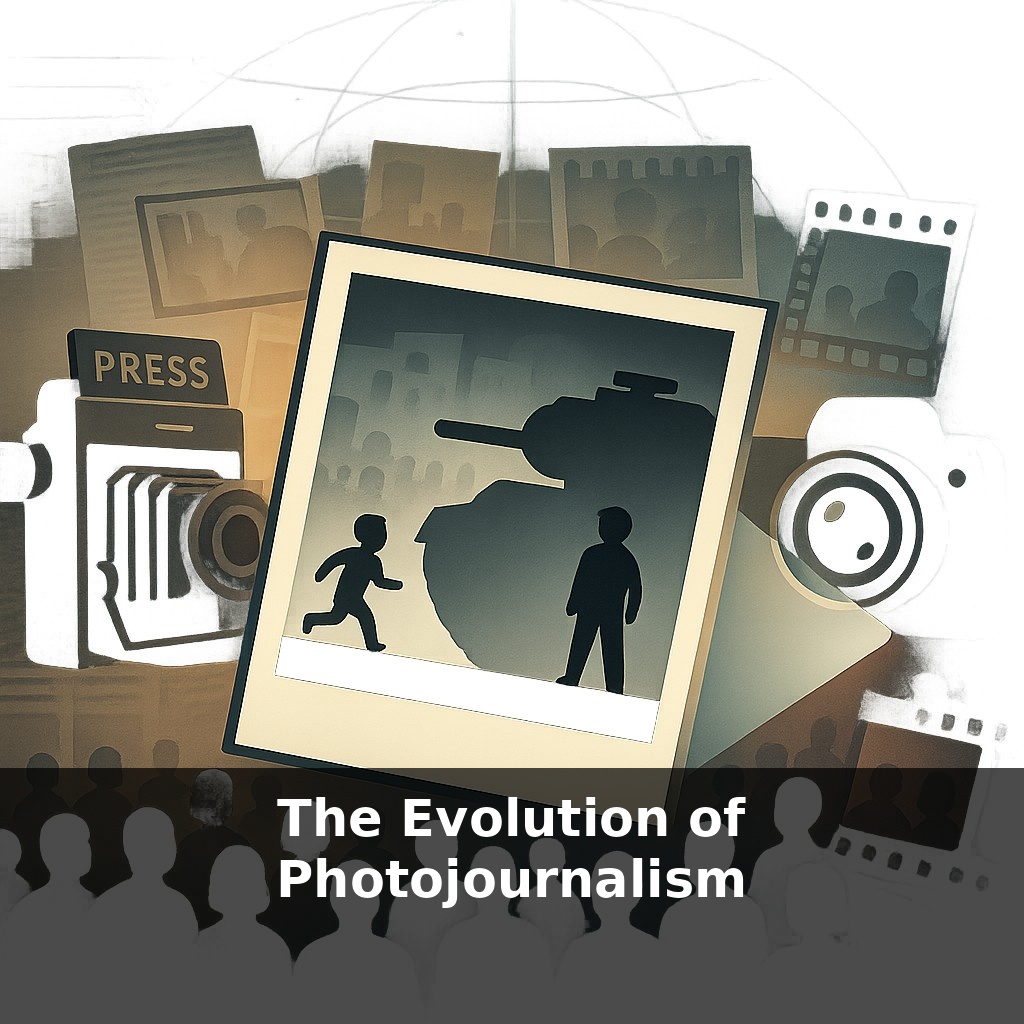
A single photograph once helped end a war, yet the person who took it wasn’t even on the battlefield. In one scene, a child runs down a road in terror; in another, a lone man blocks a tank. How do frozen moments like these move entire nations to rethink what they believe?
In 1880, a grainy image in the New York Daily Graphic quietly did something radical: it slipped a photograph into the flow of printed news for the first time. Suddenly, readers weren’t just decoding headlines; they were scanning faces, streets, skies. From that moment on, news didn’t just tell you what happened—it showed you who paid the price, who held the power, who was missing from the frame. As technology evolved—from bulky tripods to pocket-sized cameras—photojournalists could move closer, react faster, and work more like sketch artists in a storm, catching details before they vanished. By the time LIFE magazine was reaching over 13 million people a week, images weren’t just supporting the story; they were the story, turning breakfast tables into front-row seats to history.
By the mid‑20th century, cameras were slipping into coat pockets, and with them, the news slipped into everyday life. A strike in Detroit, a famine in Bengal, a protest in Paris—each could now be photographed by someone standing in the crowd, not perched on a distant rooftop. When wire services began shooting images across continents in minutes, breakfast readers in Chicago could stare at rubble in Warsaw almost in real time. The newsroom became less like a library of finished stories and more like a train station, where images arrived constantly, each one demanding a destination and a caption.
Thirteen and a half million people flipping through LIFE each week weren’t just consuming pictures; they were absorbing a visual vocabulary for how “history” should look: the heroic angle, the decisive instant, the dignified portrait of power. Meanwhile, another current was forming underneath—photographers who wanted more control over how their work was used and what stories they could tell. When four of them formed Magnum Photos in 1947, they weren’t just creating an agency; they were carving out a model where the person behind the camera had a say in where images traveled and how they were contextualized. That matters, because who owns the negatives often shapes which truths get circulated and which stay in a drawer.
As newspapers and magazines leaned harder on images, editors began betting that a single strong frame on the front page could do what a thousand-word column might not: hold a reader at the newsstand. The demand for immediacy and drama pushed photographers closer to crises, but it also deepened the tension between witnessing and staging. Cropping a cluttered street to tighten the focus on a protester’s raised fist might clarify the narrative—or oversimplify a messy reality. Ethical codes emerged not as abstract philosophy, but as guardrails responding to very specific temptations: move that object? ask someone to repeat that gesture? adjust that shadow in the darkroom?
Film stock, too, became a quiet decision about meaning. Black‑and‑white could strip scenes to shape and light; Kodachrome and other color films brought blood, uniforms, and sunsets into the frame with seductive intensity. When Kodak stopped producing Kodachrome in 2009, it marked more than the end of a beloved emulsion; it symbolized a broader pivot away from the idea that news images lived primarily on paper. By the time Reuters required digital RAW files only in 2014, the workflow had inverted: instead of shooting for the printed page and later adapting for screens, many photographers were now thinking first about how a photo would land in a scrolling feed.
Today, the same smartphone that snaps a bystander’s first blurry frame can also broadcast it worldwide before a staff photographer arrives, and AI tools are being trained not just to manipulate images, but to authenticate them. In a sense, the “front line” has shifted outward: anyone with a camera can be a first responder to history, while professionals are increasingly tasked with adding depth, verification, and continuity—turning a flood of pixels into a coherent visual record.
A teenager in Tehran filming a protest on a shaky phone, a nurse in Wuhan documenting an ICU corridor, a volunteer in Maui recording a smoke-choked sky—each is doing something war photographers once did with press credentials and metal cases of gear: creating the first draft of how an event will be remembered. Editors now sift through torrents of such images much like curators walking through an endless exhibition, asking: Which frames show consequence, not just spectacle? Which connect an isolated event to a larger pattern?
Think of it like hiking a dense forest trail: the path has been trampled by thousands of steps, yet each new footprint records a slightly different condition—mud, dust, fresh snow. Contemporary news images work similarly, layering perspectives from locals, freelancers, satellites, and staff photographers. One frame might reveal how climate shifts redraw a coastline, another how face-recognition cameras appear in a small-town square. Over time, the archive becomes less a gallery of shocks and more a map of slow transformations.
Thinner boundaries between creator and audience mean subjects can answer back, annotate, or contest the record directly under the image. Viewers aren’t just consuming; they’re comparing angles, timelines, and metadata like bird‑watchers logging rare sightings. This scrutiny may push visual reporters toward radical transparency: publishing contact sheets, field notes, even correction logs, so each frame feels less like a verdict and more like an open, revisable entry in a shared diary.
As lenses shrink and networks thicken, the most urgent question may shift from “Was this captured?” to “How was this framed, shared, and challenged?” Your role—as maker or viewer—starts to resemble a careful gardener, pruning rumor, watering nuance, and leaving space for wild, unexpected truths to take root in the public record.
Try this experiment: For the next 48 hours, act as a “mini photojournalist” and cover a single evolving local story (a street protest, a community event, a construction site changing through the day, or even your household’s morning-to-night routine) using just your phone. Shoot 10–15 images that deliberately mix “classic” photojournalism (wide establishing shot, key action moment, a revealing portrait) with more modern, interpretive frames (reflections, silhouettes, extreme close-ups, or smartphone-screen-in-frame shots that show our digital layer). Then, arrange the photos in a sequence and post them as a narrative thread or carousel with short, factual captions—no opinions, just context—like a tiny visual article. Watch how people respond (Do they comment more on the “classic” or the “modern” frames? Which gets shared or saved?) and use that reaction to decide how you’ll balance tradition and experimentation in your next visual story.