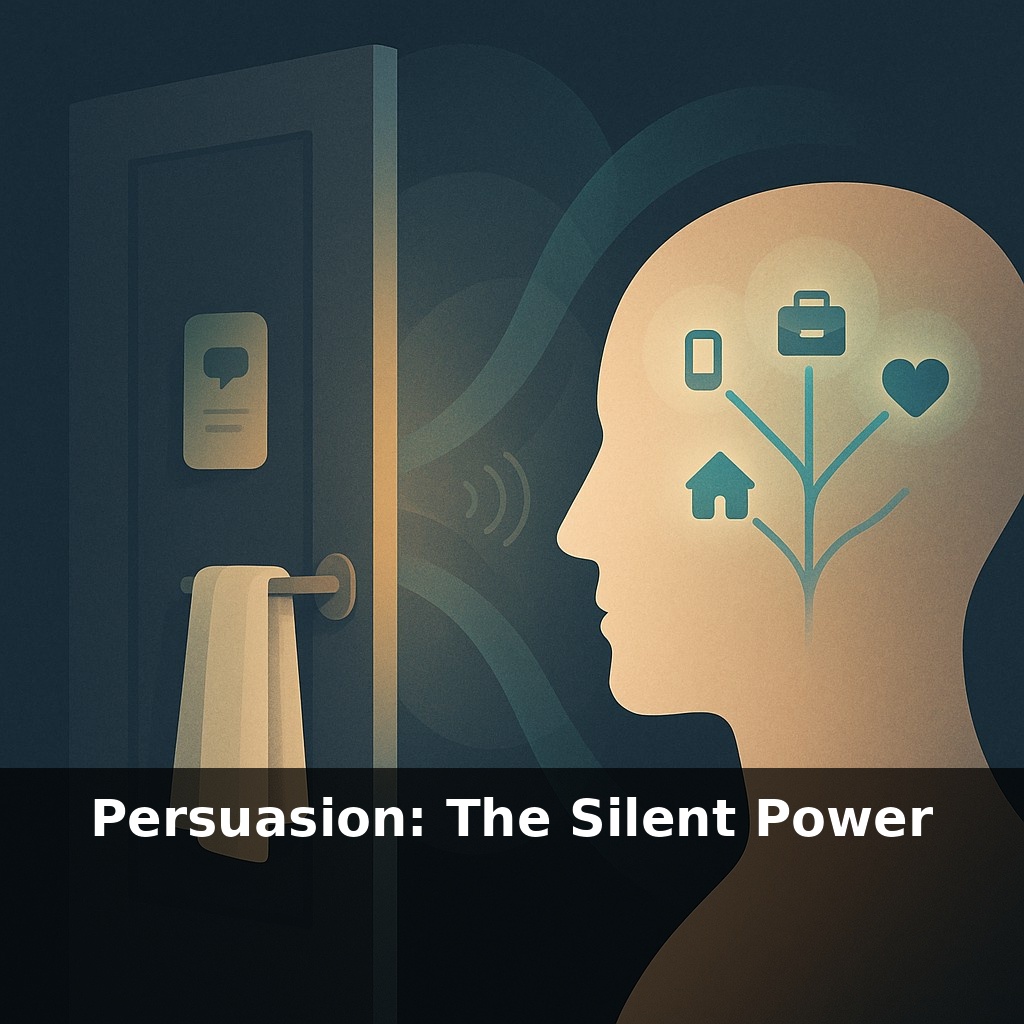
A Harvard study found a single sentence on a hotel bathroom door quietly shifted what guests did with their towels—no threats, no discounts, no lectures. Now jump to your last big decision: new job, new phone, new habit. How sure are you that choice was entirely your own?
We tend to think persuasion shows up wearing a suit and carrying a slide deck: a pitch, a debate, a hard sell. In reality, most of its power comes from quieter places—tone of voice, word order, what’s mentioned first, what’s left out entirely. A single phrase like “most people your age” can tilt your decision more than ten bullet points of data.
Researchers now track this in the brain. Subtle shifts in language light up valuation areas long before we consciously “decide.” Say a product is “95% success” instead of “5% failure,” and your neural response changes even if the numbers match. Tiny edits, different story. It’s less about adding pressure and more about rearranging the mental furniture people already have—guiding where their attention lands, what feels normal, and what suddenly seems urgent or safe.
Think about where this “silent power” actually shows up: the checkout button that’s green instead of gray, the signup form that says “Join 48,392 others,” the friend who starts a request with “I need your advice,” not “I need a favor.” Each small choice in language or design leans on patterns your brain already runs on autopilot. Reciprocity makes you feel oddly obliged after a tiny freebie. Consistency nudges you to act in line with what you’ve publicly said. Social proof whispers, “People like you do this,” while scarcity quietly turns “later” into “now.”
main_explanation: Here’s where things get uncomfortable: many of the most effective techniques don’t feel like “techniques” at all when you’re on the receiving end.
Take reciprocity. Someone picks up the tab for coffee, and later, when they ask for feedback on their project, your “yes” feels spontaneous. It rarely registers as a delayed response to that earlier kindness. In lab settings, even tiny, unexpected favors—like a researcher handing out a free soda—reliably increase compliance with later requests. The mind quietly keeps score.
Or consider consistency. The moment you say, “I’m the kind of person who follows through,” you hand future you a script. Political campaigns know this: when they first ask, “Will you vote on Tuesday?” and get a verbal “yes,” turnout goes up. You’re not just deciding; you’re defending an identity you’ve declared out loud.
Social proof adds another layer. That hotel towel sign didn’t say “Save the planet”; it said most guests reused their towels. We’re social creatures; when we’re unsure, we look sideways. Product pages showing “Best Seller” badges, testimonials from “people like you,” or live counters of “others booking this now” all borrow that instinct.
Scarcity presses a different button. “Only 2 seats left” can flip a casual browser into a hurried buyer. Internally, the choice might feel urgent, even though the information is just a line of text on a screen. Deadlines, limited editions, closing windows—all signal that indecision has a cost.
Then there’s framing and priming: subtle shifts in context that change what stands out. Describe a medical procedure in terms of lives saved versus deaths avoided, and you get different levels of acceptance. Show healthy food first in a cafeteria line, and more people take it without thinking they’ve been “sold” anything.
Storytelling weaves these elements together. Data points land one way; a concrete narrative about a single person in a specific moment lands another. The same facts, wrapped in a narrative arc, suddenly feel actionable, personal, and memorable—like a carefully drawn map through a dense forest, where every landmark gives you just enough reason to keep walking.
Think about how this plays out in everyday scenes. A manager asks, “Can you review this today so we ship on time?” instead of “Can you look at this when you have a minute?” Same task, different gravity. A nonprofit highlights one specific family’s story, then quietly notes how many donors chipped in last month. Your mind gets a face to care about and a crowd to stand with.
Online, a course creator might say, “The next cohort starts Monday; 143 people are already inside,” then show a short student story about a messy before-and-after. You’re not bullied; you’re invited into a pattern that feels both familiar and slightly aspirational.
Here’s your challenge this week: notice three moments where wording, layout, or timing nudges you toward a “yes” you weren’t planning—an upgrade screen, a friend’s request, a signup flow. For each, ask: what tiny detail made this feel easier to accept than to resist?
Regulators and designers are quietly moving from asking “Does this work?” to “Is this fair?” Interfaces will likely need “nutrition labels” for influence, flagging when biometric or AI-driven tailoring is active. Schools and workplaces may treat persuasion literacy like cybersecurity training—routine, required, slightly annoying but vital. Think of future feeds less as billboards and more as shifting mirrors, reflecting back versions of you that different actors hope will step forward.
In the end, the quiet levers shaping you can also be tools you consciously pick up. Start small: edit a subject line, soften a request, reorder how you present options, then watch what shifts. Like adjusting the lighting in a room, subtle tweaks reveal different parts of the scene—and sometimes, a version of yourself you’d rather lead with.
Start with this tiny habit: When you open a conversation (Slack, email, or in person), quickly name the other person’s goal in one short phrase before you say what you want. For example, type or say, “Since you’re trying to hit the Q2 launch date…” or “Because you want more predictable revenue…” and then continue your normal message. Do this once per day with just one person you usually try to persuade—no need to change every interaction yet. This keeps you practicing the core persuasion shift from “my agenda” to “their motivation” in a super small, doable way.