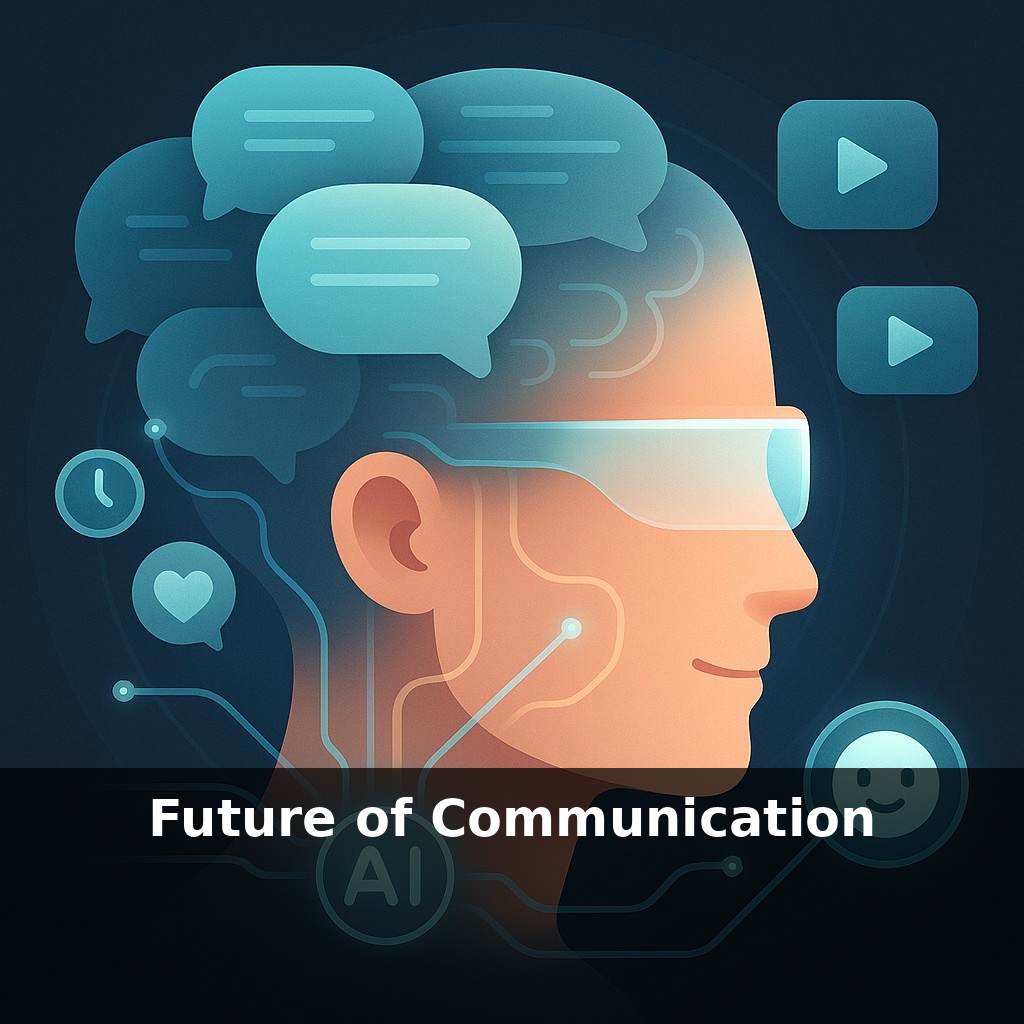
Right now, most of the world’s internet traffic is video—yet our words still pass through tiny rectangles in our hands. In this episode, we’ll step into a near future where your AI, your glasses, and maybe even your brain quietly join every conversation.
In this new landscape, messages won’t just be sent; they’ll be staged. Your words might be drafted alongside an assistant that knows your calendar, your stress level, and the context of every thread you’re in. Those micro-pauses in conversation—once awkward—could become seamless handoffs where systems summarize, translate, or even soften what’s about to be said. A disagreement with a colleague in another time zone may unfold as if you’re seated at the same table, with shared virtual notes hovering between you. Family updates could arrive as layered streams: a quick voice snippet, auto-transcribed, key moments highlighted, photos arranged into a short narrative. As networks thicken and latency drops, more of our relationships will be shaped not by distance, but by how much mediation we’re willing to invite.
On the surface, it may feel like we’re just adding smoother tools to the same old conversations. But something deeper is shifting: who “owns” the moment of connection. When an algorithm quietly decides which update from a friend you see first, or trims a partner’s late-night voice note into a two-sentence brief, it’s curating not just information, but emotion. The subtle delays, the choice of thumbnail, the auto-generated summary line—these become new levers of influence. As our calls and chats thread through more layers, the space between intention and reception gets wider, and more negotiable.
Even when you and someone else “talk” in real time, you may soon be experiencing different versions of the same moment.
As 5G hardens into infrastructure and early 6G prototypes emerge, the network stops being just a pipe and becomes a participant. 6G labs are already experimenting with channels that don’t just carry your voice, but sense motion, proximity, even micro-changes in your environment. That means a future call with a friend could quietly factor in their pace of movement, the noise around them, the devices nearby—and adjust how, when, and what gets through.
In parallel, language itself is becoming less of a barrier and more of a design choice. With real-time translation dropping below the 300-millisecond mark, the “foreignness” of another language may fade from the foreground. Two people could each speak in their native tongue, while their devices project a stabilized, culturally tuned version to the other side. The influence isn’t just in the words, but in what the translation engine decides to keep literal, what it localizes, and what it politely edits away.
Spatial computing pushes this further. As AR and VR move toward that projected $451 billion market, communication slips off a flat screen and wraps around you. A project update from a colleague could arrive as a shared 3D workspace you both step into, populated by AI-generated drafts, live metrics, and subtle attention cues. Eye focus, hand gestures, and posture can be interpreted as signals: interest, hesitation, disengagement. Some of those signals will be used to route who gets your time; others may be used to decide which relationships get surfaced first.
Satellite constellations add a different kind of reach. With low-Earth-orbit links approaching fiber-like latency, the “offline” edges of the world become newly addressable. Entire communities can join high-bandwidth conversations without ever laying ground cables. That opens enormous potential for education, organizing, and creative collaboration—while also giving persuasive actors, from brands to political campaigns, a far wider, more continuous field to operate in.
As these layers stack—dense networks, spatial interfaces, adaptive translation—the quiet question underneath every notification becomes sharper: who is this interaction optimized for, and who gets to decide?
Consider three snapshots.
First, a global team call in 2028: the designer in Lagos speaks casually in Yoruba, the PM in Berlin hears polished German, and the investor in São Paulo sees live captions in Brazilian Portuguese pinned beside a floating 3D prototype. Each person thinks they’re sharing “the same” moment—until a tiny mismatch in tone, softened differently for each, changes who seems decisive, who seems hesitant, and whose idea sticks.
Second, a rural classroom newly connected by satellite: the teacher brings in a scientist from Tokyo as a life-sized hologram. Students cluster around, asking questions in their local language while an AI quietly turns shy, fragmented questions into confident, fluent versions. Whose curiosity is the scientist actually hearing—the kids’, or the algorithm’s idealized edit?
Third, two friends on a hike wearing light AR bands. Their devices sense rising stress, nudge the topic toward easier ground, and filter one sharp comment into something gentler. Like a careful art restorer brightening an old painting, the system “improves” the scene—while slowly, invisibly, changing the original picture of their relationship.
Your future relationships may depend on how well you can “see” the hidden editors in the room. When every interaction can be tweaked, muted, or boosted, social status might hinge less on charisma and more on who controls the dials. Subtle defaults—whose alerts break through, whose updates render in full color, whose tone is smoothed—could redraw friendships, alliances, even family dynamics the way shifting riverbeds slowly redraw a coastline. The risk isn’t just distortion, but forgetting what “unedited” ever felt like.
As these layers deepen, one quiet skill gains value: noticing when a moment feels “too smooth.” Like tasting food and sensing an extra ingredient, you can learn to ask, “What was added here—and what was left out?” The future of connection may belong less to those with the loudest signal, and more to those who can still hear the faint, unedited note underneath.
Try this experiment: For your next three important messages (one email, one chat, one video call), deliberately switch the _default_ channel you’d normally use—for example, send a 60-second Loom-style video instead of an email, or a short voice note instead of a Slack message. Before you hit send, use the “future filter” from the episode: ask, “If this were auto-summarized by AI later, what 2–3 points would I want it to capture?” and say those explicitly. After each message, compare responses: How fast did people reply, how clear were the outcomes, and how much back-and-forth did it avoid compared with your usual way? Keep a simple score (1–5) for speed, clarity, and energy after each, and decide which new format you’ll adopt as your default for the next week.