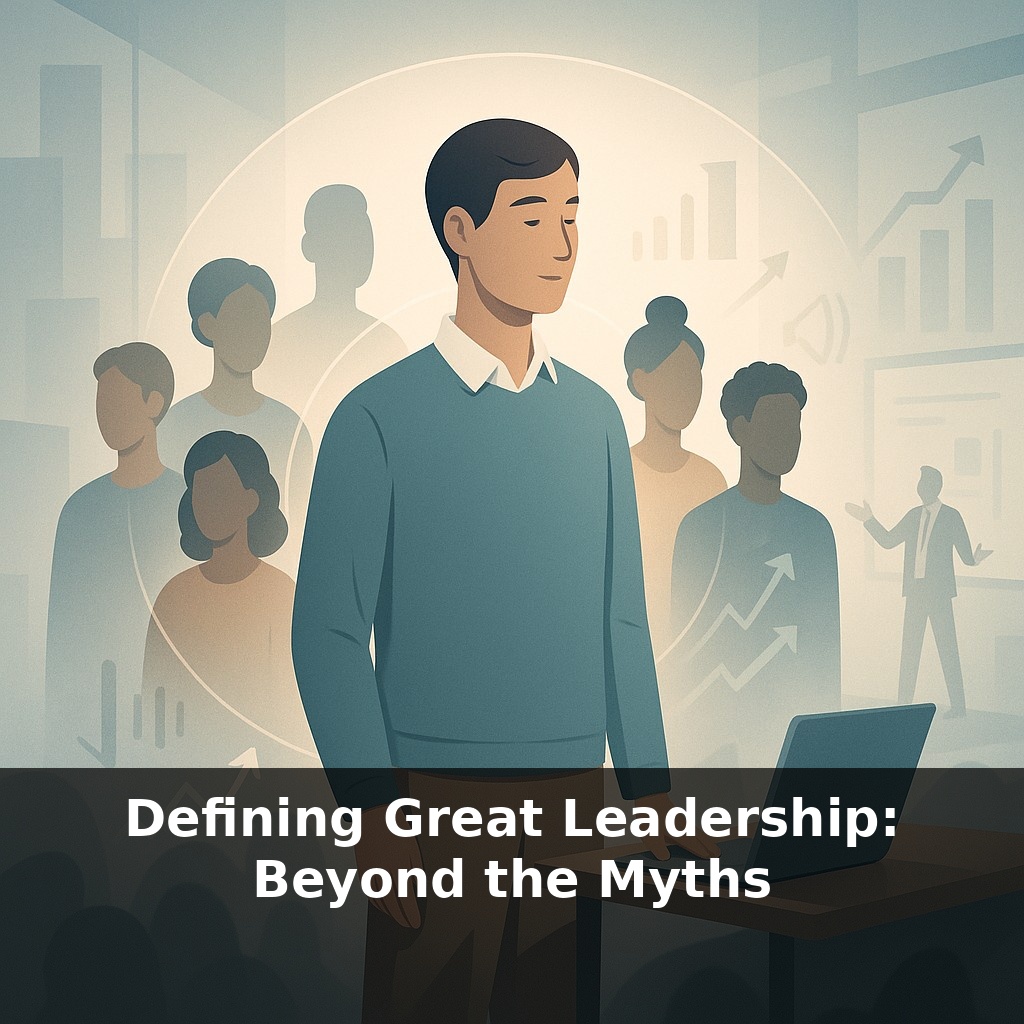
Defining Great Leadership: Beyond the Myths
📝 Transcript
A global study found that the most effective leaders often go unnoticed—yet their teams consistently outperform flashier, charismatic bosses. One manager speaks softly in meetings, another barely uses slides, yet both unlock remarkable results. So what exactly are *they* doing differently?
Some of the most quietly effective leaders share an odd pattern in their careers: they weren’t the “obvious” choice. They were passed over for the loudest voice, the sharpest dresser, the natural storyteller. Yet a few years later, they’re the ones people want to work for, the ones whose teams get the toughest assignments. Colleagues talk about them less like celebrities and more like reliable infrastructure—steady, invisible until something breaks, and absolutely essential. That’s the first clue: real leadership isn’t a spotlight skill, it’s a systems skill. It shows up in how decisions get made, how conflict gets handled, how people behave when no one is watching. And it raises a harder question: if it isn’t about personality, what *exactly* is it about?
Here’s the twist: when researchers look across industries, eras, and cultures, the same pattern keeps showing up. The best leaders aren’t defined by how they *look* leading, but by the conditions they quietly build around them. Think less “genius at the whiteboard,” more like someone configuring a complex app so the whole team can finally stop fighting with the settings and just get work done. Vision, emotional intelligence, ethics, and trust aren’t abstract virtues here—they’re levers. Pull them well, and average people start doing exceptional work. Pull them badly, and even stars begin to dim.
If you strip away job titles and personalities and just watch outcomes, a different pattern shows up. The leaders whose teams keep winning over long stretches aren’t improvising their way through; they’re running a repeatable playbook that they keep refining.
Research gives us a glimpse of what that playbook actually produces.
Jim Collins called it “Level 5” leadership: humble, fiercely determined people who leave their egos at the door and obsess over building something that lasts. Across the companies he studied, that style correlated with returns 3.3 times the market over 15 years. That’s not a great quarter or a lucky product cycle—that’s an institutional shift.
Satya Nadella’s tenure at Microsoft is another kind of x‑ray. When he took over in 2014, the company was rich but stagnant. Instead of doubling down on certainty and control, he pushed for a “growth mindset” culture: leaders asking more questions, rewarding learning, and admitting when they were wrong. In less than a decade, the company’s value multiplied several times over. The point isn’t that one slogan changed everything; it’s that a CEO deliberately practiced different behaviors and, over time, rewired how thousands of other leaders behaved.
Zoom in further and you see the same pattern at the team level. A Harvard meta‑analysis across 191 studies found that leaders with stronger emotional skills accounted for roughly a quarter of the differences in how well teams performed. That’s a huge share attributed not to IQ, budgets, or strategy decks, but to how one person consistently interacts with others.
Trust works similarly. Paul Zak’s research suggests that teams who genuinely trust their managers don’t just “feel better”—they show dramatically higher energy. People volunteer for stretch projects, share half‑baked ideas earlier, and recover from setbacks faster.
None of this looks like the myth of the lone genius. It looks more like good software engineering: define a few critical functions, make them reliable, and keep shipping small improvements. Over time, the compound interest of those choices dwarfs any one charismatic moment at a microphone.
One way to see this playbook in action is to watch what happens when a new manager takes over a struggling team. At first, nothing flashy changes: no dramatic reorg, no “vision” speech. Instead, she quietly changes three meeting norms: everyone speaks once before anyone speaks twice; decisions must have a single accountable owner; and action items always have a clear “who/when.” Six months later, the same people are shipping on time—and HR is hearing that this is suddenly a “high-performing” group.
Or take a senior leader who inherits a legacy process everyone secretly hates. Rather than mandate a fix, he runs a two‑week “friction audit”: every team member logs when they feel blocked, rushed, or confused. Patterns emerge—two key approvals and one outdated report. He kills the report, delegates one approval, and turns the other into a 15‑minute daily slot. Morale ticks up, cycle times shrink, and no one would describe any of it as heroic.
Your own experiments can be this small and this deliberate.
Soon, AI will quietly handle status updates, resource charts, even draft performance reviews. That doesn’t make leaders irrelevant; it exposes them. When dashboards surface every bottleneck and sentiment dip, you can’t hide behind “I didn’t know.” Think of it like having a mirror in every hallway: you’ll constantly see how your tone, clarity, and follow‑through land. The leaders who treat that data as a practice tool—not a threat—will adapt fastest and shape healthier careers and cultures.
Great leadership, then, becomes less a title and more a craft you practice in public. Think of each 1:1, deadline, and setback as a live experiment: which small behavior shift changes the “weather” around you? Over a career, those micro-adjustments quietly redraw your trajectory—and, just as quietly, make you the person others instinctively choose to follow.
Start with this tiny habit: When you open your calendar each morning, whisper to yourself, “Who can I make 1% better today?” and type the name of one person on your team into a 1-minute “check‑in” slot. Then, when that time comes, send them a single sentence that starts with, “What’s one thing getting in your way this week?” or “What’s one win you’re proud of from yesterday?” This keeps you out of the superhero-leader myth and builds the real leadership muscle the episode talks about: consistently clearing roadblocks and spotlighting small wins for real people.
Unlock all episodes
Full access to 7 episodes and everything on OwlUp.
Subscribe — $1.99/monthLess than a coffee ☕ · Cancel anytime