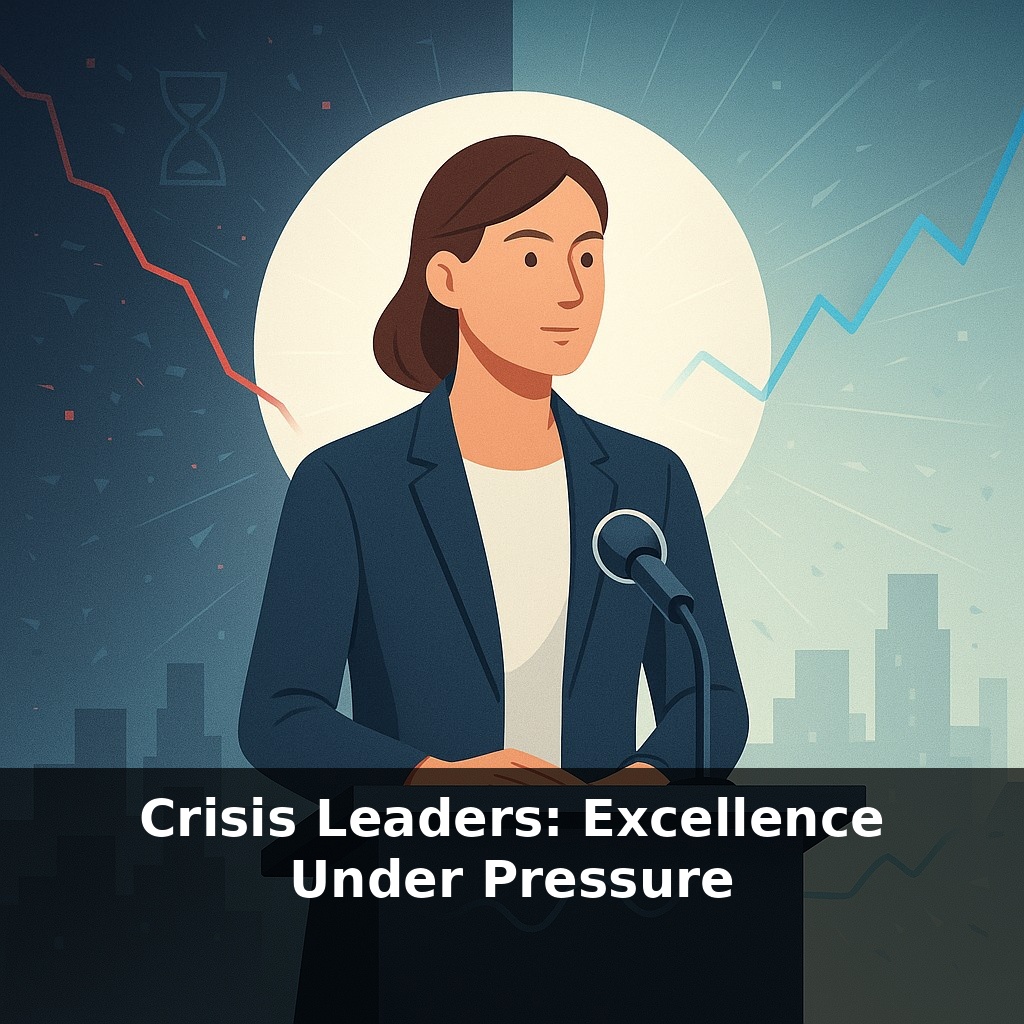
A CEO steps up to a microphone just 45 minutes after a data breach hits the news. Her voice is calm, her message is clear, and the stock stops falling. Here’s the puzzle: under pressure, most people freeze—so why do a few leaders get sharper, faster, and more human when everything breaks?
Most people think crisis leadership is about having the right answer fast. In reality, the best crisis leaders start by managing one thing first: their own biology. Under sudden pressure, your brain runs a silent auction between two systems—one that wants to react, defend, and narrow your focus, and one that wants to scan widely, connect dots, and listen. Whichever you’ve trained wins.
Neuroscience is blunt about this: if your stress response tips into “threat,” your IQ effectively drops in the moments you need it most. But if you can hold a “challenge” state, your body still surges with energy, while your prefrontal cortex—the part that handles judgment, ethics, and long-term thinking—stays online.
The striking part? This isn’t a fixed trait. From how you breathe during tense meetings to how often you rehearse worst-case scenarios, you can systematically raise your ceiling for clear, ethical decisions when stakes spike.
In real crises, this inner game shows up in very outer ways: the speed of your first statement, how steadily you speak, whether you can say “we don’t know yet” without panicking your team or investors. Top-performing firms move in under an hour not because they’re reckless, but because they’ve pre-built playbooks, practiced roles, and aligned values—so judgment, not chaos, fills the gap. Think of it like a well-run kitchen during a rush: tickets stack up, but no one sprints blindly; they rely on mise en place, short commands, and trust in the system they built.
The leaders who excel here aren’t braver or colder; they architect their environment so that, when pressure hits, good decisions are the default. Three levers matter most: how they structure information, how they share authority, and how they communicate uncertainty.
First, information. In a crisis, raw data explodes: legal updates, social feeds, operations status, regulator calls. Great leaders don’t try to personally “drink from the firehose.” They appoint a small intel cell whose only job is to filter, verify, and prioritize. Inputs are tagged: confirmed, probable, rumor. Decisions are then based on “best available truth,” updated on a fixed cadence—every 15, 30, or 60 minutes—so people stop waiting for perfection and start acting on rolling clarity.
Second, authority. The hero narrative says one person should decide everything. High-performing organizations do the opposite: they predefine “decision domains.” In a product failure, for example, safety owns recall thresholds, operations owns shutdown triggers, communications owns wording and channels, finance owns exposure scenarios. The senior leader’s role shifts from “chief decider” to “chief integrator,” asking: What are we solving for first—life and safety, containment, or continuity? That guiding priority prevents turf wars from slowing choices.
Third, communication. The best crisis messages do three things quickly: state what happened in plain language, name what matters most (“our first priority is…”), and outline the next checkpoint (“we’ll update you by…”). They resist the urge to over-reassure or speculate. When they genuinely don’t know, they pair that admission with process: what they’re doing to find out, who’s involved, and how stakeholders can reach them.
This discipline pays off. Firms that issue a first public statement within that 45-minute window tend to follow rehearsed templates, not improvisation. Organizations that have run realistic simulations know which surprises will break their systems—and they’ve already patched the obvious cracks. So when the real thing arrives, leaders aren’t scrambling for basics; they’re free to make the few judgment calls that truly require their full attention.
When a recall blindsided a consumer brand, their CEO didn’t start by calling lawyers; she convened three people: operations, customer support, and comms. Their first move wasn’t a press release—it was a “ground truth” channel where store managers could send photos, timestamps, and customer reactions in real time. That unfiltered stream surfaced a pattern: one region was hit hardest, but another was driving most of the online outrage. They split response work accordingly: logistics to one map, messaging to the other.
Think of it like debugging a live software outage. Senior leaders don’t stare at every log line; they ask for a clean dashboard: What’s definitely broken? What’s at risk? What’s stable? One tech company builds this discipline by running “chaos drills” every quarter, randomly taking down non-critical systems and timing how long it takes for someone to notice, escalate, and communicate. The metric they track isn’t just time to fix, but time to give a credible, specific update that reduces rumor and guesswork for everyone watching.
Leaders who treat crises as “edge cases” will feel increasingly outdated. ESG scrutiny, AI tools, and polycrises mean the spotlight flips on instantly and may never fully turn off. The emerging standard looks less like a warrior and more like a systems designer: someone who can tune their own physiology, read live digital sentiment, and question algorithmic advice. Think of it as moving from fire alarm to smoke detector—subtle signals matter, and so does how visibly you respond to them.
Your challenge this week: Run a 24-hour “micro-crisis drill” with your team. Pick a hypothetical hit to your reputation, operations, or data, then:
- Set a 45-minute timer to draft your first internal and external message. - Assign who would own intel, who would decide, and who would communicate. - Track how your own body reacts during the drill—breathing, heart rate, tension.
Afterward, debrief: Where did clarity break down first—information, authority, or communication?
The leaders who grow fastest from upheaval treat each incident like a lab experiment, not a verdict on their worth. They replay key moments, ask “What signal did I miss?” and adjust tiny habits—how they enter the room, who they call first, what they measure. Over time, they’re less like firefighters and more like gardeners, quietly shaping conditions so fewer sparks catch.
Before next week, ask yourself: Where in my current work or life do I tend to go “tunnel vision” under pressure, and what 2–3 alternate perspectives (other departments, customers, front-line staff) could I deliberately seek out the *next time* I feel that stress spike? In your next high-stakes moment, how will you slow yourself down for 60 seconds—what exact phrase will you say to the team (“Here’s what we know, here’s what we don’t, here’s our next step”) to create calm instead of confusion? And thinking of a recent mini-crisis you handled, if you replayed it as a “practice rep,” what would you choose to communicate earlier, delegate faster, or stop doing entirely so you’re better prepared when a real crisis hits?