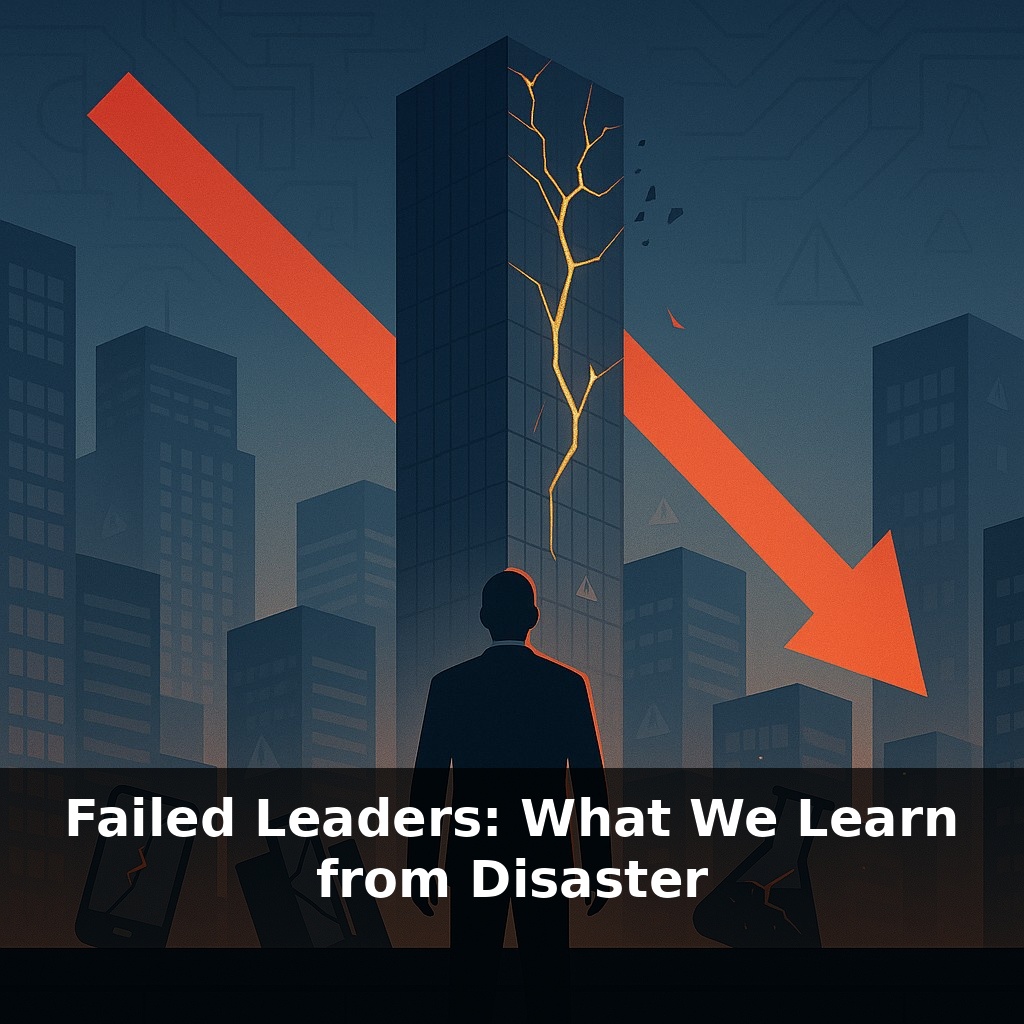
Nokia once owned almost half the world’s phone market. Blockbuster had thousands of buzzing stores. Theranos was valued in the billions. None were small, foolish, or underfunded. So how do leaders steer giants straight into disaster—and why do smart people follow them?
“Seventy percent of corporate transformations fail—mostly because of how leaders behave.” That’s not a cynical tweet; it’s Harvard Business Review’s data. So if failure is this common, the interesting question isn’t “How did they mess up?” but “Why did they keep going when the warning lights were clearly on?”
In careers, we often meet these warning lights first as small, uneasy moments: the metric that doesn’t fit the success story, the junior colleague who raises a concern and gets sidelined, the strategy meeting where dissent suddenly goes quiet. These aren’t just organizational quirks; they’re early signs of deeper fractures in judgment, culture, and ethics.
In this episode, we’ll treat famous corporate collapses like a user manual written in reverse—showing you the subtle habits that quietly steer even capable leaders toward disaster, and how to spot them in your own path before they harden into fate.
Here’s the twist: failures like Blockbuster, Nokia, and Theranos rarely begin with dramatic decisions. They start in the routine rhythms of leadership—who gets invited to meetings, which numbers are highlighted in dashboards, whose bad news gets softened or delayed. Over time, these patterns quietly rewrite what “normal” looks like. A leader skips one uncomfortable question in a review, then another; soon, the team learns what not to say. Careers get shaped in this space. Your growth often depends less on your potential and more on how your environment handles inconvenient truths.
Nokia’s engineers built working touchscreen smartphones years before the iPhone launched. Blockbuster executives were offered a chance to buy Netflix. Multiple Theranos insiders flagged problems long before regulators arrived. The pattern isn’t lack of intelligence or resources; it’s leaders training themselves—and everyone around them—to look away at the crucial moments.
Three forces tend to drive that blindness.
First, strategic tunnel vision. Once a story about “how we win” takes hold, contradictory data stops looking useful and starts looking disloyal. At Nokia, teams who pushed for a radical software shift ran into leaders still optimizing the old playbook. In careers, this shows up when you’re rewarded for polishing the current plan, not questioning whether it still fits reality.
Second, cultural self-protection. People learn quickly what is safe to say. At Theranos, internal critics were isolated or pushed out. But the everyday version is quieter: a manager who never admits uncertainty, a VP who only spotlights “wins” in all-hands meetings. When leaders won’t expose their own doubts, no one else risks exposing theirs. Performance reviews become theater, not diagnostics.
Third, over-concentration of judgment. When one person’s instincts dominate, the system stops evolving. Blockbuster’s late pivot to streaming was shaped by leaders still emotionally invested in physical stores. In your own path, this might be a charismatic boss whose opinion silently outranks customer feedback, analytics, or your frontline experience.
Notice what all three share: they break feedback loops. There’s data, but it doesn’t change decisions. There’s concern, but it doesn’t reshape priorities. Over time, careers inside these systems tilt toward compliance skills—reading power, smoothing conflict, defending legacy choices—rather than learning skills like reframing, experimenting, and admitting partial failure early.
For individual leaders, the shift starts less with dramatic courage and more with small structural choices: who is allowed to veto a plan, which metrics trigger a rethink, how dissent is logged and revisited, not just tolerated in the moment. The question under every meeting becomes: “What would need to be true for us to change our minds?”
A practical way to see this up close is to zoom in to team scale. Picture a product lead who keeps extending a launch date without ever asking why estimates are always wrong. No one is lying; they’ve just learned that surfacing real obstacles leads to extra late-night “heroic pushes,” not smarter planning. Over a year, the calendar is full, the roadmap looks busy, but almost nothing meaningfully improves. Another example: a director proudly runs “open forums,” then subtly punishes the one person who challenges a pet initiative by cutting them from a high-visibility project. Everyone notices. Next quarter’s forum is quiet, efficient—and useless. On the flip side, some leaders build small rituals that keep them honest: a standing agenda item called “What are we pretending not to know?”; a rotating “red team” of juniors asked to poke holes in sacred projects; a rule that any metric trending the wrong way gets five minutes of discussion, even on celebratory days.
Boards and investors are starting to treat failure patterns like a portfolio of risks to hedge, not one-off stories to dissect. Expect promotion decisions to hinge less on flawless track records and more on how leaders respond when a bet goes sideways—who runs a clear “after action,” who corrects course quickly, who shares the lesson widely. Leadership brands will increasingly be built on visible recoveries, not just glossy highlight reels.
You won’t face a Nokia‑scale crisis every week, but small choices train your instincts. Leaders who stay curious under pressure treat uncomfortable data like a coach treats game footage: sometimes painful, always instructive. Over time, that habit does more than avoid disaster—it builds a reputation for judgment people actually trust when stakes rise.
Before next week, ask yourself: 1) “Where in my current role am I quietly repeating a ‘disaster pattern’ I’ve seen in failed leaders from this episode—like ignoring bad news, rewarding loyalty over competence, or refusing to reverse a bad decision—and what would it look like to interrupt that pattern in my next meeting or decision?” 2) “Who on my team (or in my life) is most likely to tell me the uncomfortable truth the way those whistleblowers and dissenters tried to, and how can I explicitly invite—and protect—that kind of candor in our next conversation?” 3) “If I woke up tomorrow to a crisis similar to those in the episode, what is one concrete safeguard I wish I had already put in place (a clear decision rule, a red-team review, a pre-mortem), and how can I start putting that safeguard in motion today?”