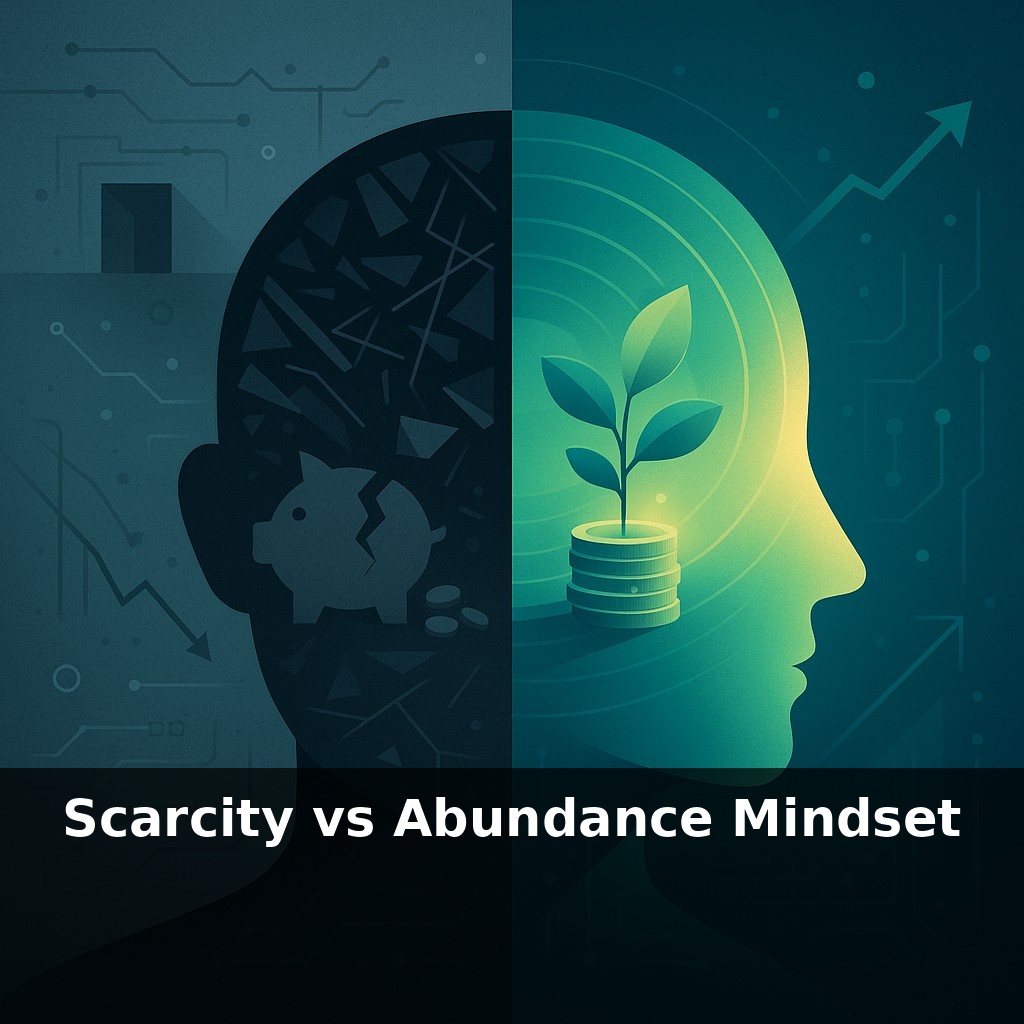
A man wins millions in the lottery… and ends up broke within a few years. Another quietly invests a modest paycheck and retires wealthy. Same economy, same stock market, totally different results. The twist? The real gap between them isn’t money at all—it’s how their minds frame scarcity and possibility.
Most people think the rich “get” more opportunities because they already have money. Research suggests something subtler: the way they *think* changes which opportunities they can even see. Behavioral economists have found that when your brain is locked onto the next bill, it literally has less bandwidth for long-term moves like learning a new skill, starting a side project, or understanding an investment. Meanwhile, people who feel they have a little space—time, money, or support—tend to scan further ahead, notice patterns, and connect dots others miss.
This shows up in quiet, unglamorous ways: choosing a course over a quick payout, accepting short-term discomfort for future leverage, or partnering with others instead of competing for scraps. Over time, those small, forward-leaning choices stack into very different financial realities—without the starting line ever looking that different.
Here’s the twist most people miss: neither mindset is “positive thinking.” They’re strategy settings your brain defaults to under pressure. Behavioral data shows that when money always feels on the edge, your choices shrink to “avoid the hit today”—so you say yes to overtime, no to learning, yes to penalties, no to planning. In contrast, an abundance orientation isn’t about spending freely; it’s about having just enough slack to ask, “What pays off next year?” That’s why two people can earn the same salary, but one quietly builds assets while the other stays stuck in the same monthly loop.
Technically, your brain is running two very different “operating systems” here—and money is only one of the inputs that switches them on.
Under a chronic sense of “not enough,” neuro‑imaging labs see something very specific: regions responsible for impulse control, planning, and weighing trade‑offs are partially hijacked. Mullainathan and Shafir’s work suggests the drop in functional capacity is comparable to losing a full night’s sleep—about 13 IQ points—every time your mind locks onto the next urgent financial threat. You can still work hard, but the quality of your decisions degrades in ways you can’t feel in the moment.
That shift quietly rewrites your relationship with time. Scarcity pulls future rewards toward zero; a dollar next year feels almost worthless compared with a dollar today, so fees, interest, and missed compounding don’t *emotionally* register. This is why someone can intellectually know that investing early matters and still repeatedly postpone it: the internal weighting of “now” versus “later” is distorted.
An abundance‑tilted setting does something different: it stretches your time horizon and makes distant payoffs feel real enough to act on. That’s what shows up when Vanguard notices that clients with a forward‑leaning orientation are multiple times more likely to own equities instead of sitting entirely in cash. It isn’t that they love risk; it’s that they perceive volatility as a temporary cost in a longer game, not a verdict on their safety.
You can see this contrast starkly with lottery winners versus compounding investors. Lottery wealth arrives without building the internal models required to manage it. The old mental defaults stay in place, and within five years, roughly 94% haven’t just failed to grow their windfall—they’ve lost it. Buffett’s career is the mirror image: same human brain hardware, but trained to keep capital in productive assets for decades. More than 80% of Berkshire’s value traces back to the simple, psychologically difficult act of not interrupting compounding.
Entrepreneurs, long‑term investors, and builders in any field tend to share that same mental habit: they treat today’s resources—money, skills, relationships—as seeds, not trophies. The external strategies vary wildly; the underlying setting that makes those strategies sustainable is surprisingly consistent.
A junior developer gets a $500 bonus. With a squeezed, short-horizon frame, that money “belongs” to this weekend: gadgets, delivery, a night out. Monday looks the same as last Monday. With a wider, growth‑oriented frame, the same $500 becomes a one‑time chance to buy time: three months of an online course, a better laptop that cuts build times, or a small cushion that lets them say yes to a risky internal project. Ten such forks don’t feel dramatic in the moment, but the trajectories diverge hard over five years.
You see a similar fork in small businesses. A café owner facing a slow month can slash every variable cost, run cheap beans, and skip staff training—protecting this week’s margins while quietly eroding next year’s reviews. Another owner in the same street uses a modest cash buffer to test a pre‑order system, refine a signature drink, and collect emails. Same rent, same foot traffic, different mental default about what today’s constraints allow.
Your challenge this week: each time money shows up unexpectedly—refund, side income, saved expense—run a 48‑hour experiment. Don’t spend or allocate it immediately. Instead, list three uses: one that makes today easier, one that reduces a recurring drag (like a fee, debt interest, or a broken tool), and one that might expand your capacity next month (skills, systems, relationships). After 48 hours, choose deliberately among the three. By the end of the week, notice whether your automatic pull is toward relief, repair, or expansion—and what that suggests about the “mental setting” you’ve been practicing.
As AI tools spread, the real divide may be less “who has cash” and more “who feels free to experiment.” People who treat new tech like a low‑stakes sandbox will quietly stack skills, automations, and tiny side bets—much like musicians who keep layering tracks until a song clicks. Others may only touch AI when forced by employers. Over time, that gap in digital “fluency” could compound into different careers, networks, and leverage, even for people starting on similar incomes.
So as AI spreads, the real leverage may come from how you *practice* thinking, not just which tools you click. Notice who treats each new app like a blank studio: they try riffs, keep what sounds good, discard the rest. The more often you do that with money and tech, the more your default setting shifts from defending today to quietly engineering your future.
Start with this tiny habit: When you notice yourself thinking “there’s not enough” (money, time, opportunities), pause and say out loud, “Someone else winning doesn’t mean I’m losing.” Then add one super-specific abundance reframe, like “If they built a 7-figure business, that proves it’s possible for me too.” Do this just once a day the first week, and treat it like a quick mental rep, not a big mindset workout.