Jeff Bezos once said Amazon burns through “hundreds of millions of dollars of failures” every year—and still wins. In this episode, we’ll step inside that mindset and explore why some people *run toward* risk, while most of us are busy trying to avoid it.
“Half our bets will probably flop” is a *feature*, not a bug, in how wealthy investors operate. Top venture capital funds openly expect roughly 50% of their startups to return less than they put in—and still target 20%+ yearly returns. That sounds reckless until you see the trick: they don’t try to be right more often, they try to be **wildly right** when they *are* right.
Here’s where technology enters the story. Software, networks, and AI are perfect environments for these “asymmetric payoffs”: limited cost to test, near‑zero cost to scale. A single app, protocol, or model can go from side project to global infrastructure without needing factories or shipping lanes. So instead of asking, “Will this definitely work?”, the wealthy ask, “If this works, can it pay for a thousand misses?” In their world, uncertainty isn’t something to erase—it’s raw material to engineer into upside.
Wealthy investors don’t just *accept* lopsided outcomes—they deliberately **engineer** them. Technology makes this practical. You can spin up an AI tool, a niche app, or a small SaaS product for the cost of a vacation, then use contracts, partnerships, and options to keep any blow‑up contained. It’s less “go big or go home” and more “run many small, capped experiments that might secretly be huge.” Think of how indie musicians now drop tracks online: most songs quietly sink, but one breakout hit can fund all the misses and reshape their entire career.
When rich people talk about “good risk,” they’re usually talking about **payoff shape**, not feelings.
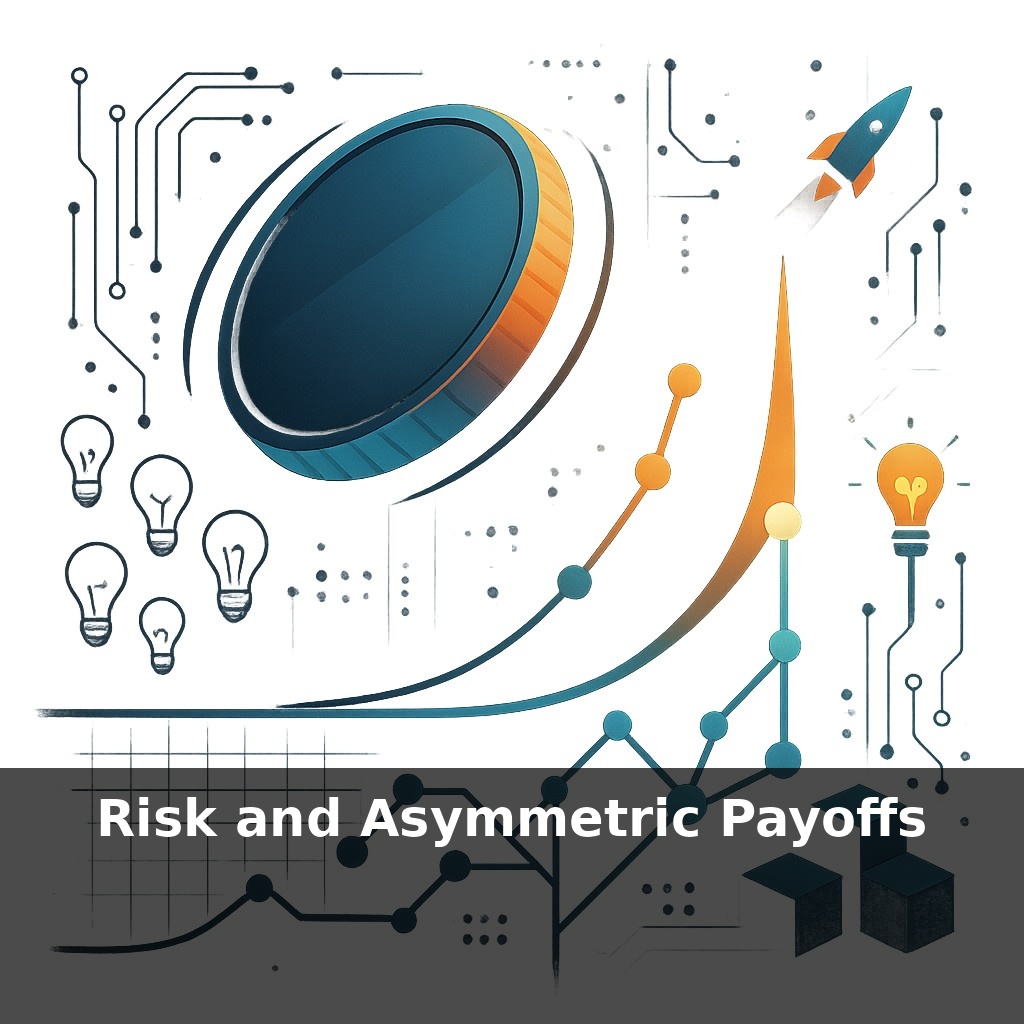
Most people focus on probability: “What are the chances this works?” Wealthy investors obsess over geometry: “How tall is the upside, and how hard is the floor?”
That’s what “asymmetric payoff” really is: a carefully built payoff *shape* where the line down is short and the line up can stretch a long way. Technology makes that shape easier to design, but the idea shows up everywhere once you start looking.
Take a tech‑enabled real estate deal. A developer might: - Put in a small equity stake - Use bank debt and outside partners for the bulk - Add a profit‑sharing clause if rents cross a certain level - Layer in data‑driven pricing tools to push revenue
Outcome? Their cash at risk is limited to their equity, but if the building becomes a hotspot, their bonus structure kicks in and multiplies gains. Same property, very different payoff *shape* than the bank’s or the contractor’s.
Or look at patents. A founder can: - Spend a fixed amount to file and maintain a patent - License it to several manufacturers - Keep royalty rates that scale with volume
Most patents sit idle or pay modestly. But the few that sit inside a blockbuster product can throw off cash for years, without more capital from the inventor. Small, defined cost; open‑ended royalty stream.
Even careers can be structured this way. Consider: - A machine‑learning engineer at a big tech firm on salary vs. - The same engineer joining an early‑stage startup for lower cash and meaningful equity
Both are “working a job,” but the second person has tilted their payoff shape—accepting constrained downside (some lost salary, some resume risk) for the chance that their equity does 20–100x if the company hits.
Notice what’s missing in all of these: nobody is trying to be a heroic forecaster. Instead, they: 1. **Cap exposure** at a level they can emotionally and financially survive. 2. **Stack upside levers**—equity, royalties, profit‑shares, performance fees—on anything that might scale. 3. **Run multiple shots** so the low‑probability wins have a chance to show up.
It’s closer to how a touring band plans cities than how a gambler plays roulette: a few breakout shows can pay for an entire leg of the tour, but only if they’ve arranged their deals so they actually share in that upside.
A songwriter releasing music online offers a clean example. They can record at home, upload to streaming platforms, and maybe pay a freelancer for cover art. Worst case, a few hundred people listen and nothing much happens; the “loss” is limited to time, modest cash, and maybe some ego. But if one track lands on the right playlist or goes viral on TikTok, the payoff can cascade: streaming revenue, sync deals, live shows, merch, brand collabs. Notice the structure: finite input, open‑ended pathways for upside.
Wealthy investors use technology to create similar trees of possibility. Take a small check into a developer building tools for musicians: low fixed amount in, but branches everywhere—equity in the company, a slice of catalog royalties, rights to future tools. Most branches yield little, but one hit feature inside a major platform can light up the entire tree. The trick isn’t predicting *which* branch wins—it’s planting enough, while keeping the cost of each individual branch strictly contained.
AI may quietly widen the gap between those who *shape* payoff curves and those who just ride them. As tokenisation turns cash into tiny slices of everything—songs, buildings, lawsuits—you could scroll past dozens of asymmetric bets before breakfast. The temptation will be to treat them like lottery tickets. The opportunity is to treat them like draft songs: rough ideas you can iterate, remix, or walk away from before they cost you the whole studio.
The next step isn’t copying wealthy investors, it’s noticing where your own life already has capped downside and expandable upside. Side projects, skill stacks, and online distribution all quietly bend your curve. Like tuning an instrument, tiny adjustments—who you collaborate with, where you publish, how you price—can shift which notes have room to ring out.
Before next week, ask yourself: Where in my life or work am I currently taking “symmetric” bets—putting in a lot of time, money, or reputation for only a small or capped upside—and what would it look like to gradually exit or shrink those? Which 1–2 asymmetric bets could I place this month (for example, a small experiment, a low-cost project, or a single email to a high-upside contact) where my downside is limited but the potential upside is meaningfully large? If one of these bets failed completely, what would the *real* worst-case scenario be (in terms of money, time, and credibility), and what specific guardrails could I put in place today to make that downside even smaller?