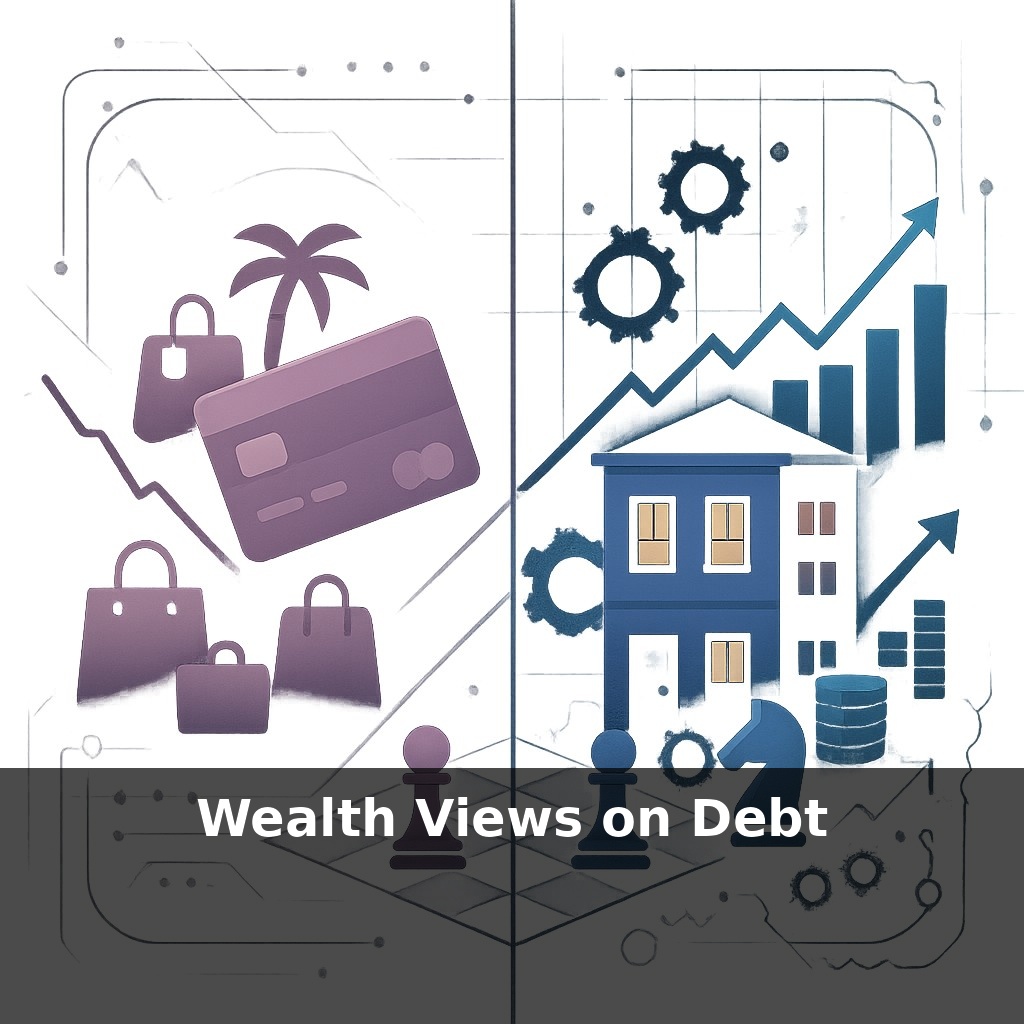
About half of U.S. millionaires carry debt on purpose. Strange, right? One person swipes a card for a vacation; another borrows against stocks to buy an apartment building. Same word—“debt”—completely different game. The real question is: which game are you actually playing?
Here’s where the gap quietly opens. Most people experience debt as a monthly payment; affluent people experience it as a moving part in a bigger system. Think about a family renting out a small duplex while still making payments on it. To their friends, they’re “in debt.” On their spreadsheet, the rent covers the loan, the tenant slowly buys them the building, and the tax bill is softer than it looks.
Wealthy individuals tend to ask different first questions: not “How much per month?” but “Who’s really paying this?” “What cash flow does this unlock?” “What protection do I get on the downside?” Sometimes they even keep cheap loans on purpose while holding extra cash or investments, trading certainty of ownership for flexibility and optionality. To them, the interest rate is only one line in a much larger story.
Wealthy borrowers also zoom out over time. They’re less fixated on “owning everything outright” and more on, “What will this position look like in 5, 10, 20 years?” That’s why they’ll accept a long repayment schedule if the asset beneath the loan can grow, throw off income, or shield them from taxes. Think of a tech founder who keeps a modest salary, but quietly uses a securities-backed line of credit to fund new projects without selling shares. To outsiders, they “still owe the bank.” On their dashboard, that loan is just one lever in a larger, evolving strategy.
Most affluent borrowers start by classifying every dollar they owe into just two buckets: debt that builds the balance sheet, and debt that drains it. One funds something that can pay you back (with income, appreciation, or tax benefits); the other funds comfort, convenience, or status today and quietly taxes your future cash flow.
This is where their thinking splits from the average consumer. When they look at a loan, they rarely stop at, “Can I afford this payment?” They run through a different sequence:
- What does this borrowing *control* that I couldn’t control otherwise? - Who or what will realistically service this over time—me, a tenant, a customer, or tax savings? - If the world gets ugly, how bad can this position hurt me, and how fast can I exit?
That last piece—downside first—is where wealthy people become almost paranoid. They stress-test. A landlord doesn’t just check if rent covers the bank; they model vacancies, repairs, rate shocks, recessions. A business owner considering equipment financing will ask, “If revenue drops 30%, does this still make sense—or does this payment turn into a noose?”
They also pay close attention to *sequence*. Average borrowers often layer debts haphazardly: car, card, personal loan, then a bigger card. By the time something goes wrong, every income dollar is already spoken for. Affluent borrowers tend to stack leverage in a specific order: lowest cost, most flexible, and most closely tied to productive assets at the base; shorter-term, riskier obligations only on top, and only when the foundation comfortably supports it.
And they respect the power of compounding on *both* sides of the ledger. High-rate liabilities are treated like emergency fires to put out early, because every month they survive, they grow more dangerous. Lower-rate, productive loans can be allowed to run, precisely because the asset’s compounding is expected to outrun the obligation.
One helpful way to see their mindset: a skilled musician doesn’t just play as many notes as possible; they choose *which* notes, in *what* order, to create harmony instead of noise. Wealthy borrowers do the same with obligations and opportunities, arranging them so the whole financial “sound” stays coherent even when the tempo changes.
Think of three friends, each with the same $20k access to credit.
Friend A takes a personal loan to redo a kitchen in a rental unit—nothing fancy, just sturdy upgrades that justify higher rent and cut maintenance calls. The higher rent more than covers the payment, and when they refinance later, that $20k shows up as a fatter appraisal and better terms on the next property.
Friend B uses the same $20k to lock in bulk inventory for a small e‑commerce brand ahead of holiday season. They negotiate a supplier discount for paying upfront, then turn that stock over at retail prices. The “debt” lives only a few months, but the customer base and supplier relationship last far longer.
Friend C spreads $20k across cards for flights, concert tickets, and impulse shopping. There’s no extra income, no resale value, and no tax help—only tomorrow’s paycheck pulled into today.
The wealthy mindset studies A and B, then asks: how many versions of those can I assemble without tipping into C?
Six percent inflation, tokenized assets, and algorithmic lending create a strange new landscape: your future “lender” might be a smart contract, not a bank. In that world, the real edge is no longer access, but judgment—knowing when *not* to pull the trigger. Think of it like choosing connecting flights: the cheapest route with tight layovers can wreck your trip if one leg is delayed. The savviest players now optimize for resilience first, returns second.
Your challenge this week: take one recurring expense in your life and reverse‑engineer how a disciplined user of leverage might redesign it. Not to copy them—but to see the hidden assumptions in your current approach.
The quiet shift is this: instead of asking “Is this normal?” you start asking “What does this unlock later?” That’s how a streaming bill can become a course budget, or a nightly rideshare becomes seed money for a reliable used bike. Small swaps like these won’t trend on social media, but over years they redraw who owes whom—and for what purpose.
Before next week, ask yourself: “If I treated debt like a *tool* instead of a burden, which of my current debts (credit cards, car loan, student loans, mortgage) would actually qualify as ‘productive’ and why?” Then ask: “If I had to pick **one** specific debt to aggressively pay down because it drains my peace of mind the most, which one would it be, and what exact dollar amount could I realistically redirect toward it this week?” Finally, ask: “Looking at my last 7 days of spending, which **three** purchases would my ‘future wealthy self’ say weren’t worth going into or staying in debt for, and what would I do differently with that money today?”