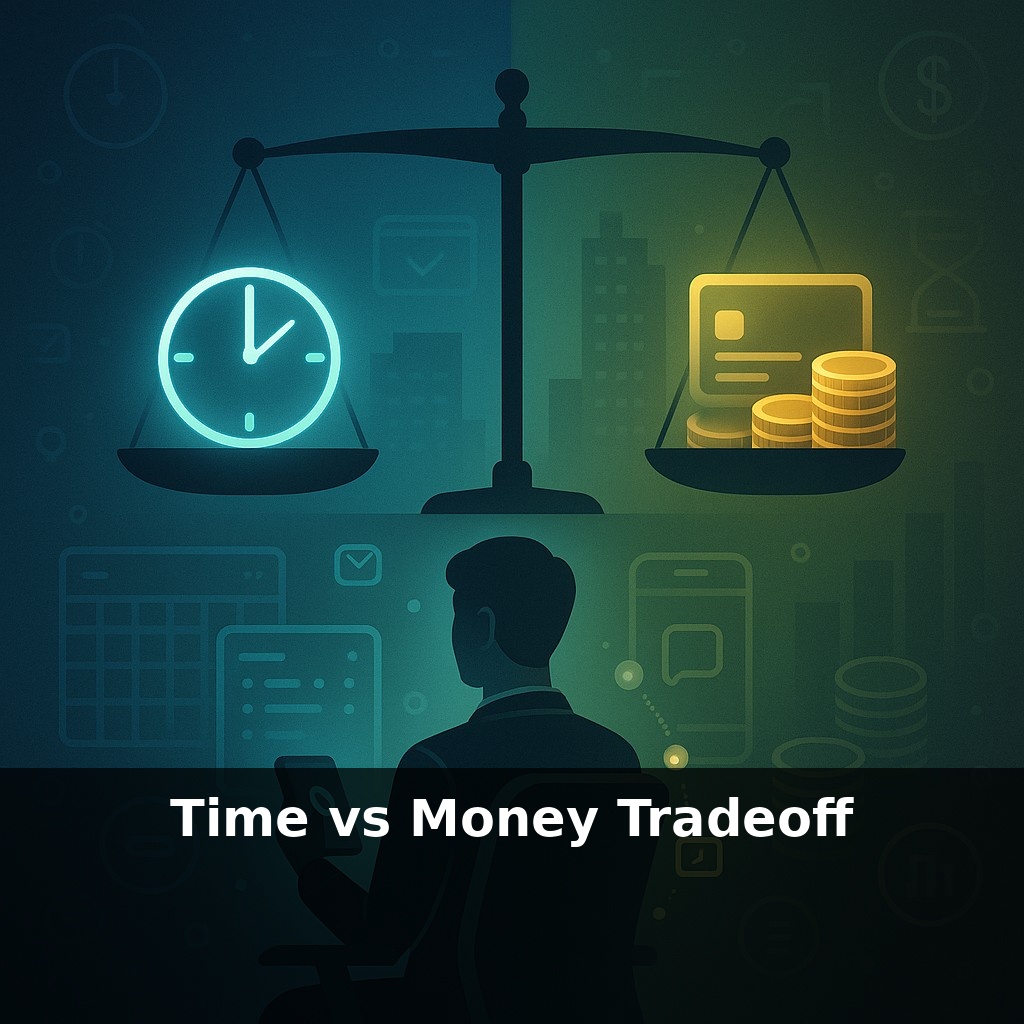
A CEO in the U.S. can earn more in one hour than many people do in a month—yet some still wait in long lines to save a few dollars. Today we step into that quiet paradox: when does chasing a little extra cash quietly steal the one thing you can’t earn back—your time?
Think about the last time you felt truly “time‑poor”: inbox overflowing, errands stacked up, still answering messages at night. Now contrast that with how the wealthiest people operate. Their schedules are aggressively protected, their calendars curated like prime real estate. This isn’t just ego management—it’s economics. Once you cross a certain income threshold, each extra dollar does less for your life than each extra free hour. So the game quietly flips: the rich stop asking, “How do I earn more?” and start asking, “What am I still doing that someone—or something—cheaper than me could do?” Technology, staff, even paid conveniences become tools to buy back mental bandwidth, not just convenience, and that shift quietly rewires every decision they make.
Here’s where the tradeoff gets concrete. Wealthy people rarely ask, “Is this expensive?” in isolation—they ask, “Expensive compared to what?” Swapping $30 for a cleaner might sound indulgent, until you realize it could free an hour you’d otherwise spend exhausted and resentful. Those traded hours can become deep work, better sleep, or focused time with family. The same logic drives choices like taking a $50 Uber instead of a 90‑minute commute or paying more for direct flights. It’s not about luxury for its own sake; it’s about deliberately upgrading how each finite hour of life is used.
Wealthy people don’t just “like convenience”; they treat their hours like a scarce investment fund. Every task is silently run through two filters:
1) **What is my real hourly rate here?** Not salary divided by 2,000 hours—a far more aggressive number. A U.S. CEO making over $3,000 an hour doesn’t see a three‑hour Costco run as “free”; they see it as a $9,000 decision. Even for someone earning $50 an hour, that afternoon lost to assembling flat‑pack furniture or dealing with bureaucratic errands quietly becomes a four‑figure annual leak.
2) **What could this time become if I freed it?** This isn’t abstract. Research on “time affluence” shows people feel significantly happier when they reduce time‑stress, even if their income doesn’t change. That Whillans et al. study found that simply paying for help with routine chores pushed happiness up by 0.77 standard deviations—a bigger effect than many classic “life upgrades” people chase.
Technology sits at the center of this shift. Online grocery orders, automated bill pay, cloud bookkeeping, AI‑drafted emails, calendar schedulers—all are ways to “hire” software instead of people. The goal isn’t laziness; it’s to clear out low‑return obligations so the remaining hours can be used at their highest value. That might mean strategy work, but it can just as legitimately mean rest that prevents burnout.
Look at how this plays out at scale. Elon Musk’s jet budget looks outrageous until you price the alternative: days lost in airport transfers, missed plant visits, slower decisions. By paying millions to compress travel, he turns scattered days into tightly packed windows of action. On a smaller scale, meal kits do the same for regular workers: converting 54 minutes of chopping and cleanup into nearly an hour that can be redirected toward a workout, learning a skill, or simply going to bed earlier.
The wealthy aren’t obsessed with doing more; they’re obsessed with doing fewer things that matter more. Their underlying question becomes: *Where am I still the bottleneck—and where am I pretending that my presence is required when a system, service, or tool could quietly take over?*
A founder I worked with had one rule: if a task showed up on his calendar three weeks in a row and didn’t clearly move revenue, product, or relationships, it got automated, delegated, or deleted. He started by hiring a virtual assistant just for travel and scheduling. That $500/month decision cleared enough space for him to close a partnership worth six figures, simply because he was finally available for the calls and follow‑ups.
You see similar patterns in less flashy roles. A freelance designer pays $20/month for software that auto‑generates invoices, reminds clients to pay, and chases late bills. She’s not “too good” to send emails; she’s deciding her Sunday evenings are better spent refining her portfolio—or actually resting—than nudging overdue accounts.
Here’s where the thinking shifts: instead of asking, “Can I afford this tech or help?” people quietly ask, “What does it quietly cost me *not* to have it?”
Your challenge this week: pick one recurring task you dread, and experiment with removing yourself from it for 7 days using a tool, service, or simple system. At the end of the week, don’t just ask, “Did this save time?” Ask two sharper questions:
1) What did I actually do with the freed‑up minutes? 2) Did my stress level change—on a 1–10 scale—because that task was off my plate?
If the answer to either question feels meaningfully different, you’ve just found a leverage point.
As AI agents and faster transport spread, the rich won’t just move quicker—they’ll live on a different schedule entirely. Think of two people starting a race an hour apart but being judged on the same finish time; one can explore, the other must sprint. If only some can afford premium queue‑skipping for healthcare, education, or courts, “time inequality” may feel sharper than income gaps, forcing debates over whether certain time‑savers should be treated like public utilities, not luxury perks.
As tech keeps slicing minutes off daily routines, the real lever becomes *how* you reinvest them. Treat reclaimed hours like a tiny seed fund: some go to health, some to learning, some to relationships. Over years, those quiet choices compound like interest—not just into wealth, but into a life where your calendar, not your wallet, tells the real story.
Before next week, ask yourself: (1) “If I had $500 that I *could* spend to save myself time this month—on groceries, cleaning, commuting, or admin—where would it remove the most stress from my actual week, not just sound nice in theory?” (2) “Looking at my calendar from last week, which 2–3 blocks of time felt the most ‘expensive’ in terms of energy and joy, and would I have been willing to pay *X dollars per hour* to avoid or shorten them?” (3) “What’s one recurring task I currently do myself (e.g., meal prep, lawn care, bookkeeping, kid logistics) that I’m honestly not better at than a professional or a service, and what’s the smallest, low-risk way I could experiment with outsourcing it just once this week to see how it feels?”