Why Most Writing Fails: The Curse of Knowledge
📝 Transcript
About half of the adults who read your work quietly miss your main point—and never tell you. A product update, a fundraising email, a critical policy: nods, silence, no questions. Looks like understanding. It isn’t. The writing failed. The scary part? The writer almost never knows.
You don’t need to be “an expert” for this to be a problem. The moment you know more than your reader—even a little—you’re vulnerable. You’ve seen the project from the inside, sat in the meetings, watched the drafts evolve. By the time you write about it, your brain has compressed months of context into a handful of terms and shortcuts. To you, they feel obvious. To your reader, they’re invisible steps in the logic that quietly go missing.
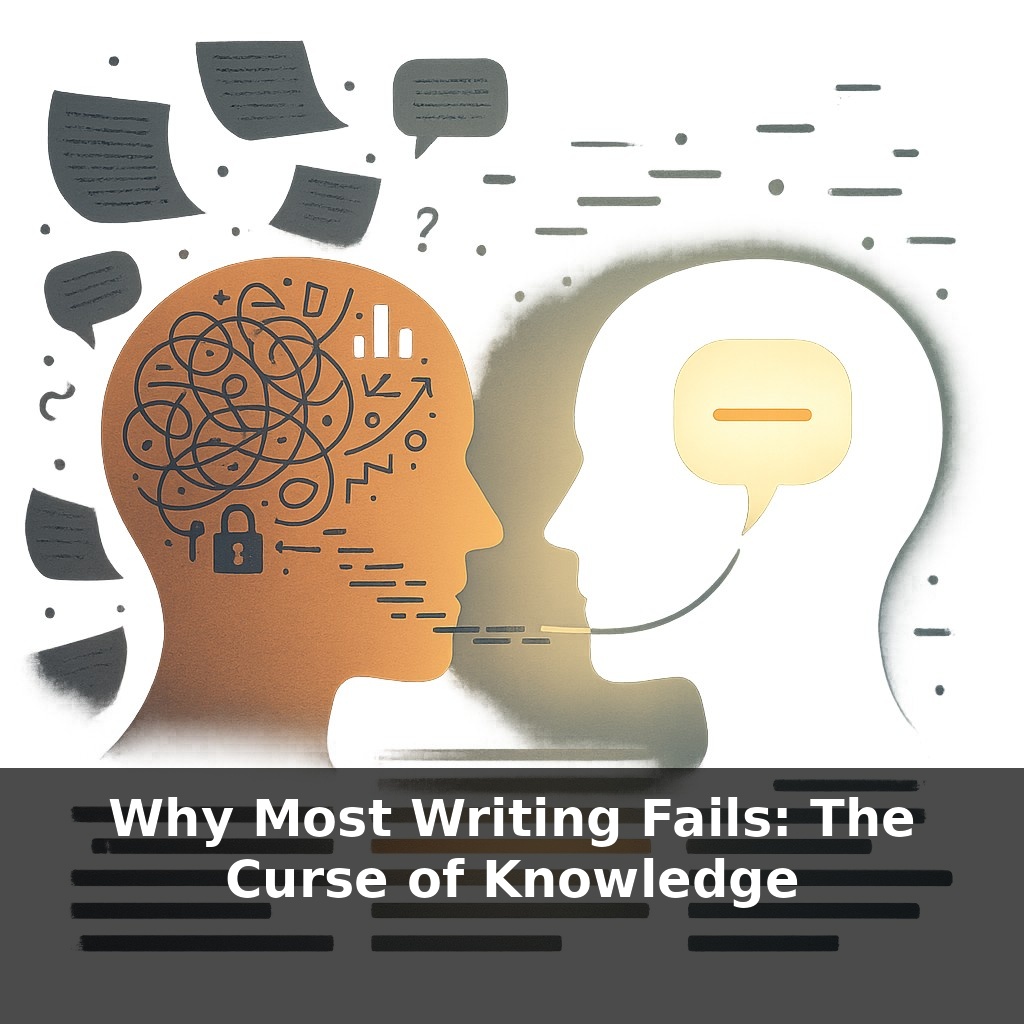
Researchers call this the Curse of Knowledge: once you know something, it’s hard to remember what it was like not to know it. In everyday writing, it shows up as unexplained acronyms, leaps in reasoning, and sentences that technically make sense but don’t quite land. The result isn’t open disagreement; it’s silent confusion, polite skimming, and decisions made on half-understood information.
Most of the world will never tell you they’re lost in your writing, but they’ll show you—by closing the tab. Half of U.S. adults read at or below an 8th‑grade level, yet we routinely ship product docs, strategy memos, and “simple updates” written like grad‑school essays. High stakes don’t fix this; they amplify it. NASA vaporized a $327 million spacecraft over a basic assumption about units. Governments and tech giants quietly spend millions untying the knots dense prose creates, then save millions more when they finally make things legible. The pattern is simple: clarity looks expensive—until you count the cost of confusion.
Here’s the move most writers miss: the problem usually isn’t what you know—it’s what you *can’t stop assuming* other people know.
When you draft, your brain is running a compressed movie of background context in the margins. You “hear” the backstory, the trade‑offs, the debates that shaped a decision, even when none of that makes it onto the page. The sentence, “We’ll sunset Legacy Sync in Q3” feels complete because your mind quietly plugs in: what Legacy Sync is, who uses it, why it’s going away, and what replaces it.
Your reader gets the sentence without the movie.
That gap shows up in patterns you can actually watch for:
- You jump straight to recommendations without setting up the problem they solve. - You refer to “the update,” “the issue,” “the new flow” as if there’s only one possible referent. - You collapse steps in your logic: “We saw X, so we’re doing Y,” with no bridge between.
Notice what’s missing in each case: orientation. Not more detail, but specific anchors—time, who, what changes, what it affects.
The teams that write clearly treat those anchors as non‑optional. GOV.UK’s rewrite didn’t succeed because people suddenly got smarter; they rebuilt pages around the single task a visitor needed to complete, and surfaced the one or two decisions a person had to make next. Microsoft’s shift toward shorter sentences worked because they forced every clause to earn its place. When your average sentence drops from 22 to 14 words, you can’t afford three half‑explained ideas jammed together; you’re pushed into saying one concrete thing at a time.
This is why glossaries rarely help. If your core paragraphs lean on a side document to be decipherable, the real problem is structure, not vocabulary. Definitions belong where the confusion would otherwise arise, almost like stage directions inside the script.
The uncomfortable truth: you can’t reliably see any of this on your own. Your draft will always feel more obvious to you than it is. The only known antidote is to externalize your reader: picture a specific person, in a specific moment, with a specific job to do *right after* reading you. Then ask: what, exactly, would they need on the page to do that job without guessing?
Watch what happens when two people write about the same change.
Version A: “We’re rolling out the new consent experience next week. Legal has approved. Please update comms accordingly.”
Version B: “Starting Monday, Feb 17, every new user will see a 2‑step consent screen before signup. This only affects mobile. Owners: Growth (design), Legal (wording), Support (FAQs). If you email users about signup after the 17th, link to the new FAQ below, not the old help article.”
Same topic, but the second one makes next actions almost automatic. Notice how it walks a reader from “when” to “who” to “what changes” to “what I do differently.”
In practice, this is less about “dumbing down” and more about narrating the scene the reader is about to step into. A staff email becomes: where will they be when they read this, what are they juggling, which sentence tells them whether they can safely ignore it? A product update becomes: what breaks, for whom, starting when, and what’s the smallest decision they must make now versus later?
Fortunes will tilt toward teams that design writing like doctors design treatment: test, adjust, personalize. As tools evolve, “default” text will quietly reshape itself to each reader’s history, language comfort, and task—no extra effort from the writer. Regulators are already moving from “disclose” to “prove they understood,” pushing companies to log evidence that their words actually land. In that world, drafts that stay locked in a single expert’s head won’t just underperform; they’ll be liabilities.
Treat each draft as a first hypothesis, not a final verdict. Shift your goal from “sound smart” to “make action effortless.” Read your work like a stranger with five minutes and low patience. Where do you hesitate, reread, or guess? That’s your map. Follow it, and your writing stops performing intelligence and starts creating it.
Here’s your challenge this week: Pick one thing you know deeply (a framework, process, or concept you usually explain with jargon) and rewrite it as a 250-word explanation for a smart 12-year-old—no acronyms, no insider terms, no metaphors you haven’t unpacked. Then send that explanation to one real person who is *not* in your field and ask them to underline every sentence that felt confusing or “skimmable.” Finally, revise the piece once using only their reactions: shorten any sentence over 20 words, replace every abstract noun (like “learnings,” “insights,” “synergies”) with something concrete, and swap at least three assumptions (“of course…”, “obviously…”, “as you know…”) for plain, explicit context.
From this course
Writing That Gets Read
7 episodesUnlock all episodes
Full access to 7 episodes and everything on OwlUp.
Subscribe — $1.99/monthLess than a coffee ☕ · Cancel anytime