Most people sound smarter out loud than they do on the page. Yet readers remember far more from conversational writing than from stiff, formal prose. So why do so many of us still type like a textbook while we talk like a human at coffee? Let’s pull that apart.
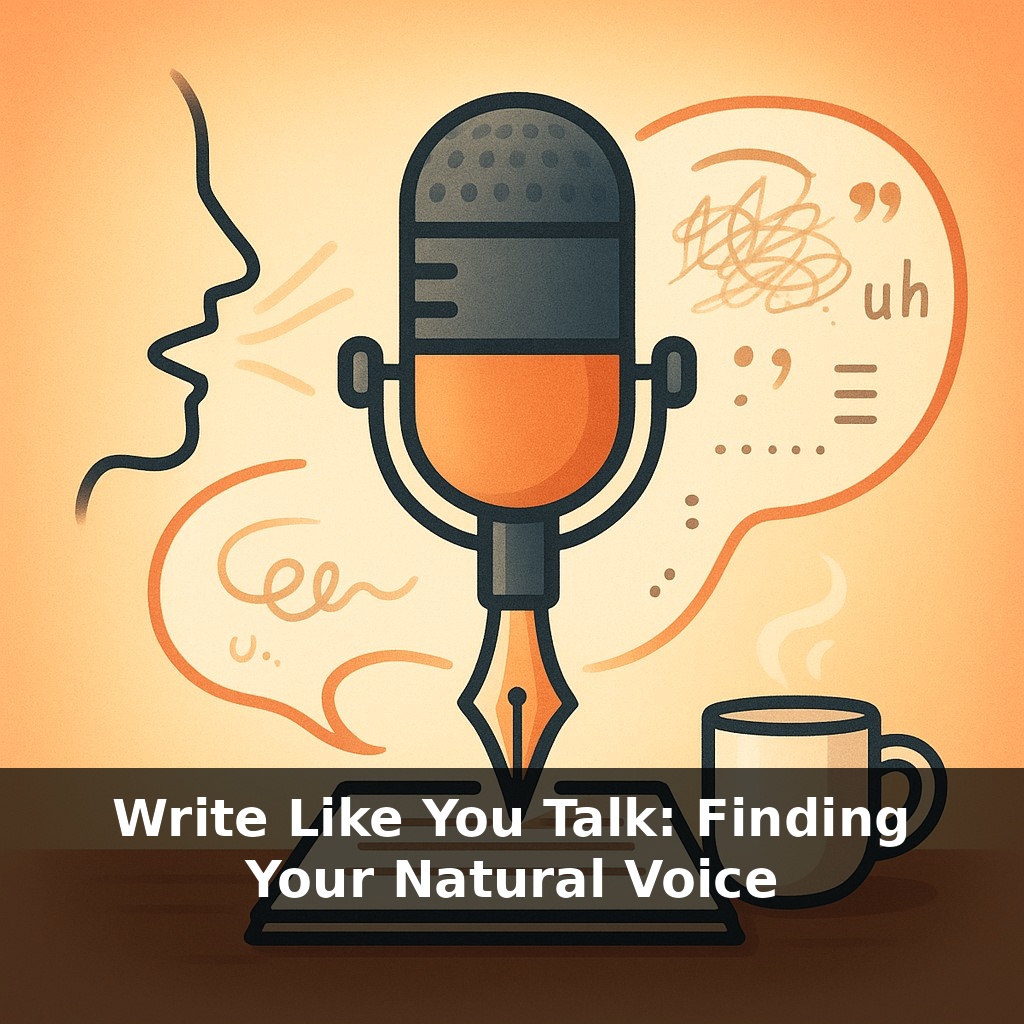
Here’s the twist: “write like you talk” is terrible advice if you take it literally—and powerful advice if you treat it like raw material. When you speak, you ramble, backtrack, fill the air with “uh” and “you know.” On the page, that same unfiltered stream exhausts readers instead of connecting with them. The goal isn’t a transcript of your mouth; it’s a translation of your mind. What you actually want is the *effect* of a good conversation: clarity, momentum, and the feeling that a specific person is talking to *me*. To get there, you need to notice how you naturally explain ideas when a friend is confused, how you emphasize what matters, and how you shift tone when you’re excited versus serious. Those patterns are your real voice. The craft comes in capturing them, then tightening the screws so your writing sounds like you—on your sharpest day.
Most people skip a crucial step between talking and typing: noticing what actually happens when words leave their mouth. Under pressure, we default to “professional mode,” layering on jargon and long sentences that sound nothing like how we solve problems out loud. Yet research keeps showing that readers stick around longer, remember more, and trust you more when your writing feels grounded in a real person’s cadence. That doesn’t mean dumbing things down; it means treating your speech patterns like rough sketches and your edits like the inking pass, where you choose what to keep, sharpen, or erase.
Most people never see how differently they sound on the page because they never put their spoken and written words side by side. So let’s get concrete and a bit nerdy about how to do that.
First, you need raw material. Record yourself explaining a familiar topic to a specific person—your colleague who “gets it but not all the way,” or a client who keeps asking the same question. Don’t script it. Just talk for three to five minutes as if you’re in the room with them. Then, transcribe it. Now you’ve got an x‑ray of your natural cadence.
Next, mark it up like a coach. Highlight three things:
- Phrases you actually like: turns of phrase, quick analogies, the way you soften or sharpen a point. - Moments where you clearly guide the listener: “Here’s the catch…,” “So what this really means is…” - Spots where you lose yourself: detours, stacked clauses, throat‑clearing.
From there, build a written version that keeps the best moves and cuts the sludge. Shorten sentences by default. Swap multi‑syllable words you’d *never* say out loud for simpler ones you *do* use with smart friends. Watch your pronouns: “you” and “we” pull readers in; “the user” and “the organization” push them away.
Now layer in structure. Speech leans on tone and timing; text has to fake those with layout and rhythm. That’s where headings, line breaks, and varied sentence lengths do heavy lifting. Think of them as pacing tools: a tight, three‑word sentence after a long one snaps attention back. Lists untangle what would otherwise be a breathless paragraph.
Real‑world voices are built this way. Mailchimp’s copy, for example, sounds like a sharp coworker walking you through a task—confident, specific, and generous with small clarifications—because they relentlessly edit toward that persona. Same with standout newsletters: you can almost “hear” the writer, not because they’re casual, but because they’re consistent.
Finally, remember: your voice is a range, not a single note. You won’t sound the same in a launch email, a technical doc, and a personal essay—and you shouldn’t. What stays stable is your underlying stance: how direct you are, how much context you give, how you balance warmth with precision.
Think of three versions of you giving the same advice: on a podcast, in a meeting, and in a text to a friend. The core idea doesn’t change, but the *surface* does—length, formality, detail. That’s the level you’re tweaking on the page.
For instance, say you’re warning a client about a risky decision:
- Text-to-a-friend version: “Honestly, this could blow up. I’d wait.” - Meeting version: “There’s significant downside here. I recommend pausing until we’ve tested assumptions.” - Podcast version: “Let’s talk about why rushing this move could backfire, and what to do instead.”
On the page, you can borrow moves from each. From the text: bluntness. From the meeting: precision. From the podcast: clear setup and payoff.
One practical pass: read a draft out loud as if you’re voice-noting a busy, smart colleague. Anywhere you stumble, over-explain, or feel unlike yourself, mark it. Don’t fix as you go. Then, in a second pass, edit only those marked spots—cut a clause, swap a word, split a sentence. You’re not rewriting your voice; you’re sanding down the splinters that would snag a reader’s attention.
In a few years, “voice” may be as measurable as spelling. Teams will run drafts through tools that flag when a policy update suddenly sounds like legal boilerplate instead of a steady mentor, or when a founder’s note drifts from candid to corporate. Think of it like a nutrition label for tone: ingredients listed, balance visible. Students who learn to shift smoothly between slide decks, video scripts, and emails will navigate careers where *how* you sound travels with you across every medium.
Treat this less like “finding yourself” and more like running field tests. Try a draft that’s bolder, one that’s quieter, one that’s playful. Watch which version makes people reply, click, or quote you back. That’s where your signal spikes. Over time, patterns emerge the way a favorite playlist does: different moods, same unmistakable taste.
To go deeper, here are 3 next steps: (1) Grab a short article or email you’ve already written and run it through Hemingway Editor or Grammarly, then read it aloud and adjust every sentence that doesn’t sound like how you’d say it to a friend. (2) Pick one writer known for a conversational voice—like Anne Lamott’s *Bird by Bird* or Austin Kleon’s *Show Your Work*—and highlight specific lines that feel “spoken,” then imitate that rhythm in a 200-word practice piece. (3) Install a voice-to-text tool (e.g., Google Docs Voice Typing or Otter.ai), hit record, and “talk” your next draft out loud, then lightly edit the transcript so it keeps your natural phrasing instead of defaulting back to stiff, formal writing.