Right now, most people switch tasks in under a minute—often before they’ve finished your first paragraph. A VP half-scans your report on her phone, a client skims your email between meetings. They’re all silently asking the same thing: “Why should I care—right now?”
They’re not being rude; they’re triaging. In those first seconds, your reader is running a quiet calculation: “Is this worth finishing? Is there something I need to *do*?” When your main point is buried halfway down, you’ve already lost the people who most needed your message—executives, clients, decision-makers who live in their inboxes. This is why high-stakes communicators—from military briefers to crisis PR teams—lead with the point. They treat every message like a headline: clear claim, clear consequence, clear ask. Only then do they spend precious words on context, nuance, and proof. For busy readers, clarity isn’t “nice to have”; it’s the only way your work survives first contact with a crowded screen and a crowded mind.
Most of us were trained to “warm up” first: scene-setting, background, throat-clearing—and only then, eventually, the point. That structure worked when readers had time and paper in front of them. In a notification-filled inbox, it backfires. The longer you take to announce your destination, the more people quietly exit the ride. Busy readers scan like investors flipping through pitches: they look for the return first, then the reasoning. Put the outcome, decision, or request up top and you’re no longer competing with distractions; you’re offering a fast, clear payoff they can choose to engage with—or delegate—on the spot.
Think of “start with the point” less as a writing trick and more as architectural design. You’re deciding what the reader sees when they walk through the door: the load-bearing beam (your main point) or the decorative plants (your interesting details). Get the beam in place first, and everything else can hang off it without collapse.
For busy readers, that beam usually takes one of three forms: - a decision: “We should approve X.” - an outcome: “X increased revenue by 18%.” - an action: “Please do X by Friday.”
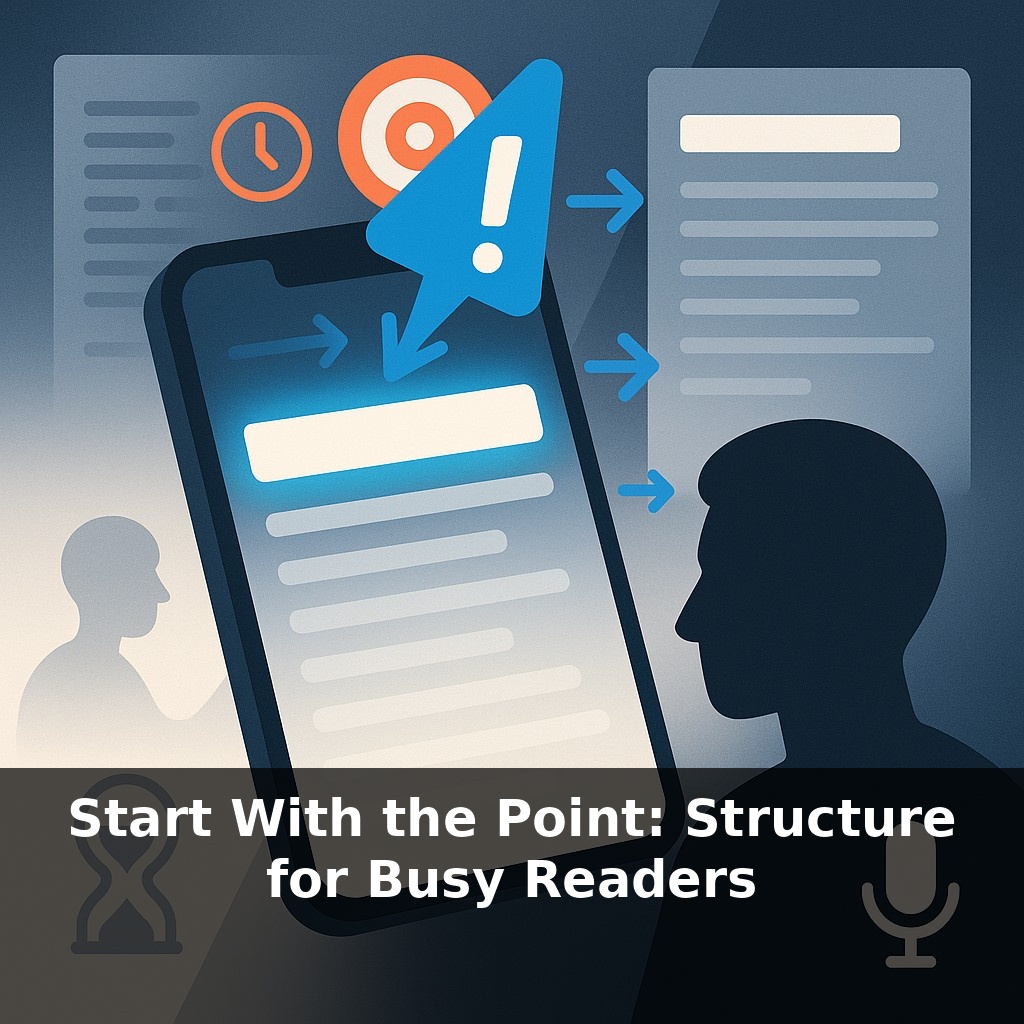
Once that opening is nailed down, the rest of your structure has a clear job: answer the questions that point naturally triggers. Think in layers, not in chronological order.
Layer 1: Point State the decision, outcome, or action in a single, concrete sentence. No hedging, no suspense.
Layer 2: “Because” Immediately follow with the 1–3 highest-impact reasons. Not everything you know—just the pieces that most strongly support the point for *this* reader. Ask yourself: “If they stop reading after this screen, what must they still walk away knowing?”
Layer 3: “Show me” Only now bring in data, examples, or scenarios. This is where you can unpack methods, timeline, risks, and edge cases for those who keep reading or need to justify the decision to others.
Layer 4: “What now / what if” Close with next steps and contingencies: what happens if they agree, disagree, or delay? This reassures skeptical or cautious readers that you’ve thought beyond the happy path.
A useful test: can someone who only reads your first 30–50 words accurately report your ask and why it matters? If not, you’re asking them to assemble the meaning themselves from scattered pieces—and many simply won’t.
Notice what this doesn’t do. It doesn’t forbid nuance; it forces you to *prioritize* it. It doesn’t flatten complexity; it makes the complexity easier to navigate because the reader always knows what each paragraph is in service of. And it doesn’t kill creativity; it challenges you to be precise at the moment your reader is most attentive, then creative in how you support, illustrate, and anticipate their questions.
A simple way to practice this structure is to rewrite real messages you’ve already sent. Take a recent status update you posted in chat. Original: “I’ve been looking into our Q2 user trends and pulling data from Mixpanel and GA…” Revised, point-first: “Our Q2 signup rate is flat despite 30% more traffic; here’s what the data shows and what I recommend.” Same facts, different entry point.
Try it with a slide title: instead of “User Metrics – Q2,” use “Q2: Traffic Up 30%, Signups Flat.” The title now carries the point; the chart becomes evidence, not a puzzle.
Or with a project proposal: don’t open with scope, history, or methodology. First line: “We can cut onboarding time by 40% with a two-step change to our signup flow; details below.” The reader instantly knows the payoff and can decide how deeply to dive.
Your language can stay conversational, but your structure becomes surgical: cut straight to what matters, then let the rest of the message earn its place.
Start-with-the-point writers will have an edge in a world flooded with auto-generated fluff. Systems that summarize, rank, and route information effectively “reward” clean, front-loaded structure. It’s like triage in an emergency room: the clearest cases get seen and acted on first. As regulations, ESG disclosures, and AI filters tighten, buried points start to look non-compliant or low-signal. The risk isn’t just being ignored—it’s being algorithmically sidelined before a human ever sees your work.
Lead with your point and you’re not just “being concise”—you’re redesigning how others make decisions around your work. Over time, people will start to trust your messages the way they trust a good physician’s note: diagnosis first, then evidence and options. Your writing stops competing for attention and starts shaping what actually happens next.
Try this experiment: Take the last email you sent that was more than three sentences, and rewrite it so the very first line is your main point in plain language (e.g., “I’m writing to ask for your approval on X by Friday”). Then rearrange the rest into a simple Point–Reason–Details structure: one short sentence explaining why it matters to them, followed by 2–3 bullet points with only the facts they need to decide. Send this version to a colleague and ask them, in one sentence, what they think you wanted from them—if they can’t answer instantly, tighten your first line and try again on your next email.