Most people don’t quit your long articles because they’re busy. They quit because they’re bored and lost. One moment they’re curious, the next they’re skimming, and then—gone. The paradox is this: when you add more words, you’re forced to add more structure… and that’s what keeps them reading.
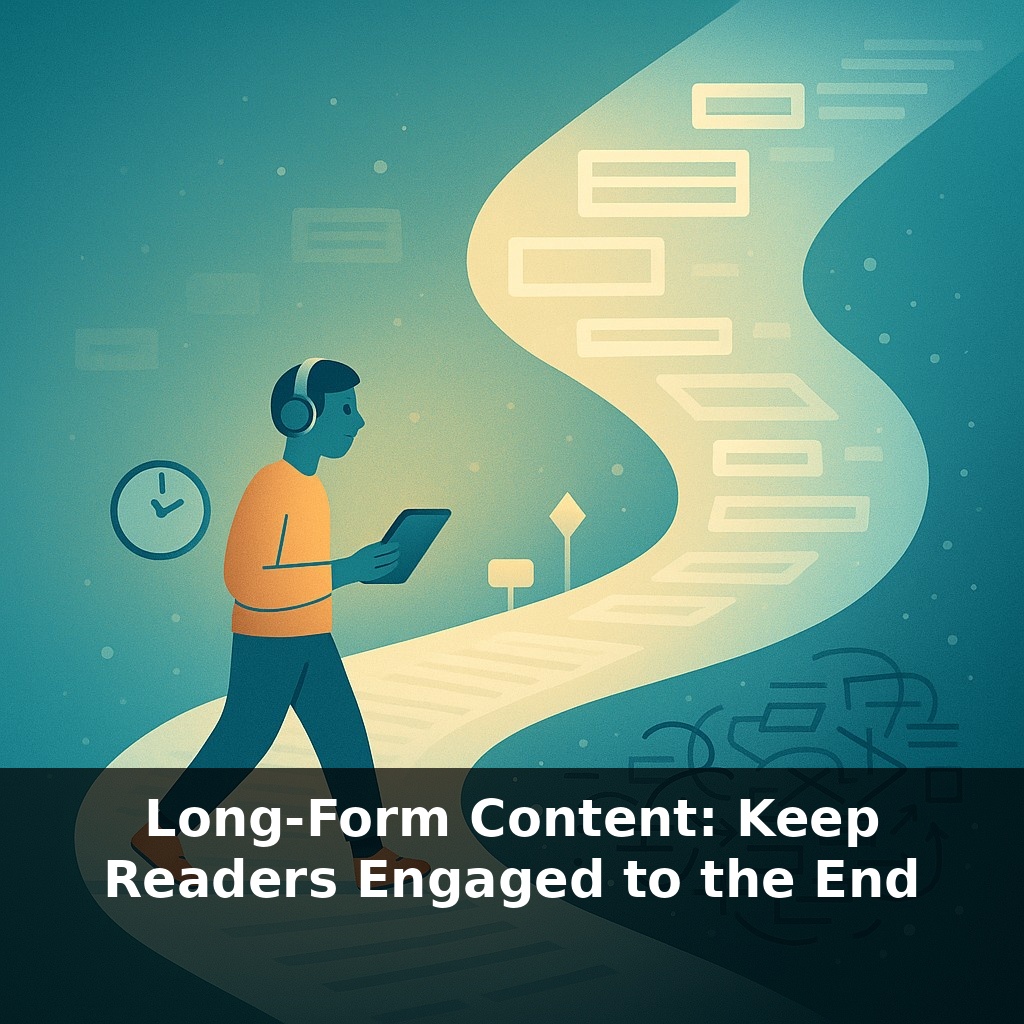
123 seconds vs. 57. That’s the median time readers spend on long vs. short pages, according to Chartbeat—and it tells you something crucial: attention isn’t disappearing; it’s being selective. When a piece earns trust early and signals where it’s going, people will stay. They just refuse to hack through a wall of grey text to find the value. Long-form that works behaves less like a static essay and more like a guided experience: readers get signposts, previews, and payoffs at regular intervals. Sub-heads act as commitments (“if I keep going, I get this next”), summaries act as safety nets, and small narrative hooks reset curiosity whenever it dips. In this episode, we’ll move from “write until you’re done” to “design a path your reader wants to follow”—one that respects their time while rewarding their attention.
You also have another force working against you: the way memory and focus actually function over several minutes. Readers don’t just glide through 2,000 words; they move in bursts of attention, then hit tiny cliffs of fatigue. Analytics tools quietly reveal these cliffs as sudden drop-offs in scroll depth or sharp exits right after dense paragraphs or abstract tangents. To keep people past those danger zones, you need more than “good writing.” You need an intentional sequence of payoffs—small wins, answered questions, new tensions—that arrive just before attention would normally fracture. This is where cognitive design meets narrative craft.
There’s a hidden rhythm to long-form that most writers never map. They think in sections (“intro, argument, conclusion”), while readers move in micro-units of effort: “I’ll give this two more screens… okay, one more… okay, last one.” Your job is to decide exactly what they get in exchange for each extra unit of effort.
Start by planning “promise points” every few hundred words. Each promise point answers one question while quietly raising another. For example:
- You resolve a tactical question (“Here’s how we structured the case study section”), but you hint at a bigger strategic payoff coming later (“…and this is why clients now stay 40% longer—more on that in a minute.”). - You deliver a data nugget, then tease application (“This pattern shows up across 3 industries; we’ll borrow the most surprising tactic from each.”).
This is where cognitive principles like variable reward matter. Not every beat should pay off in the same way. Alternate between:
- Quick, concrete wins (a template, a phrase to steal, a graph that reframes the problem) - Medium-depth explanations (why this works, where it fails) - Occasional “jackpot” moments (a story or framework that reorganizes how the reader sees the whole topic)
The unpredictability keeps curiosity alive without slipping into clickbait, because every reward is genuinely useful.
To make this sustainable over 2,000+ words, pre-plan three layers of navigation:
1. **Surface layer** for scanners: sub-heads that read like a compressed outline of the piece; bullets that hold standalone insights. 2. **Path layer** for committed readers: callbacks (“remember the Chartbeat spike?”), foreshadowing, and section transitions that clearly state *why this next part exists*. 3. **Memory layer** for future recall: strategic mini-summaries that compress a section into one sentence a reader could tell a colleague.
Think of it like a good financial portfolio: you’re diversifying how readers “earn” from each minute they invest—some quick returns, some longer-term value, all clearly labeled so they know why they should stay in the position instead of cashing out halfway.
Think of each long section as a room in a gallery you’re curating. The door (sub-head) tells visitors what they’re about to see; inside, you decide how bold or quiet each piece is. One “wall” might hold a brief real-world vignette (a founder realizing their launch post is underperforming), another a single striking chart, another a short quote that reframes stakes (“Most readers aren’t short on time; they’re short on reasons.”). As they move through, you occasionally install a bench—a two-sentence recap or a “pause and notice” moment that consolidates what just happened before they enter the next room.
Concrete example: in a 2,300-word teardown of a failed crowdfunding campaign, you might sequence like this—1) open with the day the campaign died, 2) then a tight table of key numbers, 3) then a short DM exchange showing internal panic, 4) then a side-by-side of original vs. revised pitch. Each element earns the next click of the scroll wheel.
As AI skims everything, long-form shifts from “nice to have” to a signal of seriousness. Readers will treat it like choosing a specialist over a general practitioner: they’ll invest only when your piece promises rare insight, not recycled summaries. Expect platforms to rank for “completion likelihood,” not just clicks, and teams to treat one flagship deep-dive as the spine for talks, courses, and even product strategy, instead of pumping out endless shallow posts.
Treat your next long piece like drafting blueprints, not pouring concrete: sketch the load-bearing ideas, then decide where readers can stand, look around, and choose a route. As you revise, track where you’d quit as a stranger. Move or cut those sections. Long-form that earns rereads becomes your quietest but most persuasive salesperson.
Here’s your challenge this week: Take one existing long-form piece (1,500+ words)—a blog post, article, or guide you’ve already published—and rebuild its engagement structure. Add a hook in the first 3 sentences that promises a concrete outcome, then insert a curiosity gap or open loop at least every 300–400 words (e.g., “In a minute, I’ll show you the mistake that ruins this for most people…”). Break every section into scannable chunks with subheads, bullet lists, and at least one story or example per major section. Finally, add a clear “keep them moving” element at the end of each section (like “Next, let’s test this on a real example…”) and send it to one real reader, asking them to highlight any point where they felt tempted to stop reading.