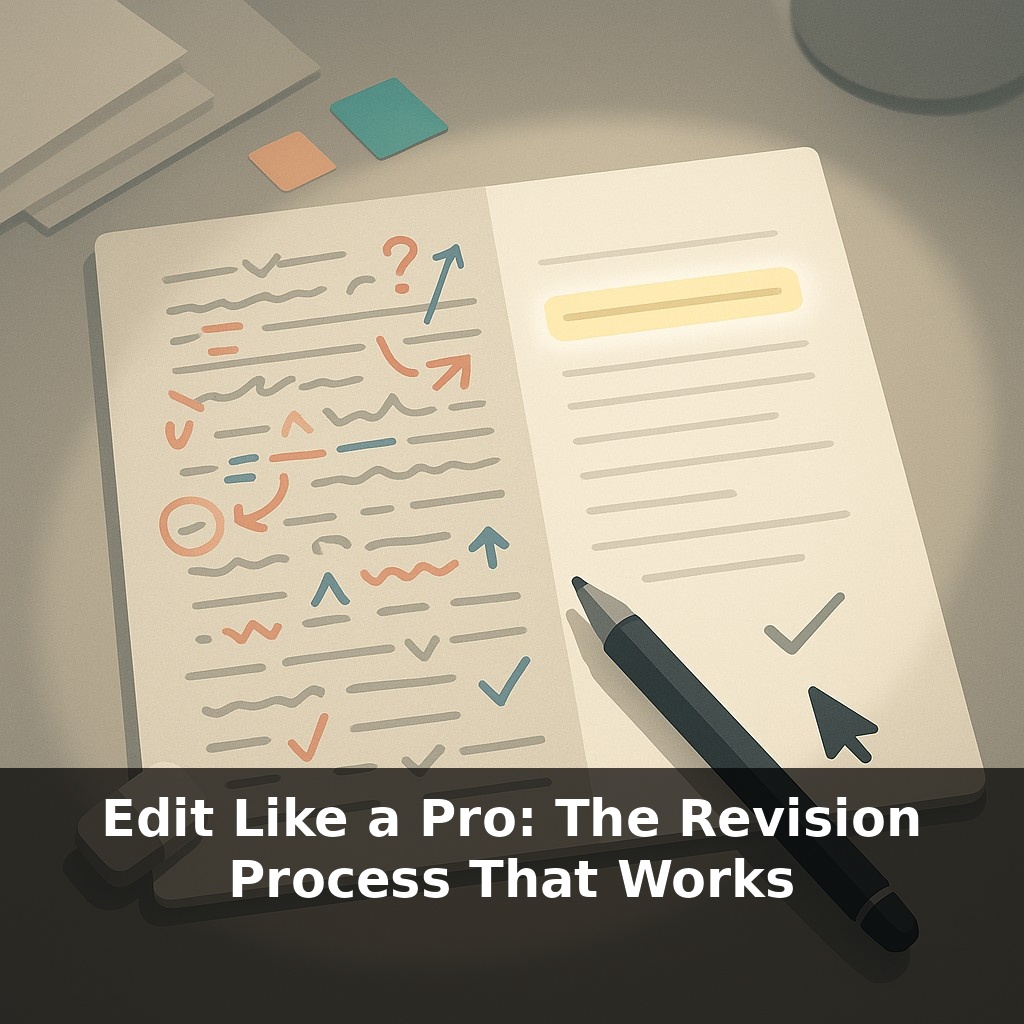
About half of what readers dislike in your writing has nothing to do with your ideas—it’s what you didn’t fix in revision. A clumsy intro. A buried point. A sentence that almost works. Today, we’re stepping into that backstage zone where good drafts quietly become irresistible.
Most people “revise” the way they clean a room before guests: grab what’s visible, shove it somewhere, call it done. It looks better, but open any closet and chaos spills out. That’s how readers feel when your surface fixes hide deeper problems—confusing order, missing context, no clear path through your thinking.
Professional editors work differently. They don’t trust a single tidy-up pass, and they don’t treat every sentence as equally important. Instead, they move through a deliberate sequence of questions: Does this piece *matter* to the right reader? Does each section earn its place? Is the path through the ideas obvious, even to a skimmer? Only after that do they worry about the little stumbles.
This shift—from “fix what I see” to “follow a clear revision route”—is what turns effort into impact.
Think about how you approach other complex tasks. A chef doesn’t season before tasting. A developer doesn’t optimize before the basic feature works. Yet with writing, most people jump straight to fiddling with sentences, hoping clarity appears. The pros reverse that instinct. They separate their passes on purpose, so each read-through has a single job: big-picture sense-making, information flow, reader focus, then rhythm and precision. This not only saves time; it makes decisions easier. You’re no longer asking, “Is this good?” but, “Does this step do *its* job yet?”
Start with how the piece *hits* a stranger, not how it feels to you.
Pass 1 is your “cold reader” pass. You’re not fixing yet—you’re diagnosing. Print the piece or change the font so it looks unfamiliar. Then read straight through, once, without stopping to edit. Afterward, answer three questions on a separate page:
- Where did my attention dip? - Where did I feel confused or impatient? - What, if anything, felt surprisingly strong?
Mark only the *moments*, not the solutions. You’re mapping friction, not paving the road yet. This keeps you from sinking time into a paragraph that may not even survive the next pass.
Pass 2 is about purpose alignment. Keep your draft open but your hands off the sentences. At the top of the document, write a one-line goal in plain language: “When they finish, I want readers to ___.” Then test each major part against that line: does this section move the reader toward that outcome, or does it pull sideways? Label sections with quick shorthand—“core,” “nice-to-have,” “off-track.” You’ll use those labels when you cut and reorder.
Pass 3 is structure in motion. Now you’re allowed to pick things up and move them. Treat your sections like movable cards: headline ideas, key examples, and transitions each get their own “card” (physical sticky notes or digital outline). Rearrange until a skim down the left edge (headings, first sentences) tells a coherent mini-version of the piece. If you can follow that skeleton without reading the body, your structure is doing its job.
Pass 4 targets emphasis. Most drafts underplay what matters and over-explain what doesn’t. Highlight the true hinges—the claims or moments everything else leans on. Give them more real estate: a clearer subhead, a concrete example, a brief story from your own work. At the same time, compress or cut support that merely repeats or softens.
Only after these passes is it worth diving into the finer-grain work: rhythm, clarity at the sentence level, then precision of language. Skipping straight to that micro layer is like adjusting the lighting in a room you might still decide to demolish.
A useful way to *feel* this process is to watch it in a different craft. Think of a surgeon planning a complex operation: they don’t start by choosing sutures. First comes the scan—what’s really going on? Then the sequence of steps, the order of incisions, the points where things could go wrong. Only when the overall plan is safe and coherent do they worry about the neatness of each stitch.
Try mapping that mindset onto a single piece you’re working on. Label one pass “diagnosis only” and refuse to change anything; just note where the piece feels off. Next pass, pretend you’re building a treatment plan: which parts must stay, which are optional, which actively harm the outcome you want for the reader? On another pass, trace only your headings and first lines—would a skimming reader “survive” with just those? Finally, zoom in once to clean up anything that would break trust: sloppy phrasing, small inconsistencies, nagging typos that signal you weren’t fully paying attention.
Future implications
As tools get smarter, the real leverage will come from *how* you decide what to change, not how fast you can fix things. Think of metrics like scroll depth or click paths as an EKG for your piece: they reveal where attention spikes or flatlines. Teams will revise live pages the way product people iterate features—testing alternate openings, adjusting pacing, swapping examples—so the “final” version quietly evolves based on how real readers move through it.
Treat this workflow as a lab, not a law. Over time, you’ll notice patterns: maybe you always bury your sharpest insight halfway down, or rush endings like a meeting that ran long. Use those tells as custom prompts for future pieces—“front‑load the best idea,” “earn the close”—so each pass quietly upgrades the next starting point.
Start with this tiny habit: When you open your draft, highlight just ONE paragraph and read it out loud once, without changing anything. Then, on the next line, type a single label for what that paragraph is doing (for example: “setting,” “conflict,” “backstory,” or “transition”). If the label doesn’t come easily, put a question mark next to it and move on—no fixing yet, just noticing.