About half the people who open your article bail out before the third sentence. Not because you’re wrong—because you’re wordy. In this episode, we’ll step inside that moment and dissect, line by line, why extra words quietly kill reader attention.
Writers don’t usually sit down and think, “Time to add some fluff.” It sneaks in disguised as helpful context, authority, or “my voice.” A qualifier here, a softener there, a sentence that repeats what you just said but “sounds nicer.” Line by line, the draft feels fine. But to your reader, it feels like walking through ankle‑deep water: possible, just slow enough to question whether it’s worth it.
In this episode, we’ll zoom in on the tiny decisions that create that resistance. You’ll see how hedging (“kind of,” “a bit,” “it seems”) weakens claims, how throat‑clearing (“in today’s world,” “it’s important to note that…”) pads paragraphs, and how vague verbs blur impact. Then we’ll test simple edits that turn the same ideas into clean, direct sentences—without losing nuance or personality.
Here’s the twist: most “fluff” doesn’t look wrong when you’re the one who wrote it. On the screen, your draft feels necessary, even lean. That’s because you remember the ideas behind every sentence, so your brain auto‑fills gaps and forgives detours. Your reader doesn’t. They only see what made it onto the page. Their attention rides on surface signals: how fast the eye can move, how quickly each line delivers a payoff, how rarely it doubles back. Think of your page like a city street: clear signage and direct routes invite wandering; cluttered sidewalks send people home early.
Start by assuming your draft is lying to you. On the surface, it *feels* tight. But the research is blunt: when more than a quarter of your words don’t pull real weight, over a third of readers vanish after two sentences. So instead of asking “Does this sound good?” start asking “What job is this word doing?” If you can’t name a job—clarifying, contrasting, advancing the argument, adding necessary evidence—it’s a candidate for deletion.
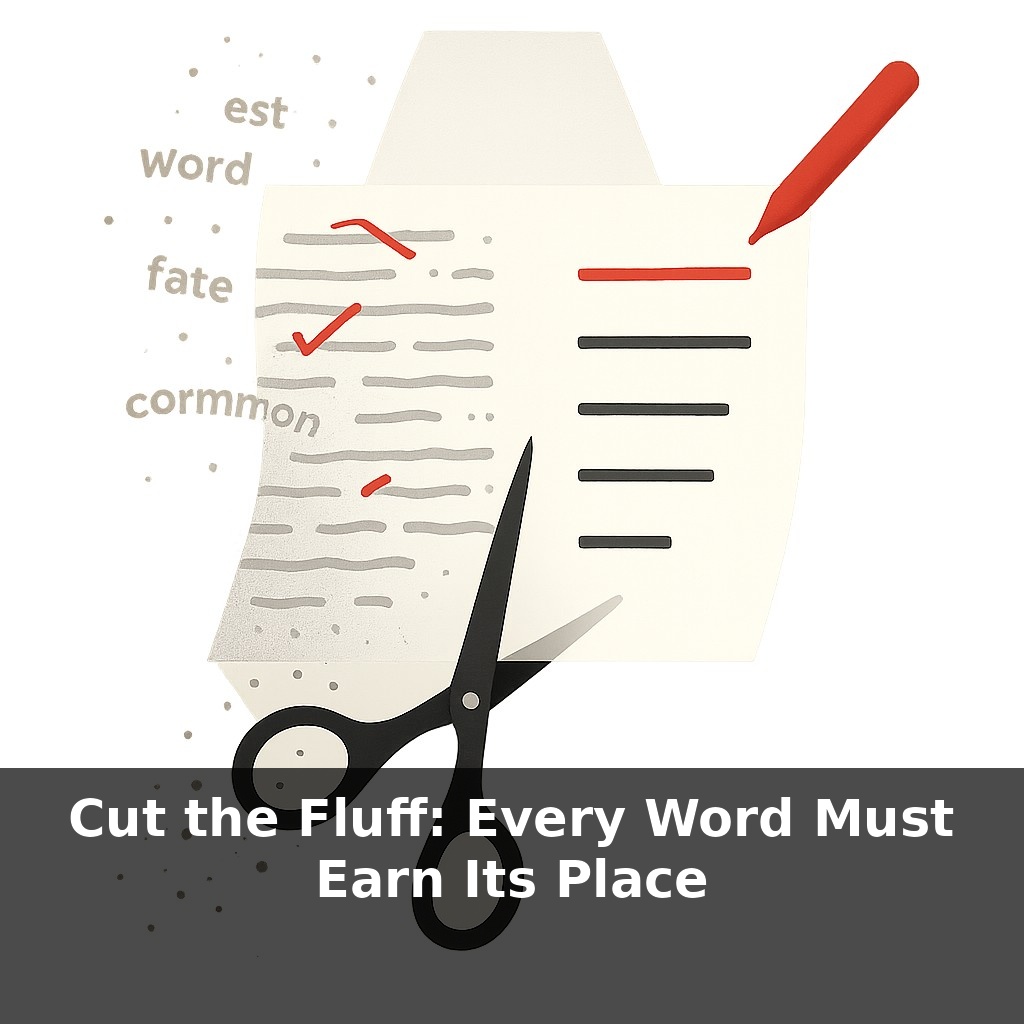
A practical way in is to edit by *layers*, not vibes. First layer: structure. Take a paragraph and underline the one sentence that actually moves the idea forward. Everything else has to justify its existence in relation to that sentence. Is it proving the claim with data? Tightening the scope? Giving the one example that makes the point land? Keep it. Is it restating? Softening? Wandering? Cut or merge.
Second layer: sentences. Look for long chains where one short line would do. “The reason for this is that” collapses into “because.” “There are three things that you need to understand” becomes “You need to understand three things.” You’re not hunting big words; you’re hunting extra steps between question and answer.
Third layer: words. Scan for clusters—phrases that travel in packs: “really, actually, basically,” “in order to,” “due to the fact that.” Deleting just one in each cluster usually changes nothing except pace. In professional newsrooms, this kind of pass routinely chops 10–30% of the draft without touching the core.
Notice we haven’t talked about *making it short*; we’re talking about making it *clean*. Some ideas need length: nuanced arguments, technical explanations, careful caveats. Concision here means removing the scaffolding once the building stands. You keep the depth, you lose the babble.
Your best ally is distance. Bezos’s six‑page memos work not because they’re short, but because teams live with them for days—reading aloud, questioning every sentence, trimming, swapping passive constructions for active ones until decisions feel obvious. That’s the standard: not “Is this pretty?” but “Can a busy person get the point the first time they read it?”
Think of a surgeon trimming anything that doesn’t keep the patient alive: you’re after that same ruthless focus, but for ideas instead of organs. One concrete move: swap abstractions for specifics. “Improve customer outcomes” is soft; “cut refund requests by 15% in 90 days” pins the thought to the wall. The more your nouns and verbs point to observable things—clicks, sign‑ups, hours saved—the less room there is for drift.
Another lever: rearrange so payoff comes first, context second. Instead of easing in and circling the point, lead with the result, then give only the support needed to trust it. Notice how this forces you to choose: which detail actually earns a place beside the claim?
Try treating each paragraph like a tiny budget meeting. You have room for, say, four sentences. Which ones generate the most “return” in insight, tension, or proof? Fund those fully. Everything else becomes a candidate for consolidation, or gets cut from the agenda entirely.
Soon, teams won’t just “write less”; they’ll design information flows the way urban planners design traffic: shortest safe route to the destination wins. Precision becomes infrastructure. Leaders will expect updates that slot cleanly into dashboards, scripts that AI can summarize without warping intent, and policies that legal, ops, and frontline staff can all apply the same way. Word economy turns into operational risk control—and a hiring filter.
Treat your next draft like a carry‑on bag: only what you can “lift” in one clear read gets to come aboard. Notice how sharper nouns and verbs quietly reshape structure, not just style. Over time, this restraint becomes a creative constraint—forcing better ideas, not just better sentences, to survive the trip to your reader.
Try this experiment: Take a 300–500 word piece you’ve already written (an email, sales page, or blog post) and force yourself to cut it down by exactly 40% without losing the core message or any key promise. Keep a copy of the original, then go sentence by sentence asking, “If I delete this, does the reader lose anything essential?” and delete or tighten anything that doesn’t clearly move the reader closer to the outcome you promised. Send Version A (original) to half your usual audience and Version B (cut-down) to the other half, and compare replies, clicks, or responses over the next 24–48 hours. Notice which version gets clearer questions, faster yes/no decisions, or more engagement—that’s your real-world proof of how much fluff you can cut and still be powerful.