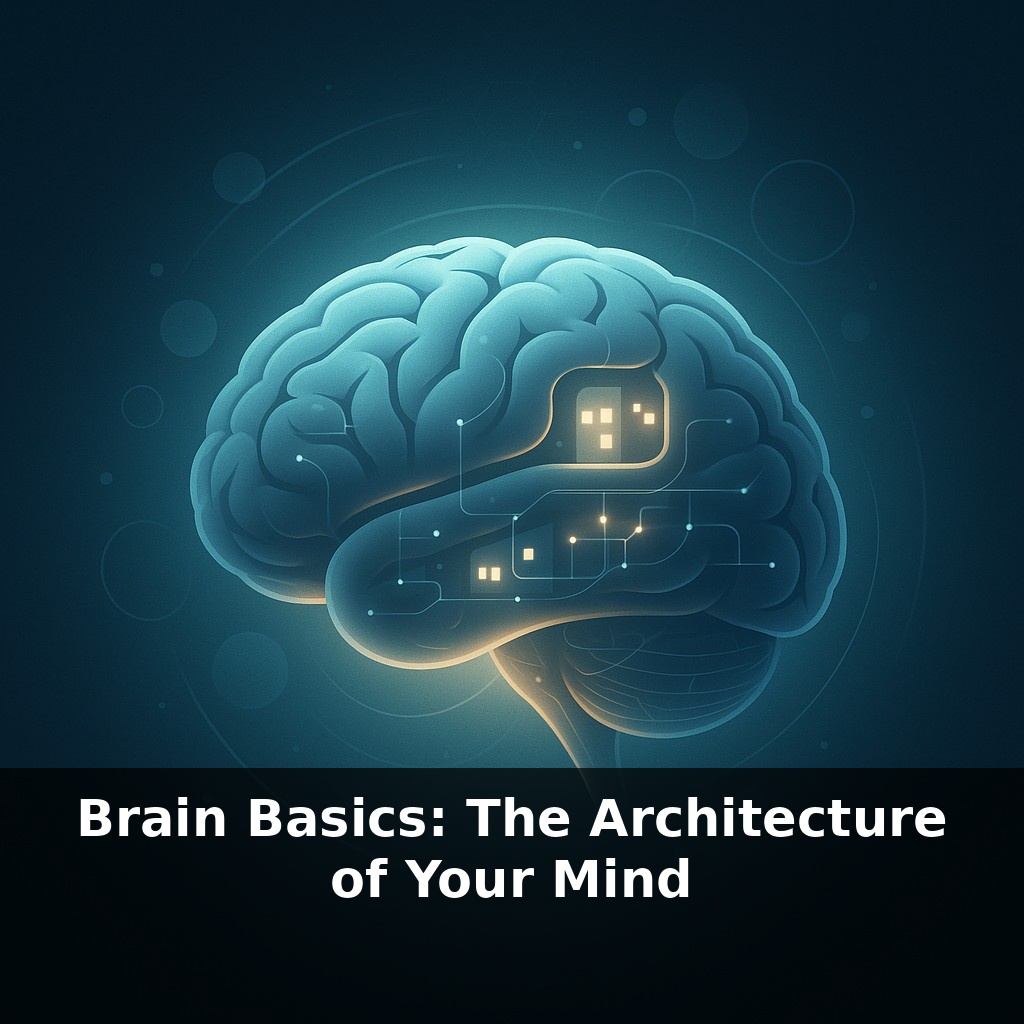
Brain Basics: The Architecture of Your Mind
📝 Transcript
Right now, the three pounds of tissue between your ears are quietly burning about a fifth of your body’s energy—just to keep you thinking, daydreaming, and scrolling. In this episode, we’ll step inside that invisible power plant and explore how its hidden rooms shape your life.
That energy-hungry organ isn’t just a blob of “gray matter” doing one big job. It’s a layered, organized structure: thin outer cortex folded into ridges and grooves, deeper hubs handling emotion and memory, even older regions keeping you breathing and balanced while you think about lunch. These parts aren’t isolated; they’re linked by dense bundles of axons that let signals zip around in milliseconds, more like group chats than solitary texts. When you read a sentence, plan your day, or resist checking your phone, multiple regions fire in precise patterns. Some handle raw input, others evaluate and predict, and still others integrate it all into a single, unified experience that feels like “you.” In this episode, we’ll map that architecture—and see how understanding its layout can change how you learn, focus, and manage your moods.
And here’s the twist: that intricate layout isn’t fixed at birth. Experience, practice, stress, and even sleep can subtly reshape which circuits strengthen and which ones quiet down. Regions that rarely “join the conversation” can, over time, become key contributors if your habits demand it—like when adults learn a new language or musical skill. Even a thin layer of tissue only a few millimeters deep can reorganize its priorities, devoting more territory to the things you use most. In the next section, we’ll zoom in on key neighborhoods of this system and what roles they tend to play in daily life.
The cortex may be thin, but it’s highly specialized territory. Broadly, it’s divided into four lobes per hemisphere, each with its own typical “jobs,” even though they constantly collaborate.
Start with the frontal lobes, just behind your forehead. Activity here ramps up when you hold a phone number in mind, plan tomorrow, or stop yourself from saying something you’ll regret. Damage or underdevelopment in parts of this region can leave basic intelligence intact but derail judgment, impulse control, and long‑term planning. This is one reason teenagers, whose frontal systems are still maturing, tend to be more driven by immediate rewards than distant consequences.
Slide backward and you reach the parietal lobes. These help construct a moment‑to‑moment map of your body and the space around it. They integrate touch, body position, and even numerical quantity. When you catch a ball without looking directly at your hand, or “just know” that 8 is bigger than 3 without counting, parietal networks are translating raw input into an internal geometry of the world.
Farther back sit the occipital lobes, heavily devoted to vision. Rather than storing a literal “picture,” they extract edges, motion, color, and patterns. Specialized patches become tuned to faces, written words, or object categories through experience. This tuning is so precise that trained radiologists, for example, show distinct occipital and temporal patterns when spotting tiny anomalies on scans that novices completely miss.
Along the sides are the temporal lobes, crucial for decoding sound, language, and meaning. One strip responds to the basic ingredients of speech; nearby areas help you recognize voices, melodies, and objects. Deeper temporal regions support stable long‑term memories, allowing your ongoing experiences to link to everything you’ve learned before.
Underneath all this, the cerebellum quietly refines movement and timing. It predicts the sensory consequences of your actions and adjusts on the fly so you can type, speak, or play an instrument fluidly. Recent work shows it also participates when you mentally rehearse sequences—like running through a presentation in your head.
Together, these areas form dynamic coalitions. The exact pattern of which regions “team up” for a task can shift with training, fatigue, mood, or context, reflecting the brain’s living architecture rather than a static wiring diagram.
In day‑to‑day life, you can watch this architecture at work without any equipment. Try following a recipe you’ve never cooked before. As you read each step, your frontal regions juggle timing and order, while parietal systems track where your hands, knife, and pans are in space. Temporal areas help you distinguish the faint sound of simmering from boiling over, and occipital patches tune to subtle color changes that signal “done.” The cerebellum quietly smooths out each movement so you don’t have to think about every stir.
Or notice what happens when you walk into a crowded room. In a split second, your brain sorts faces into “familiar” or “stranger,” estimates distances to avoid bumping into people, and updates a running model of who is paying attention to whom. None of these computations feel effortful, but they rely on vast, practiced coalitions of regions working together, refined by years of social experience and trial‑and‑error interactions.
Your brain’s layout isn’t just a blueprint; it’s a living negotiation between stability and change. Networks that fire together more often can reshape how signals flow, nudging certain habits or skills to feel “automatic.” Like a city updating traffic lights after rush‑hour jams, training, stress, or injury can quietly reroute processing. This matters for therapy, learning, and even tech design: the same architecture that locks in bias can also be coached into new, healthier patterns.
So the “architecture of you” isn’t fixed like concrete; it’s more like wet clay that firms with use. Each habit is a fingerprint pressed into that clay, each new skill another groove. Your challenge this week: pick one tiny behavior—like pausing one breath before replying—and notice how often that single tweak subtly redirects your mind’s next move.
From this course
Your Brain Explained: How You Think, Feel, and Decide
7 episodesUnlock all episodes
Full access to 7 episodes and everything on OwlUp.
Subscribe — $1.99/monthLess than a coffee ☕ · Cancel anytime