Right now, your attention span is being auctioned off—without you in the room. You start an email, a message pops up, a headline flashes, and suddenly you’re on your third tab, wondering why you opened your laptop in the first place. So who’s actually steering your focus?
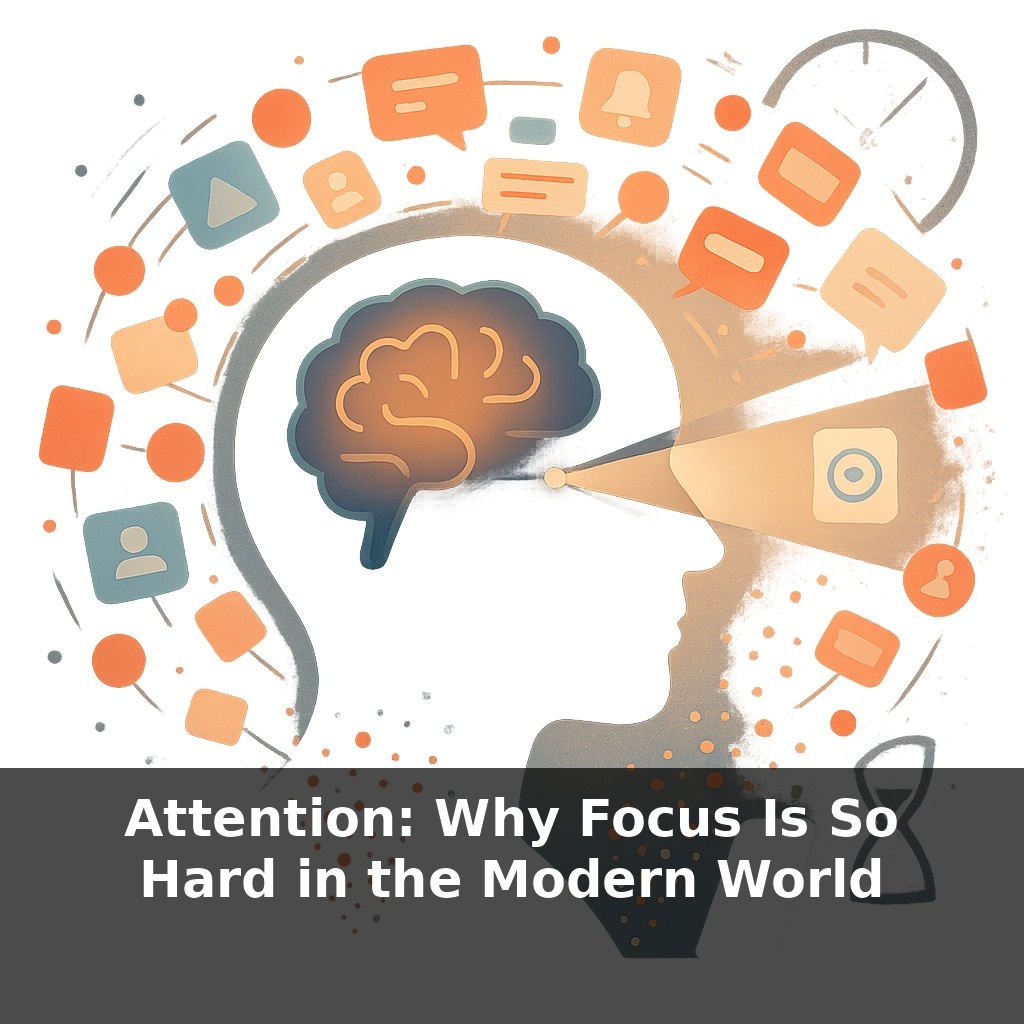
Your brain was never designed for a world where hundreds of tiny “urgent” things can tap you on the shoulder every minute. It evolved in an environment where most days were quiet—and then, occasionally, something genuinely important snapped into view: a rustle in the bushes, a flash of movement, a human voice calling your name. That wiring is still running the show, but now it’s being pinged by calendar alerts, group chats, breaking news banners, and auto‑playing videos that never quite stop. Each one is calibrated to feel just important enough that you might regret ignoring it. The strange part is that nothing “broke” inside your head; the machinery still works as intended. What changed is the volume and precision of the signals hitting it. In this episode, we’ll look at how modern tech exploits that ancient circuitry—and what you can do to quietly take some of that control back.
Open-plan offices, group chats, and infinite feeds don’t just “distract” you; they quietly reshape what your brain treats as normal. When every lull in stimulation feels uncomfortable, your mind starts reaching for micro‑hits of novelty the way a bored hand reaches for snacks. Over time, that baseline of constant pinging trains your networks to expect interruption and to skim instead of sink in. This is why a simple document can feel weirdly “heavy” while scrolling feels frictionless. The cost isn’t just lost minutes—it’s losing access to the deeper, slower modes of thinking where insight and real creativity live.
If your mind feels “louder” than it used to, that’s not just a vibe—it’s traceable in how your brain’s control systems and reward systems are being driven at the same time.
On one side, you’ve got what neuroscientists call top‑down control: frontal regions that help you hold a goal in mind, filter out irrelevant input, and stay on track. On the other, bottom‑up systems constantly scan for anything that might be important or rewarding. Modern apps lean hard on that second system. Every notification, red badge, and pull‑to‑refresh is a tiny lever on your salience and dopamine circuits, nudging them to flag, “This might matter—check now.”
The result isn’t just “I got distracted.” It’s a tug‑of‑war in which your goal‑oriented networks are repeatedly overruled. Each time you glance at your phone or hop to a new tab, your brain has to “reload” what you were doing: which details were important, where you were in the argument, what you’d already decided. Those switch‑costs sit beneath your awareness, but they’re why an hour of fragmented work can feel strangely tiring and strangely unproductive at the same time.
And the device doesn’t even have to win your attention to drain it. Studies show that just having your phone in view quietly soaks up working‑memory capacity—some of the bandwidth you’d use to reason, plan, or understand complex text is siphoned off to keep the possibility of checking it “on standby.”
Over weeks and months, this teaches your brain a new habit loop. Boredom or slight difficulty appears; your prediction systems have learned that a quick check of something—anything—usually delivers a small reward. So the impulse to switch shows up faster, and feels more compelling. That’s why it can feel almost physically itchy to stay with one demanding task when easier, shinier ones are a tap away.
None of this means you’re doomed to be a pinball. The same plasticity that let these habits form can be used in your favor. When you deliberately engineer stretches of single‑tasking—no alerts, one window, one clear intention—you are training those frontal control networks to hold the line longer. When you add practices that strengthen awareness of your own mental drift, like brief mindfulness exercises, you increase the chance you’ll notice the “urge to check” before you automatically act on it.
Think about what this looks like in actual days, not lab graphs. A software engineer sits down to untangle a gnarly bug. She silences notifications, closes extra tabs, and writes her plan on a sticky note beside the keyboard. For the first 10 minutes, her mind keeps reaching for phantom alerts—then the pull eases and she enters a smoother, quieter mode of thinking. Her output doesn’t just speed up; the solution she finds is cleaner because she held the whole system in mind at once.
Or take a writer drafting a report. He sets a 25‑minute timer, puts his phone in another room, and keeps only the document open. The first few sessions feel cramped, like working in a cast. By day four, that same interval starts to feel spacious. It’s not willpower magically increasing—it’s his brain updating its expectations about how long it stays with one thing before seeking a hit of novelty.
Analogy: focus is cardiac rehab for your attention—short, repeated bouts of deliberate strain that slowly rebuild the strength you assumed you’d lost.
Your attention isn’t just a private struggle; it’s becoming economic and political terrain. As feeds, games, and even work tools learn your patterns, they’ll tug at your mind with the precision of a tailored ad. Some companies will treat protected focus like safety gear—mandatory and monitored. Others may sell “premium calm,” like noise‑cancelling for your mind. We may soon argue about default settings the way we argue about food labels or city traffic.
You don’t have to move to a cabin or delete every app; you’re adjusting recipes, not burning the kitchen. Treat focus like a muscle group you program on purpose: light warm‑ups, heavier “sets,” real rest. As more tools compete to slice your day into crumbs, the quiet skill will be deciding which slices stay whole—and protecting them like appointments with yourself.
Before next week, ask yourself: 1) “If I checked my screen time right now, which 2–3 apps are stealing the most of my attention each day—and what specific boundary (time limit, no-notifications window, or ‘no phone in this room’) am I willing to test for just the next three days?” 2) “When during the day do I feel my mind is naturally the clearest, and how could I protect just one 60–90 minute ‘deep work’ block at that time—no email, no social media, no tabs—so I can actually experience what full focus feels like?” 3) “In the last week, when did I feel most mentally scattered, and what was happening right before that (news scrolling, multitasking, constant pings)—what’s one of those triggers I’m ready to pause or remove for a week to see how my attention changes?”