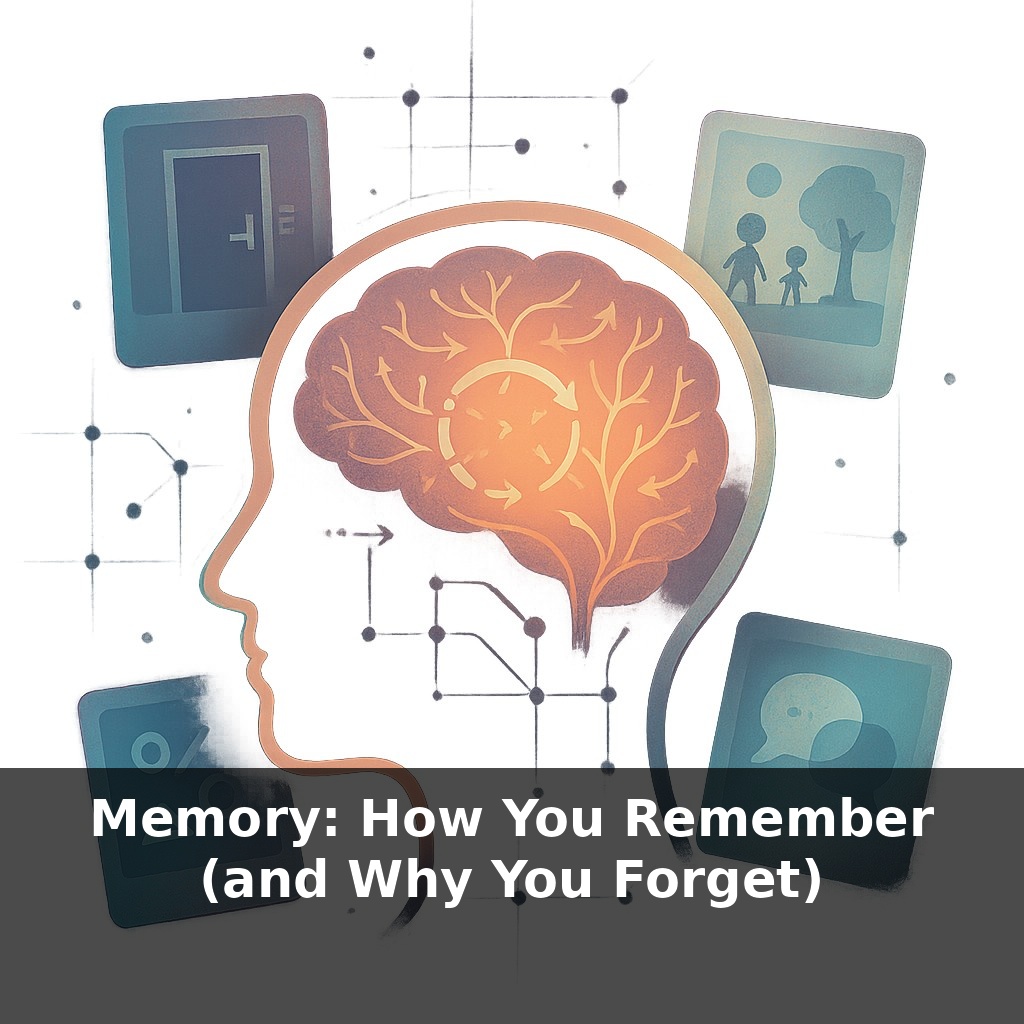
Right now, as you listen, your brain is quietly rewriting some of your memories. Not replaying them—editing them. You walk into a room and forget why. You recall a childhood story and your sibling swears it never happened. So which “you” is right: the one who felt it, or the one who remembers?
You’d think with all this covert rewriting, your brain would be a terrible historian. Yet it’s precisely this messy, living system that lets you learn a new language at 40, remember your front door code while half-asleep, or suddenly recall a coworker’s name just as you give up trying. Memory isn’t one thing—it’s a loose coalition of systems, each with its own strengths and weaknesses. Some help you keep a phone number in mind for 10 seconds, others help you recall the layout of your childhood home decades later. Some remember *how* to ride a bike, others remember *that* you fell off one. What’s more, these systems compete and cooperate: a stressed, overstuffed working memory can sabotage long-term learning, while a well-rested brain quietly stabilizes fragile traces overnight. To understand why you forget, we first need to sort out what, exactly, is trying to be remembered.
Some of these systems are tied to time and place, helping you re-live last summer’s road trip when a certain song plays. Others latch onto meaning, letting you recall the gist of a conversation but not the exact words. Emotional systems tag a breakup or a near‑miss on the highway with extra “do not delete” flags, while habit systems quietly automate your morning routine. These aren’t isolated modules—they overlap, recruit each other, and sometimes clash. That’s why a strong emotion can burn in one detail while the rest of the scene fades, or why you flawlessly type a password your mind “can’t” consciously recall.
Think of what happens the instant something “memorable” occurs: a sharp comment in a meeting, a new colleague’s name, a near‑fall on the stairs. Before any of it can stick, your brain has to encode it. This is the messy negotiation between raw sensation and the limited capacity of the systems that can hold onto it long enough to matter.
Attention is the bouncer at that door. Hundreds of sensory details stream in, but only a few get promoted. Novelty, relevance to your goals, and emotional charge all boost the odds. That’s why you can walk a familiar route and barely register anything, yet instantly remember where you were when you got bad news. In experiments, simply warning people, “You’ll be tested on this,” measurably improves how strongly those patterns are laid down. The brain literally encodes “importance.”
Once something is in, consolidation begins. Here, the hippocampus and neighboring structures act less like a storage locker and more like a logistics hub. Activity patterns that were briefly coordinated during an experience get replayed later, especially during sleep. Recordings from sleeping humans and animals show “memory traces” firing in compressed bursts, as if your brain is fast‑forwarding through the day’s highlights. Cut short on sleep and those replays are fewer, sloppier, and some traces never stabilize.
Crucially, consolidation doesn’t just strengthen; it reorganizes. Over hours to years, responsibility for a memory’s details gradually shifts outward to distributed cortical networks. That’s why very recent events are fragile—damage to medial‑temporal regions can knock them out—while older, well‑rehearsed knowledge often survives such injuries.
Retrieval is its own creative act. When you recall your colleague’s name or that meeting remark, you’re not pulling a pristine record; you’re reconstructing from scattered cues. Context matters: the room you’re in, your mood, even your body posture subtly steer which network patterns light up. Change the cues, and different aspects of the same event surface—or fail to.
Here’s the twist: every successful retrieval reopens the memory to change. In lab studies, slipping in misleading details after recall can alter what people “remember” later. Day to day, that means each retelling of a story, each private replay of an argument, is a chance for emphasis to shift, gaps to be filled, edges to blur. Over time, what feels like a stable memory can drift, even as your confidence in it grows.
Forgetting rides alongside all of this, not as a glitch but as an ongoing pruning. Synapses that don’t get reactivated weaken; similar memories interfere. Learned a new password and now the old one feels just out of reach? That’s interference in action: overlapping patterns competing for the same cues. In a world where your hippocampus can add hundreds of new neurons daily, some form of selective loss is the only way to prevent chaos.
One carefully used analogy: memory consolidation is a bit like slow‑cooking a stew. The raw ingredients—fleeting experiences—need time at low heat (replay during rest and sleep) so flavors can blend and intensify. Rush the process, or keep lifting the lid with constant distraction, and the result is thinner, less satisfying, and easier to spoil later.
Think about the last time you crammed for an exam and then blanked on the first question. That’s a live demo of how fragile recall can be when it’s chained to one narrow context: late‑night desk, specific notes, particular playlist. Shift any of those and your brain’s search cues no longer line up. Students who quiz themselves in multiple locations—library, café, kitchen table—often remember more later, not because they “tried harder,” but because their brains learned several different routes back to the same information.
The same trick shows up in everyday life. Actors rehearse lines while walking, gesturing, changing rooms, so the dialogue isn’t trapped in one rehearsal chair. Musicians who only practice on a single instrument in a single mood are shocked when a performance hall suddenly makes “known” pieces feel unfamiliar. Even small changes help: reviewing a tough conversation while standing where it happened, then once more in a totally different spot, gives your brain more ways to find that memory when you actually need it.
Upgrading memory will reshape daily life long before sci‑fi “total recall” arrives. Routine tasks may offload to wearables that cue names, routes, even half‑finished ideas, like a subtle prompter at the edge of awareness. That could free more bandwidth for creativity—but also tempt employers or schools to expect nonstop performance. Law and therapy might lean less on what you “remember” and more on traceable data streams, shifting trust from inner narratives to external records.
Your brain, then, is less a vault and more a living garden: paths worn in by use, others quietly overgrown. Some stories fade so new ones can take root; some resurface when a stray “seed” of a cue lands in the right soil. Your challenge this week: notice **when** memories pop up uninvited—and what tiny detail in your environment might have called them back.