About half of what you’ll do today will unfold on autopilot—without you really deciding to do it. You’ll unlock your phone, reach for snacks, even phrase an email, and only later realize you “chose” it. So who moved first—your conscious mind, or your wiring?
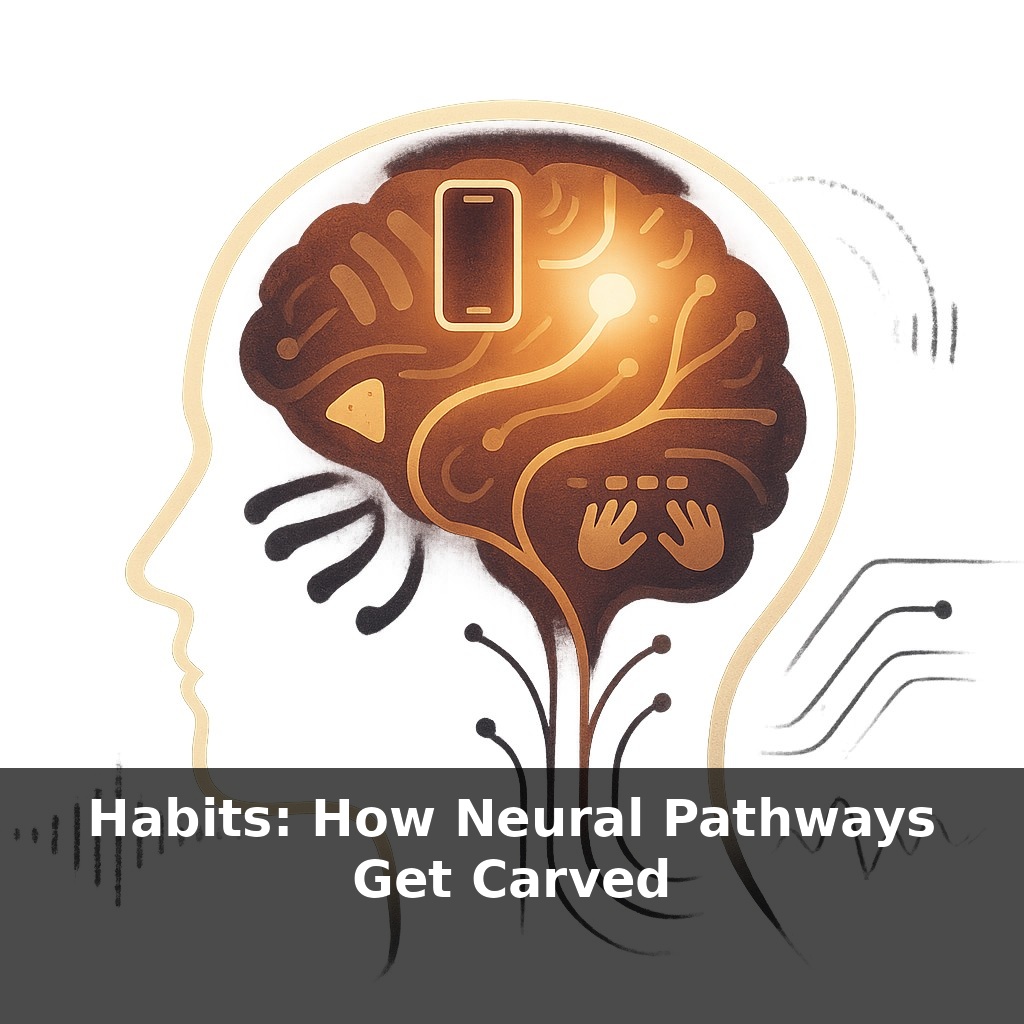
To answer that, we need to zoom in on how habits actually get carved into the brain. Every repeated action sends tiny electrical “votes” through the same network of cells. Add a neurochemical reward—often a spike of dopamine—and that pathway gets tagged as worth using again.
Here’s the unnerving part: for well-practiced habits, structures deep in the brain can start firing milliseconds before you’re aware you’ve “decided.” That split-second head start is why an old routine can slip out even when you sincerely mean to do something different.
In this episode, we’ll look at how those pathways form, how stubborn they really are, and what it takes to rewrite them.
Some of those circuits help you—like the ones that get you brushing your teeth without debate. Others quietly cost you time, focus, or health. What’s tricky is that your brain doesn’t label them “good” or “bad”; it just tracks what’s repeated and rewarded. That means the same machinery that keeps you stuck can, with enough reps, be turned into an ally. In neuroscience studies, you can watch this shift: early on, effort regions light up; months later, control hands off to deeper structures and the behavior runs leaner, faster—freeing your limited willpower budget for tougher decisions.
Think of a single Tuesday morning habit you have—say, scrolling your phone in bed. To your brain, that’s not one action; it’s a tight three-part script:
1. A cue 2. A routine 3. A reward
The cue is the “starter pistol.” It can be external (alarm sound, notification buzz, the sight of your nightstand) or internal (a feeling of sleepiness, stress, or boredom). What matters is consistency: the more often a particular cue precedes a behavior, the more tightly they become linked.
Next comes the routine—what you actually do. Early on, this takes effort and debate. But with enough runs, something interesting happens: control shifts. Activity gradually migrates from brain regions that burn a lot of energy on deliberation toward regions that specialize in fast pattern execution. That shift is why you can carry out a familiar routine even while your attention is half elsewhere.
Then there’s the reward. It doesn’t have to be dramatic. A tiny mood lift, a sense of completion, a drop in anxiety, even simple relief from uncertainty can be enough. The key is that your system quietly asks: “Did this move me toward feeling better or safer?” If yes, the loop is more likely to run again next time the cue appears.
Over days and weeks of repetition, two things happen. First, the delay between cue and routine shrinks; it feels less like you’re choosing and more like the action “just happens.” Second, the reward can start to arrive in anticipation. Your system learns that certain cues predict a good outcome, so it begins to respond earlier in the sequence, nudging you toward the familiar script.
This is also how competing behaviors get crowded out. When two different routines follow the same cue, the one performed more often and more consistently rewarded tends to win the internal “tug-of-war.” That’s why changing a routine is hardest in the exact situations where the old one has been most reliable.
Here’s the hopeful twist: weakening an unhelpful pattern doesn’t require erasing it. In adult brains, old loops can be silenced by repeatedly inserting a different routine after the same cue, while preserving some form of reward. Over time, the newer pattern can become the default, and the older one fades into the background—still traceable, but no longer running the show.
A hospital shift-change offers a useful parallel. Nurses don’t rethink each step of a medication round; they follow a practiced sequence anchored to specific triggers: the time, the patient list, the cart in front of them. What’s interesting is how small tweaks in that environment—like moving the cart or changing the checklist—can redirect what happens next without requiring heroic willpower each time. In daily life, similar micro-adjustments can redirect well-worn responses. Consider reaching for your phone each time an app pings. One option is sheer restraint; another is to reroute the sequence by disabling non-essential alerts and placing a book where your phone usually sits. Eventually the notification silence itself becomes a cue for a different action. Weather offers another lens: a storm front doesn’t “decide” where to go; tiny pressure differences nudge its path. In a similar way, modest changes in cues and friction can gradually tilt which routines actually run.
If nearly 40% of your day runs on loops you barely notice, the stakes for who designs those loops get high. As interfaces learn which prompts keep you tapping, “habit UX” will quietly shape defaults at work, home, and in public spaces—like nutrition labels, but for your attention. Policy may need to catch up: should there be a “recommended daily dose” of notifications, or zoning-style rules for digital environments that overfit to your weak spots?
Your wiring won’t just reflect what you repeat; it will increasingly anticipate it. That means tiny upgrades in what you rehearse—switching one tap, phrase, or late‑night default—quietly train tomorrow’s impulses. Like stocking your kitchen, the options you place within easy reach today become the “snacks” your nervous system grabs first when energy or focus runs low.
To go deeper, here are 3 next steps: 1) Watch the free "Habit Loop & Brain Wiring" module from Dr. Andrew Huberman’s Habit Toolkit episode on YouTube and, while you watch, pause to literally label your current **cue–craving–routine–reward** loops out loud as he describes them. 2) Download the **Streaks** or **HabitBull** app and set up one “synaptic pruning” habit from the episode (e.g., replacing your default phone-checking cue with a 60-second breath-focus when you sit down), then track it daily for the next 7 days. 3) Read the chapter on **“The Neurology of Free Won’t”** in *The Power of Habit* by Charles Duhigg and use it to experiment with a 5‑minute “pattern break” window at your strongest habit time (like late-night snacking), deliberately inserting a different routine the way the book’s case studies do.