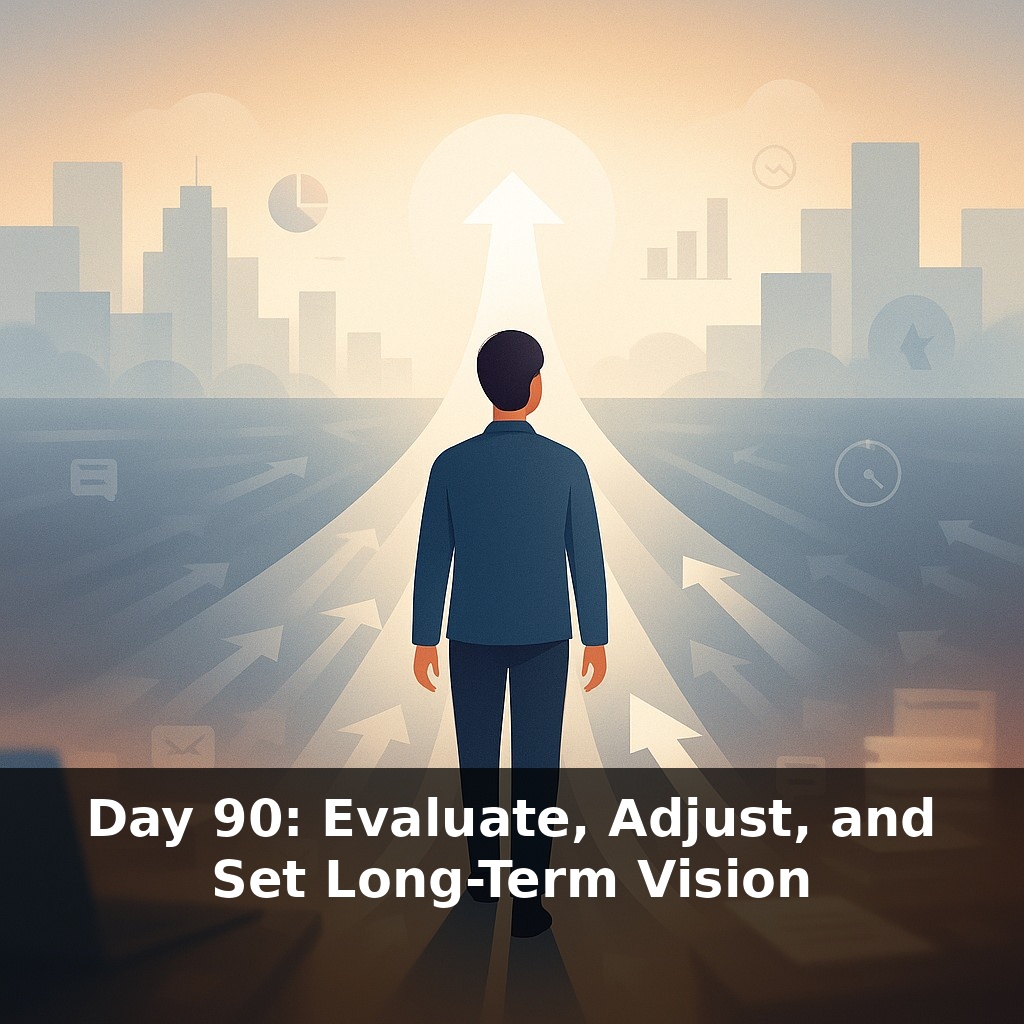
Only about one in five employees believes their leaders know where they’re going. Now it’s day ninety in your new role. Emails are flying, meetings are stacked, and you’re hitting targets—yet something feels fuzzy: where is all this effort actually taking you?
So day 90 isn’t about proving you can “keep up.” It’s about proving you can *step back*. By now you’ve seen how decisions really get made, which goals are sacred, and which “priorities” quietly die in inboxes. You’ve watched projects that moved like a river after heavy rain, and others that stalled into stagnant pools—same company, same people, very different flow.
This is the moment to stop judging yourself only by how busy you are and start judging by the quality of your bets. Instead of adding more to your plate, you’re asking: *Of everything I could push forward, what truly deserves three to five years of my energy—and my team’s?*
That shift—from doing more to choosing better—is what separates leaders who react their way through years from those who set a direction others can trust and build on.
Now, with 90 days of real data behind you, you can finally see patterns instead of noise. Certain metrics quietly flicker red. A few “small” experiments have outsized traction. Some habits you brought in from past roles clearly don’t fit this terrain. Think of this moment less like locking in a grand master plan and more like drafting the first legible sketch on a blank canvas: bold enough to be seen, loose enough to refine. Your job isn’t to predict the future; it’s to name a direction clear enough that smarter questions start to appear.
Those 90 days you just lived? Treat them like a lab study you finally get to analyze. You’ve run dozens of “mini experiments” without calling them that: how your team responds to deadlines, which stakeholders actually move the needle, what happens when you delegate versus hold on. Now the question isn’t “Did I survive?” but “What did I *learn* that should shape the next 3–5 years?”
Start with evidence, not vibes. Pull three kinds of signals into one place: - **Outcome metrics**: the hard stuff—revenue, delivery speed, churn, error rates. - **Behavioral signals**: meeting dynamics, escalation patterns, how often people surface risks early. - **Sentiment**: what people say in 1:1s, surveys, offhand comments when the meeting “ends” but no one hangs up.
Instead of labeling things “good” or “bad,” ask, *What system produced this?* A missed target might reveal unclear ownership, not laziness. A surprise win might point to a hidden strength you can double down on. This is how evaluation stops feeling like a performance review and starts feeling like diagnosis.
From there, you’re looking for **pivot points**, not cosmetic tweaks. Where should you: - Stop investing entirely (a ritual, report, or project that no longer earns its keep)? - Narrow focus (a product, customer segment, or process that’s too broad to excel)? - Go bigger (an experiment that outperformed its size and deserves real backing)?
Now lift your eyes to the longer horizon. A compelling vision answers three practical questions for your future team member who hasn’t joined yet: 1. **What are we trying to change in the world, specifically?** 2. **What will be unmistakably true here in 3–5 years if we’re winning?** 3. **What will we *not* do, even if it’s tempting or popular?**
Draft this as a story you can tell at lunch, not a slide you present once a year. Name the customer, the pain you’re obsessed with, the kind of work that becomes your signature move, the standards you refuse to compromise. Then pressure-test it with people who will have to live it daily: *Does this scare us a little? Does it excite us a lot? Can we spot concrete next steps from it?*
Think of your 90 days as a sketchbook full of rough drawings. Some pages show quick thumbnails, others half-finished scenes. Now, instead of flipping past them, you’re looking for the few lines worth inking. For example, maybe a “small” customer segment keeps reappearing in support tickets, roadmap debates, and sales calls. That repetition is like a recurring motif in an artist’s portfolio: it’s telling you where your hand naturally returns. Or maybe every time deadlines slip, the same handoff between two teams is involved—less a one-off mistake, more a structural weak joint, like a painter’s canvas that always buckles where it wasn’t stretched tight. Use these recurring elements as clues: circle them, name them, and ask, “If this became central—or if we finally fixed this—how would our work look completely different in three years?” Your long-term vision isn’t invented; it’s distilled from these recurring strokes you can no longer ignore.
In the next decade, “90-day labs” could be standard: AI quietly tags every experiment, meeting, and micro-win, then surfaces patterns you’d miss—like a radiologist spotting tiny fractures on a scan. Your job shifts from collecting data to interpreting it with your team: which weak signals hint at emerging risks, and which tiny, consistent wins deserve a moonshot? Expect vision to become less of a manifesto and more of a living draft you revise as the landscape shifts.
Treat this 90-day mark less like a finish line and more like arriving at a new trail junction. You’ve seen the terrain; now you choose which paths to actually follow. As you refine that choice, notice who leans in when you share it. People “vote with their feet”—the ones who stay and stretch with you become the real proof your vision is worth the hike.
Before next week, ask yourself: 1) “Looking back over the last 90 days, what specific habits, routines, or decisions actually moved the needle most toward my long-term vision—and which ones drained time without real impact?” 2) “If I zoom out 3–5 years, what does ‘success’ in this area really look like for me in concrete terms (numbers, lifestyle, relationships, energy)—and which of my current commitments clearly don’t fit that future?” 3) “What is one meaningful adjustment I’m willing to make this week (a boundary, a routine change, or a project I’ll stop or double down on) that would bring my daily life one step closer to that long-term vision?”