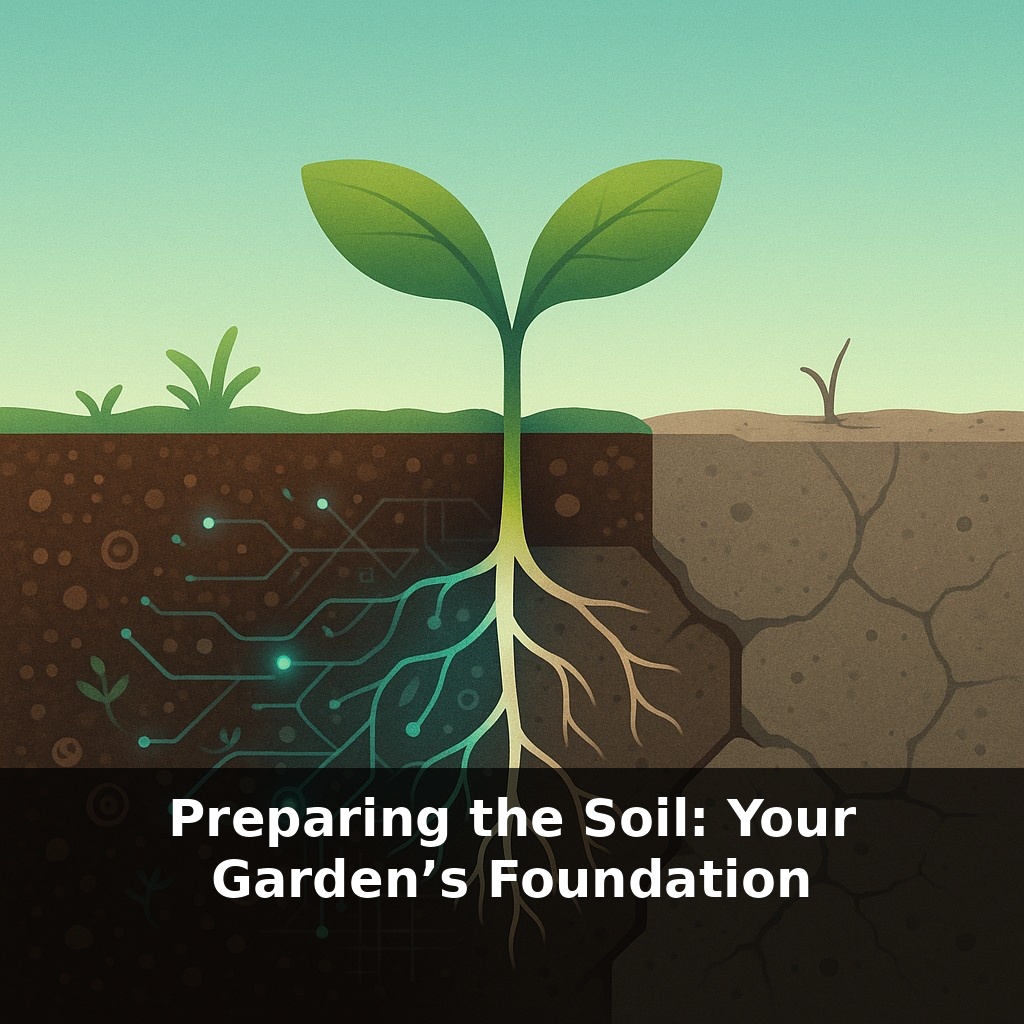
Garden soil is supposed to be about half rock dust and half space for air, water, and life—yet most first gardens are started in dirt that’s closer to sidewalk than ecosystem. You tuck in seedlings, water faithfully… and they just stall. Why does “good enough” soil fail so badly?
The hidden truth under your feet: a handful of thriving garden soil can contain more organisms than there are people on Earth. Yet most of us treat it like a static material—something to dig, dump, or bag and pour—rather than the living community it is. That’s why two gardens on the same street, in the same weather, can behave like different planets: one shrugs off a dry spell, the other wilts in three days; one shrinks pests to a minor annoyance, the other turns into an all-you-can-eat buffet for bugs.
This episode, we’re going past “does water drain?” and “does it look dark and crumbly?” and into the pieces you can actually adjust: pH that quietly locks nutrients away, mineral balance that shapes flavor, organic matter that decides whether rain soaks in or runs off, and biology that can either feed your plants daily… or go almost silent.
Think of this episode as moving from “soil is alive” to “so what can I actually do about it in my yard?” Instead of guessing from color or texture, we’ll lean on simple, one-time tests that tell you where you stand, and then on a few high‑leverage tweaks that change how your whole garden behaves in heat, drought, or heavy rain. We’ll look at how texture (sand, silt, clay) sets the stage, how structure can be ruined or rebuilt with a single habit, and how a targeted test—cheaper than one bag of fertilizer—can keep you from blindly dumping products that don’t solve your real problem.
Start with what you *don’t* know. Before you buy a single bag of compost or fertilizer, you need a baseline—and that means a real soil test, not just guessing from color or feel.
There are two routes: a lab test or a DIY kit. A lab test (from your local extension service or a reputable company) gives you pH, major nutrients, often organic matter, and clear recommendations. It usually costs less than one bag of fertilizer and can change how you spend money for years. A DIY kit is faster and fine for a rough first pass, but if you’re serious about vegetables or fruit, lab data pays for itself quickly.
Here’s the flow: mark out the future garden, scrape away mulch or sod, and take several small “cores” of soil from the top 6 inches, mixing them in a clean bucket. That mix is your sample. Send part to the lab; reserve a cup for at‑home experiments.
While the lab does its work, run two quick tests yourself:
1. **Drainage check.** Dig a hole about a foot deep and wide. Fill it with water and let it drain. Fill it again and time it. Draining in 1–4 hours is ideal. Faster suggests droughty soil; slower hints at compaction or heavy clay. This tells you whether to focus more on water‑holding or on opening pathways for air and roots.
2. **Squeeze test, upgraded.** Moisten a handful of soil and squeeze it into a ball. Instead of just noting whether it crumbles, pay attention to how it breaks: does it snap into hard chunks, smudge like putty, or fall apart into soft crumbs? That break pattern hints at how easily roots will move and how vulnerable the soil is to becoming either rock‑hard or soupy when wet.
When your lab results arrive, don’t chase perfection. For most vegetables, “good enough and stable” beats “ideal but finicky.” Focus on three things you can actually steer in the first season: bringing pH into the crop’s comfort zone, correcting any glaring nutrient excesses or shortages (especially phosphorus and potassium, which change slowly), and steadily nudging organic matter upward.
Think of this as coaching a team, not buying a star player: instead of one miracle product, you’re lining up small, smart adjustments that let the whole system perform better—especially when weather gets weird.
Think of your lab report as a weather forecast for the underground world, not a verdict. A slightly “off” number isn’t a failure; it’s a direction to lean toward over the next few seasons. For example, if potassium shows up high but calcium is low, that’s a nudge toward gypsum or high‑calcium amendments rather than a generic “all‑purpose” fertilizer. If your results list “CEC” (cation exchange capacity) in the single digits, picture a small toolbox: you’ll want more, lighter nutrient applications because the soil can’t “hold” much at once. Teens or 20s? Bigger toolbox, fewer but deeper feedings. You can even map differences across your yard: one bed might be your “leafy greens zone” because it stays cooler and richer, another your “root crop lane” where tests show fewer nutrient excesses. Over time, those quiet numbers help you match crops to micro‑spots the way a coach assigns positions on a field, instead of treating every square foot as identical.
Soon, basic soil readings may be as routine as checking the weather. Low‑cost probes could log shifts in moisture and nutrients every hour, so you’ll learn how your beds react to heat waves, downpours, or skipped waterings. That kind of feedback lets you tune inputs like a sound engineer sliding volume levels, instead of blasting everything at “max.” As neighborhoods share data, patterns emerge—dry pockets, soggy corners, nutrient “hotspots”—turning scattered backyards into a coordinated, resilient growing network.
You’ll keep discovering quirks: a corner bed that sips water like a camel, a strip that gulps and forgets. Treat those patterns like tracks in fresh snow, hinting where roots travel and where they hesitate. As you adjust, your soil’s “personality” emerges. Your challenge this week: notice one odd spot, test it, and try a tiny, targeted tweak—then watch what changes.