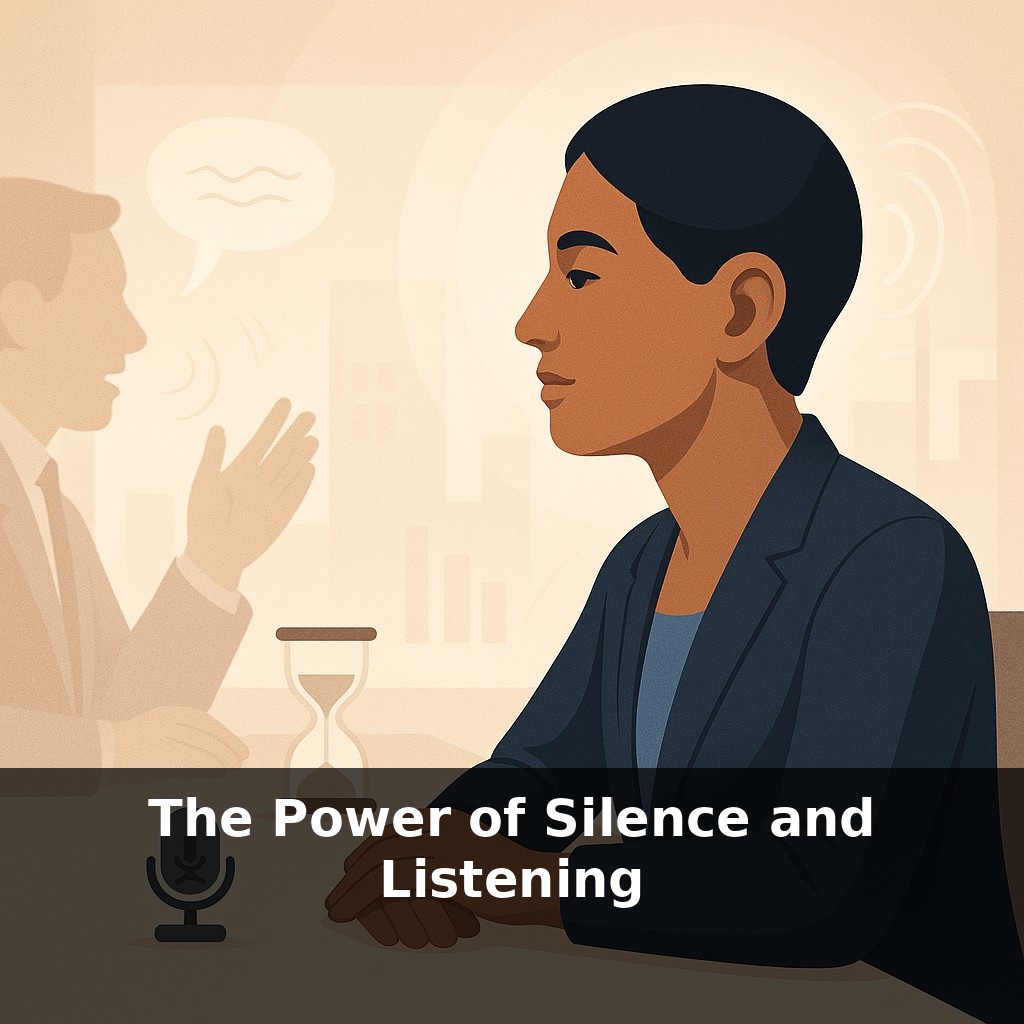
In many high‑stakes negotiations, the person who speaks least often walks away with the best deal. A manager makes an offer, then stops. Ten seconds crawl by. The other side fidgets… and suddenly sweetens the terms. The twist? Nothing new was said—only silence did the heavy lifting.
Silence isn’t just a negotiation trick; it’s a performance review tool, a promotion strategy, and a quiet form of leadership. In day‑to‑day career moments—status meetings, 1:1s, interviews—the instinct is to fill gaps, defend, explain, “add value” with more words. But those small pockets of quiet you avoid are often where the useful truth lives.
Think about your last tense meeting: after someone dropped a half‑baked idea, did you rush in to rescue them—or let the room sit for a moment and show you what people really thought? When you resist jumping in, three things tend to appear: what people actually worry about, what they really want, and who’s willing to step up.
Relationally, this kind of deliberate quiet signals respect: “I’m not here to win this minute; I’m here to understand.” Over time, that’s what makes colleagues bring you the unpolished, politically risky information first—which is where real influence starts.
Most careers aren’t derailed by one bad meeting; they drift off course through hundreds of rushed, half‑heard conversations. The real leverage isn’t in having the sharpest argument, but in becoming the person who actually hears what others miss. That’s where disciplined listening comes in: using short pauses, clarifying questions, and small summaries not to “win,” but to surface what people didn’t plan to say out loud.
Like walking a forest trail at dusk, details only appear when you slow your pace—suddenly you notice tracks, side paths, and signals that were invisible at full speed. Your conversations work the same way.
When you start using silence and real listening on purpose, the first surprise is usually internal: you notice how fast your own mind wants to jump in. Your boss pauses after saying, “I’m not sure your team is ready for that scope,” and before they’ve finished the sentence, you’re drafting three defenses, two excuses, and one compromise. That mental sprint is exactly why most people never hear the information that would actually help them.
The research angle matters here. If a 4–6 second pause measurably changes offers in formal negotiations, think about what it does in everyday power dynamics: project assignments, performance feedback, budget discussions. Those are negotiations in disguise. The person who can sit in that tiny gap—without filling it with nervous explanations—invites the other side to keep talking. And the more they talk, the more data you get about their constraints, fears, and flexibility.
Active listening isn’t about being “nice”; it’s about steering the conversation without announcing that you’re steering. Three small moves do most of the work:
- Paraphrasing: “So your main concern is the timeline, not the ownership, right?” This forces them to clarify vague complaints into usable criteria. - Mirroring a few key words: They say, “This feels risky.” You answer, “Risky?” They’ll usually unpack what “risky” really means—reputation, money, politics, or something else. - Calibrated questions: “What would need to be true for you to be comfortable green‑lighting this?” Now they’re designing the path forward for you.
Notice what’s missing: speeches. You’re trading arguments for prompts.
Because your brain can process far more words than anyone can speak, undirected listening time becomes daydream time. Deliberate quiet is how you reallocate that surplus capacity: watching body language, tracking what wasn’t answered, listening for contradictions. It’s less “zoning out,” more “zooming in.”
Think of a gallery curator walking slowly through an exhibition just before opening. They aren’t adding new pieces; they’re noticing what’s slightly off, what needs more light, what should be moved. Strategic silence puts you in that curator role in your own conversations—you’re not the loudest voice in the room, but you’re quietly deciding what actually matters.
A junior PM sits in a roadmap meeting while two senior leads argue over priorities. Instead of jumping in with “my take,” she leans back, stays quiet, and just tracks who interrupts whom, which items make everyone sit up, and where voices soften. When there’s finally a gap, she says, “I’m hearing three different ‘must‑haves’—can we list them and see what’s non‑negotiable this quarter?” Because she caught the unspoken hierarchy and pressure points, her one sentence moves the room from chaos to structure—and her influence jumps far beyond her title.
Try this in 1:1s too. When your manager vents about “too many fires,” resist solution‑mode. Give them a few beats, then: “Out of everything on your plate, which two issues are keeping you up at night?” You’re not just being supportive; you’re quietly mapping what actually drives their decisions. Over time, those maps become your unfair advantage in choosing projects, timing asks, and spotting chances to step in where it really counts.
Silence may become one of the few “un-automatable” skills. As tools caption, summarize, and even respond for us, constant noise will be cheap and abundant. Thoughtful quiet will be rare signal. The people who can hold a pause while others rush to fill it will notice subtle shifts: who’s tense, who’s undecided, where there’s real room to move. In fast, hybrid careers, that micro‑ability to wait half a beat longer than everyone else might separate those who are heard from those merely recorded.
Silence won’t hand you a script; it will hand you raw footage. In those extra beats, you start to notice who avoids eye contact when risk appears, whose voice lifts when they care, which priorities keep resurfacing. Over time, you’re not just “good in meetings”—you’re reading the undercurrent, like spotting the tide by watching how the shoreline slowly reshapes.
Start with this tiny habit: When you open your mouth to respond in a conversation, silently count “one… two…” in your head before you say anything. Use those two seconds to notice one thing about the other person’s tone or facial expression, without trying to fix or answer them yet. If you’re on a call, just focus on the pace of their voice during those two seconds. This tiny pause trains you to sit in silence for a moment and actually listen beneath their words.