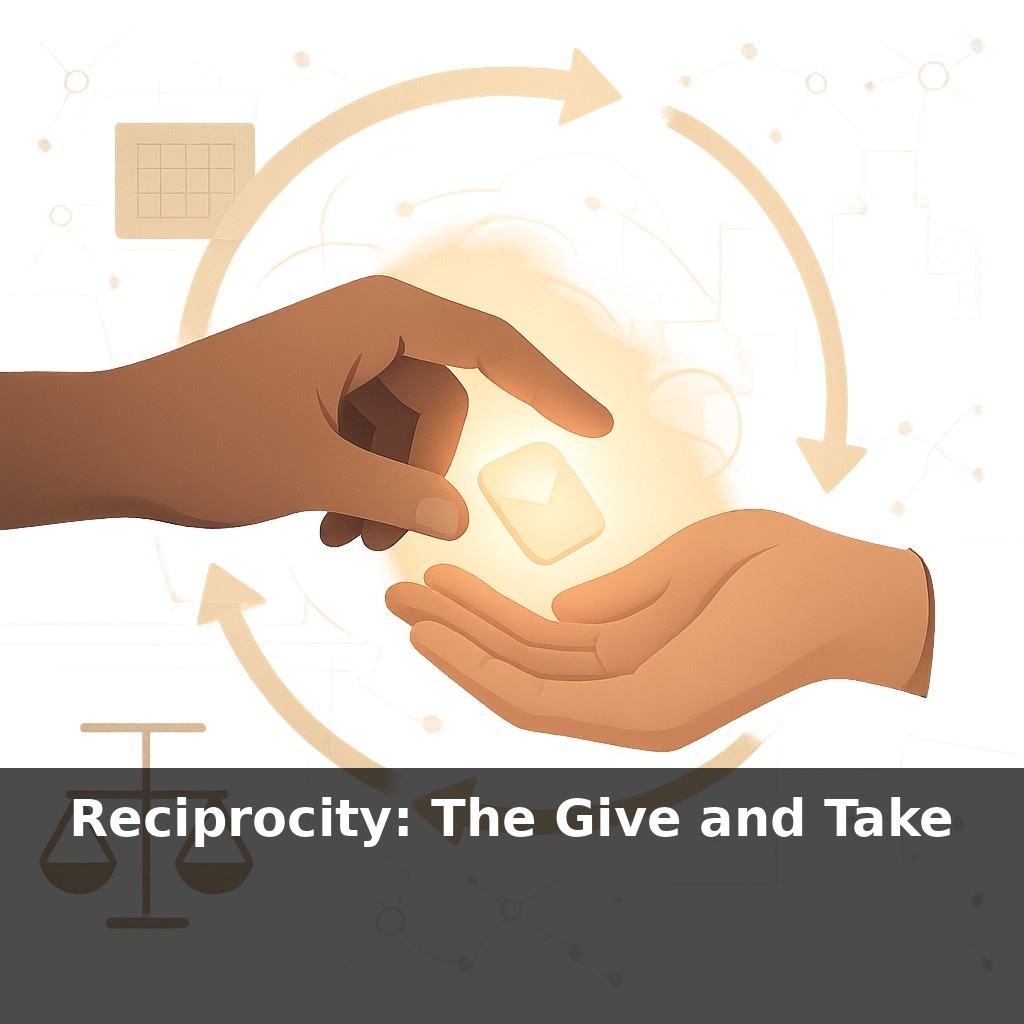
About half the time you say “thanks” at work, you’re quietly negotiating your future. A tiny favor, a quick intro email, a shared document—seconds for you, but they can unlock promotions, partnerships, even job offers you never officially asked for.
Sixty‑one percent of people who get a small, unexpected favor in a negotiation later give more than they planned. Not because they’re weak—because they’re wired. That quiet “I owe them one” runs the show far more often than formal power, job titles, or clever arguments.
This is reciprocity at work: the barely visible current underneath your day‑to‑day career moves. It’s there when a colleague stays late after you once covered their morning, or when a hiring manager “takes a chance” on you after you helped them years ago. It isn’t about keeping a spreadsheet of debts; it’s closer to an invisible balance sheet that groups maintain to feel fair and stable.
In this episode, we’ll pull apart how that balance sheet forms, why tiny gestures can tilt it dramatically, and how to participate in it without becoming transactional or manipulative—so your generosity creates real leverage instead of quiet resentment.
Think about the last time someone “over‑delivered” for you—answered a late‑night message, rushed feedback before your deadline, or quietly fixed a problem you caused. You probably didn’t calculate the value; you just filed them under “people I show up for.” That label is where reciprocity really lives. It shapes who gets looped into high‑visibility projects, who’s trusted with sensitive information, and who gets first call when an opportunity appears. In careers, doors rarely swing open at random—they open toward the people we already feel a little indebted to.
In actual negotiations—salary talks, scope discussions, cross‑team projects—reciprocity doesn’t start with the big ask. It usually starts with a small, visible “I’ll move first.” And visibility matters more than size.
In the lab, when negotiators were told clearly, “I’m reducing my price by X because I want to reach an agreement,” those labeled concessions triggered much stronger reciprocity than quiet, unexplained flexibility. The move wasn’t just generous; it was legible. The other side could see there was something to reciprocate.
That’s your first lever: make your give unmistakable. Not dramatic, not theatrical—just explicit enough that the other person can’t miss it:
- “I shifted my deadline so we can hit your launch date.” - “I added an extra option in case Legal pushes back later.” - “I stayed within your budget by re‑scoping instead of cutting quality.”
Contrast that with the silent martyr approach: you absorb extra work, bend timelines, smooth conflicts—and no one realizes you moved. Reciprocity rarely fires if the system can’t detect a change.
Second lever: give in a currency the other side actually values. A generic “let me know how I can help” creates no psychological pull. A tailored offer does:
- To a time‑poor manager: “I’ll draft the first version so you’re only editing.” - To an anxious stakeholder: “I’ll loop you into early mockups so there are no surprises.” - To a recruiter: “I’ll send you two strong referrals this quarter from my network.”
This is why those restaurant mints work so reliably: they arrive right when the decision is being made and in a form the diner intuitively cares about—personal attention, a touch of surplus.
Third lever: pacing. Reciprocity is strongest when the sequence is: small give → pause → clear response opportunity. Flood someone with favors without a breather and you disable the circuit. Instead of “I owe you,” they feel “I can’t keep up” or “What do they want from me?”
In career terms, that might mean: you stay late to help a teammate prep, then let them be the one to suggest how they’ll “return the favor” (“I’ll cover your client call Friday”). When you jump in and script their payback—“Next week you can do X for me”—you trade a social norm for a transaction.
Finally, note that reciprocity can scale beyond pairs. Teams remember which groups reviewed their docs on short notice, which departments share credit in presentations, which leaders publicly protect them when things go sideways. Over time, entire units get reputations:
- “They always help when timelines explode.” - “They only show up when there’s a spotlight.”
One of those reputations magnetizes opportunities. The other quietly repels them.
When companies understand this quiet “I owe you” current, they start designing for it. Zappos famously leaned into free returns—not as charity, but as a deliberate first move. Covering the small hassle cost for customers built a loop: people felt safer ordering, then felt oddly loyal to the brand that “took the risk” first. Internally, you can do a lighter‑weight version of this. Say you’re the new hire on a product team. Instead of waiting to be assigned, you create a clean summary of user feedback for everyone after a research call. Nobody asked; nobody paid you; but you’ve just set a reference point: you move early for the group’s benefit. Do that twice and you’re no longer “the new person,” you’re the person people want in the room when things are uncertain. The dynamic is less “they owe you” and more “they’d rather not move forward without you,” which is a subtler, more durable kind of leverage.
Trusted colleagues often treat early offers like a quiet signal: “I’m safe to cooperate with.” Over time, people start testing that signal deliberately—sharing sensitive context, looping you into draft plans, inviting you into rooms where trade‑offs are made. Your name shows up in “who should we include?” moments. The risk: these asks can snowball. The skill isn’t just offering the first move; it’s learning when to set limits without breaking the larger pattern of mutual support.
So the question becomes: where will you place your next deliberate “first move”? Treat your week like a trail with cairns—small stone markers others quietly notice and follow. Your challenge this week: once a day, offer one clearly labeled, low‑cost help that you do not need. Then, simply watch which paths start opening that weren’t visible before.