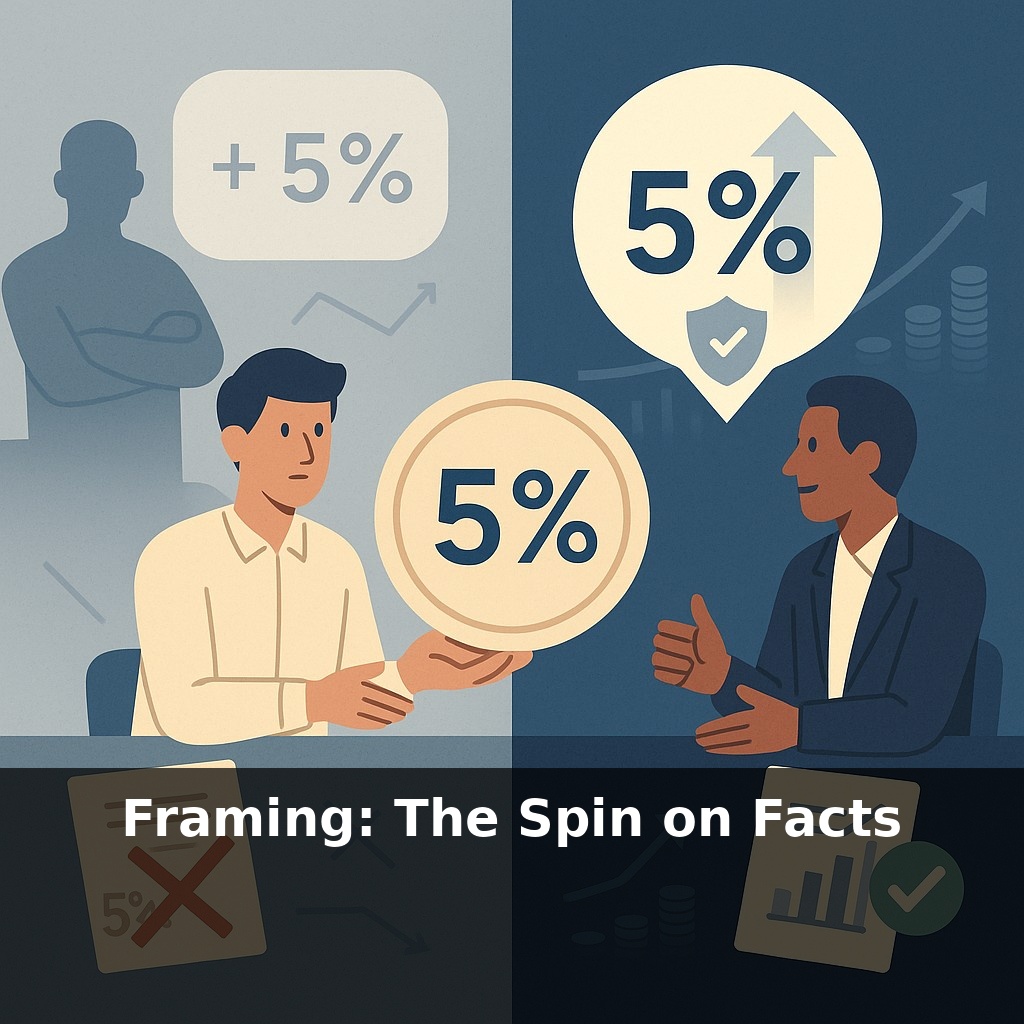
You and a colleague say the same number in a salary meeting. Your offer gets rejected; theirs gets a yes. Here’s the strange part: the only difference was how you each told the story around that number. Same facts, totally different outcome. Why did their version win?
One reason: your colleague quietly controlled the frame. While you described “a 5% raise,” they described “protecting your market value in a rising-cost year.” Same number, but theirs sits in a loss frame (avoiding falling behind), yours in a modest-gain frame (getting a little extra). Because our brains are roughly twice as sensitive to loss as to gain, that subtle shift can flip a lukewarm “maybe” into a committed “yes.”
Framing isn’t fluff; it’s a structural choice about *which* facts you highlight, *when* you surface them, and *what* you place them next to. Think of how a museum places a small painting on a dark wall with a single spotlight, instantly elevating its importance. In negotiation, you’re doing the same with numbers, trade‑offs, and risks: choosing what deserves the spotlight, what sits in the background, and what never makes it onto the wall at all.
Now we go one layer deeper: *when* and *where* you place information quietly shapes how “fair” or “generous” it feels. Lead with a painful trade-off and every detail after it gets judged against that sting; open instead with what the other side cares about most, and the same trade-off can land as reasonable. Skilled negotiators manage sequence like chefs manage courses: they decide what comes out first, what’s paired together, and what never shares the same plate. Numbers don’t move on their own; they ride in on context—precedents, comparisons, and timing you deliberately choose.
There’s another layer most people miss: *which mental yardstick* you invite the other side to use. You can keep all the numbers identical and quietly swap the comparison set—and with it, their judgment of what’s “good.”
Offer a candidate $140k and it can feel flat. Call it “$10k above our internal midpoint,” and you’ve anchored them to your budget. Call it “at the 75th percentile for this role in our industry,” and you’ve anchored them to the external market. Same $140k, but now they’re comparing against a different invisible reference line.
That reference line is rarely neutral. When you drop the first concrete number, you’re not just haggling—you’re planting a measuring stick that can pull final outcomes halfway toward it. A high opening price on a consulting project makes the later “discount” feel meaningful; a low opening price on the *same* scope can make the very same final fee feel inflated.
Frames also multiply when you bundle or unbundle issues. Say you’re negotiating workload and salary. Treat them as one blob (“for this pay, here’s the role”) and you invite a single, global judgment: too heavy or just right. Split them (“let’s price the role, then see what mix of responsibilities fits that level”) and you’ve just created room to trade—more mentorship duties for fewer urgent deadlines, for example—without changing the headline cost.
Even the way you slice time quietly biases reactions. A 3‑year contract with an 8% total increase sounds different from “a 2.6% raise per year”—and different again from “protecting you against typical 2% inflation with a bit of upside.” Twelve extra hours a month can feel intrusive; “about 30 minutes a day” can feel manageable.
Notice what’s happening: you’re not touching the raw facts, but you’re choosing *neighbors* for those facts—comparisons, bundles, time slices—that pull the brain toward particular conclusions. The most effective negotiators don’t only ask, “What can I offer?” They also ask, “What will I place this next to so it gets judged on the most favorable scale?”
Think about a promotion talk where your manager says, “We can’t move your title yet, but we *can* send you to that advanced leadership program and put you on the next big cross‑functional project.” The “no” on title stings less because it’s placed beside concrete future upside, not hanging there alone. Or consider a startup offering equity: “It’s 0.3%” feels tiny; “it’s a stake that would’ve been worth $400k at Company X’s Series D” invites a different internal comparison.
You can also rotate the frame by *who* is centered. A project cut sounds harsh as “We’re reducing your team’s budget by 10%.” It lands differently as “We’re protecting your team’s core work by trimming 10% from experiments so we don’t touch headcount.” Nothing material changed; the “hero” of the story did.
Even silence can frame. If you present a package and pause *before* mentioning the riskiest clause, you invite questions on what was already said. If instead you rush to fill the silence by over‑explaining that clause, you quietly label it as the problem to scrutinize.
As data becomes denser and faster, the real skill won’t be finding more facts but choosing which *version* of true to show first. In cross-cultural deals, this matters even more: the same proposal can look bold in one norm set and cautious in another. Careers will tilt toward people who can surface frames transparently—“Here’s one way to look at this, here’s another”—like a guide pointing out different trails on the same mountain, then letting others help pick the route.
When you notice yourself locked in a tug‑of‑war over “yes or no,” try zooming out: is there a version of “yes, if…” that shifts the terrain? Like rearranging furniture in a cramped room, a small repositioning of terms can reveal unexpected space. Careers often pivot not on bigger offers, but on sharper choices about which door you quietly invite others to walk through.
Before next week, ask yourself: 1) “The next time I share a metric or result (like revenue, error rates, or survey scores), how could I deliberately frame it differently—gain vs. loss, short-term vs. long-term, relative vs. absolute—to see how it changes my own emotional reaction?” 2) “In a current decision I’m wrestling with (e.g., a project proposal, policy, or purchase), what’s the ‘opposite’ frame I’ve been ignoring, and how would the choice look if I flipped it—highlighting risks instead of benefits, or vice versa?” 3) “Looking at a headline, email, or slide I’m preparing today, which single word or comparison might be subtly nudging people (like ‘only 10% fail’ vs. ‘90% succeed’), and what happens if I experiment with swapping it to make the framing more honest and balanced?”