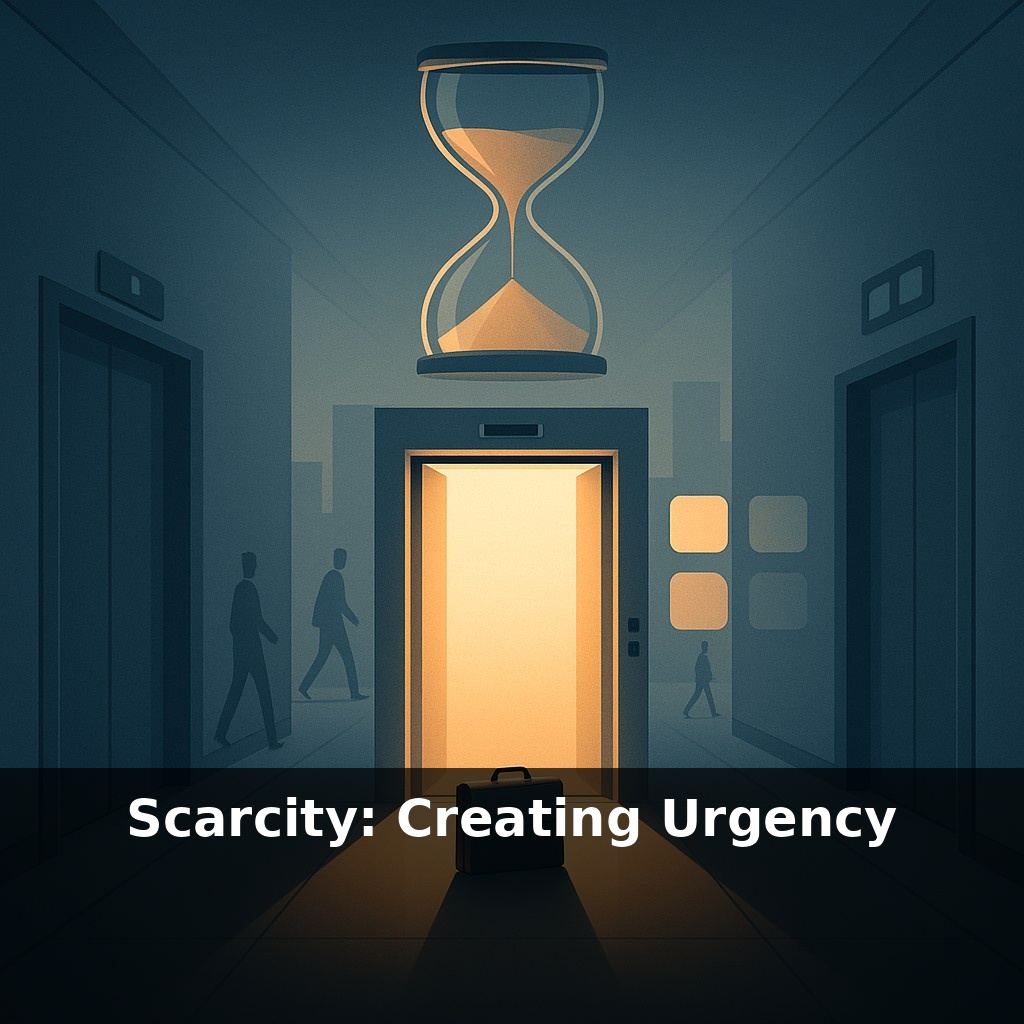
“Only 3 left in stock.” That tiny line on a product page made sales jump by about one‑seventh in an Amazon test.
Now drop into a salary talk, a promotion meeting, a client pitch—how differently would people move if they quietly believed this opportunity wasn’t going to wait for them?
In career negotiations, though, you can’t just paste an “only 3 left” badge on your promotion case or job offer. You need a subtler move: making it clear that your time, attention, and alternatives are not infinite—without bluffing or turning manipulative.
Loss‑averse brains care less about “Is this perfect?” and more about “Will I miss this?” When your boss senses that your next big project, conference talk, or cross‑functional role might go to someone else—or another company—they start weighing what they stand to lose by waiting.
That’s why senior candidates often mention parallel interview processes, or consultants flag that a project slot is open only this quarter. They’re not being coy; they’re shaping the timeline. In this episode, we’ll look at how to signal real constraints in your career moves—calendars, capacity, and concrete options—so decisions speed up, and you don’t have to keep “chasing” answers.
The trap most people fall into is confusing *silence* with *flexibility*. They think, “If I don’t mention constraints, I seem easy to work with.” In practice, it often signals the opposite: that your bandwidth is endless and your options are thin. Decision‑makers then unconsciously downgrade the cost of delaying you.
What actually moves timelines is when your calendar, projects, and competing demands are visible in a calm, matter‑of‑fact way—like a train schedule posted at the station. The train isn’t threatening to leave; it just *will*, at a specific time, whether or not someone is ready to board.
The move now is to turn vague “I’m busy” energy into *observable*, checkable scarcity. The brain discounts anything that feels squishy. It sharpens up when it sees numbers, dates, and thresholds.
There are three levers you can pull without bluffing:
**1. Slot‑based availability**
Instead of “I’m open whenever,” define specific windows and capacities:
- “I can take on one more strategic project this half. Once that’s committed, I’ll need to focus there.” - “I’m talking with two other teams about Q3 moves; I expect to firm things up in about three weeks.”
Notice the structure: a clear *unit* (one project), a *period* (this half), and a *trigger* (once that’s committed). No drama, just constraints people can plan around.
**2. Competing priorities, ranked**
Leaders constantly triage. Help them see where this opportunity fits in your stack:
- “If we can scope this role at the senior level, it becomes my top priority. If not, I’ll likely double down on expanding X initiative instead.” - “If we move on this client proposal by month‑end, I can anchor my travel around it. After that, my bandwidth will skew toward Y account.”
You’re not saying, “Do this or else.” You’re saying, “Here’s how I will rationally allocate my effort.”
**3. Organization‑driven limits**
Some scarcity is baked into systems: budget cycles, headcount approvals, conference season, product roadmaps. Tie your ask to those:
- “This level of title change typically only happens during the annual promotion cycle. If we miss that, the next realistic window is a year out.” - “Training budget for certifications usually closes by end of quarter; if we decide now, we can still use this year’s pool.”
The power move is to make these boundaries *verifiable*. Mention policies, send links, reference known dates. Scarcity that can be checked feels like context, not pressure.
This is also where overplaying it blows up: fake deadlines, mysterious “other offers,” or constantly shifting cutoffs erode credibility. Think of a coastline slowly reshaped by steady waves; you want your constraints to be that consistent, not a storm that appears and disappears at random. Over time, people learn, “When they say a window exists, it really does—and it really closes.”
Think of your week like planning a small gallery show. You don’t hang every painting you own—you curate a few pieces, each with a tag: “On loan until May 30,” “Reserved for another collector,” “Available for commission only.” That quiet labeling changes how visitors move.
Concrete career examples:
- In a promotion discussion: “I’m designing my next 12–18 months. If we can define a staff‑level path this cycle, I’ll orient my projects here. If not, I’ll likely aim for an external lead role where I can own a full product line.”
- With a potential client: “I hold two advisory slots per quarter. One is spoken for; the other is open until we lock in scope for Q3.”
- With your manager about stretch work: “I can lead either the launch review or the new pilot, but not both. Which creates more value for the team if I own it end‑to‑end?”
In each case, you’re not dramatizing; you’re simply tagging the “artwork” of your time so others see what’s truly on the wall—and what might leave the room.
As tools start auto‑tuning urgency around you—“personalized” reminders, smart nudges, adaptive offers—your edge is choosing *where* you’ll still move slowly. Treat your future options like a trail system: some paths are clearly marked “closing soon,” others are deliberately left unpaved so you can explore later. Expect employers and platforms to label more trails for you; your job is to keep deciding which signs you’ll honor and which you’ll quietly walk past.
Treat this like learning to season food: too little urgency and everything tastes flat; too much and people push the plate away. Over the next few months, notice which “last chance” signals make *you* lean in versus roll your eyes. That’s your calibration guide—use it to design the scarce moments in your career on purpose, not by accident.
Before next week, ask yourself: 1) “Where in my current offer (price rise, limited spots, bonus expiring, or deadline) do I *genuinely* have a built-in ‘until when’—and am I clearly telling people that, or just assuming they know?” 2) “If I emailed my list or posted today with a 48–72 hour urgency window, how could I spell out exactly what disappears (bonus, discount, or access) and why, in a way that’s honest—not hype?” 3) “Looking at the last time I hesitated to use scarcity, was I avoiding ‘being salesy,’ or was I actually hiding information my people needed to make a real decision—and how will I handle that differently in my next promotion?”